Career intelligence
Why I Canceled LinkedIn Premium After Writing a Book About Its Value
An open letter to LinkedIn
After years as a Premium member and a book advocating LinkedIn's value, Keith Lawrence Miller explains why greater activity, less exposure, and standardized AI presentation led him to cancel.
Dear LinkedIn,
I believed in LinkedIn enough to pay for Premium for many years and write a book explaining its value.
I have now canceled my subscription.
The cost was about $60 a month. For a professional tool that produces meaningful value, that is inexpensive. A $60 professional tool should be easy to justify when it earns its place. This one no longer did.
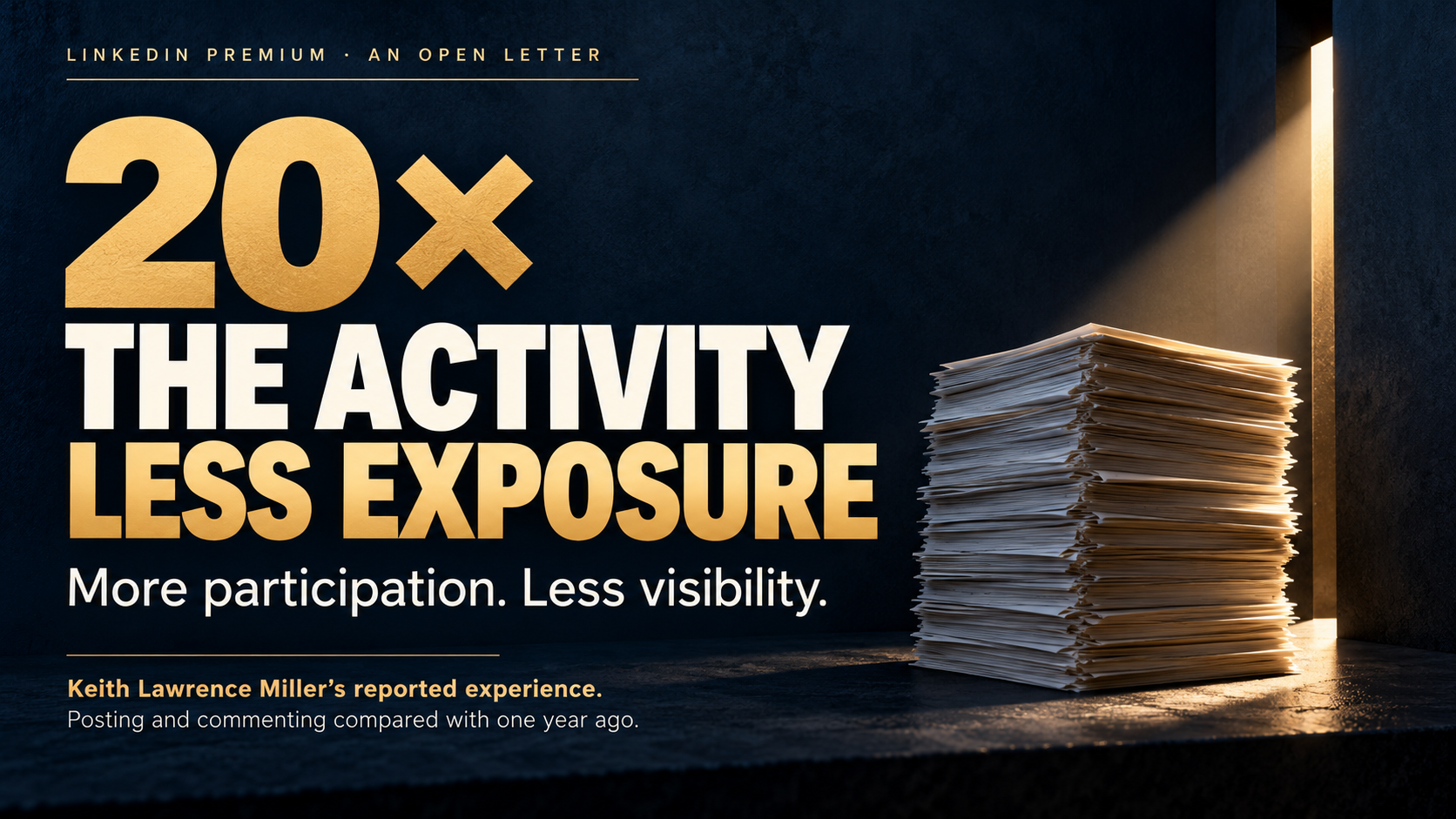
Over the past year, I increased my posting and commenting roughly twentyfold. My exposure decreased. I have not seen an improvement in my search experience or visibility that justifies continuing to pay.
That experience has changed the meaning of the subscription for me. Continuing to pay would feel like endorsing a direction I no longer support. It would mean renewing my confidence in a company that I believe has diminished the value I trusted it to provide.
LinkedIn has lost its way when professional activity increases, professional differences become harder to recognize, and the member is still being sold the promise of standing out.
Twenty times the activity and less exposure
The most meaningful before-and-after comparison is my own experience.
| My experience | Roughly one year ago | Now |
|---|---|---|
| Posting and commenting | My previous level of activity | Approximately 20 times that activity |
| Exposure | Greater than I am experiencing now | Decreased despite substantially more participation |
| Premium membership | A subscription I was willing to maintain | Canceled because the value no longer justifies the cost |
Those are my observations as a member. Whatever the underlying explanation, that is the experience against which I evaluate the paid service.
An expanding product catalog does not cancel out that comparison. Announcing more features does not establish that an existing customer is receiving more value. The subscription has to earn its place through what it makes possible in practice.
For someone building a professional business, exposure has a purpose. Relevant people need an opportunity to encounter the work, evaluate the expertise behind it, and decide whether to begin a conversation. If substantially more participation produces less exposure, the practical case for investing further time and money becomes harder to make.
A new feature announcement is a weak answer to an experience of doing substantially more and receiving less exposure.
A focused feed can become an echo chamber
My concern with a more focused feed is that focus can become confinement.
LinkedIn described an AI-ranked feed in August 2025, including recommendations beyond a member's existing network. In March 2026, it announced more advanced ranking models that use professional information and engagement patterns to determine what members see. Personalization was already present a year ago, and LinkedIn has invested further in it. [1, 2]
I see LinkedIn's version of focus as increasingly enclosing members in familiar subjects and professional circles. From my perspective, that encourages silos and groupthink while limiting the opportunity for work to reach new audiences.
A system that keeps interpreting yesterday's behavior as tomorrow's preference can reinforce silos. Familiar perspectives receive more attention. Similar conversations recur. Groupthink becomes easier to sustain when people are repeatedly exposed to what already fits their existing patterns.
That is the echo-chamber concern, and why I do not regard a narrower feed as an improvement.
Professional growth requires discovery beyond what a person already knows to request. A prospective client may need expertise they have never encountered. A business relationship may begin between people who do not share an industry, vocabulary, or existing circle.
As a career professional, I need opportunities to reach people who could benefit from my services. A feed that mainly circulates career commentary among other career professionals would miss much of that purpose.
The ability to predict what someone will click is an incomplete measure of whether a professional network is serving them well. Useful exposure can introduce a person to something unfamiliar, challenge an assumption, or connect a problem with expertise the person did not know existed.
A network should expand the professional world available to its members.
My concern is that LinkedIn's version of relevance can make that world smaller. I want broader, meaningful discovery and a realistic opportunity for my work to travel beyond familiar circles.
Professional providers are becoming harder to tell apart
The loss of differentiation is just as serious as the loss of exposure.
My education, professional credentials, years of experience, and documented client results represent work performed over time. They should matter when someone evaluates my services. A prospective client should be able to understand what supports the promises being made.
Instead, I believe LinkedIn has saturated its presentation features to the point that providers increasingly look interchangeable.
Someone with no relevant training, no established professional credentials, and little practical experience can use AI to produce confident service descriptions and polished claims of expertise. The language can resemble that of an experienced practitioner even when the ability behind it is very different.
That is the problem I want LinkedIn to address. The presentation gap can shrink while the competence gap remains substantial.
LinkedIn's Premium Business page promotes AI profile suggestions alongside tools intended to build credibility and visibility. The product's own positioning puts professional presentation at the center of its value proposition. [3]
But making a profile sound more authoritative does not establish the authority of the person behind it. When the same forms of polish are widely available, the platform has to make the underlying evidence easier to evaluate.
Otherwise, the experienced professional must work harder to explain why the services are different, while the prospective client must work harder to determine which claims deserve trust.
That is a poor outcome for a professional marketplace.
The customer should be able to examine relevant qualifications, the depth of the provider's work, and evidence of results. Those details should carry more meaning than a description that sounds impressive because a tool made it sound impressive.
When I say the platform is reducing differentiation, that is what I mean. The features increasingly standardize how providers present themselves while leaving the buyer to uncover the differences that actually matter.
Selling everyone an advantage over no one
There is a basic problem with selling the same promise of superiority to everyone.
If competing professionals use the same tools to strengthen their profiles, improve their messages, and produce more content, those enhancements become a shared baseline. They cannot, by themselves, place every user ahead of every other user.
LinkedIn is selling everyone an advantage over no one.
That is my criticism of the relative advantage being marketed. A tool may make an individual task easier while doing very little to make that person stand out once competitors have the same capability.
As the tools become more common, the bar moves. A polished profile becomes expected. A confident service description becomes ordinary. The professional still needs a way to demonstrate something that other people cannot produce simply by using the same writing assistance.
The answer should be evidence of the person's work and judgment. Too much of the product's appeal, in my view, remains concentrated on improving the presentation around that evidence.
The result can be a market in which more people sound impressive and fewer people sound recognizably different.
This goes beyond repetitive writing. It affects the usefulness of professional communication. If a reader cannot tell whether a confident statement reflects experience or generated phrasing, the statement carries less information about the person making it.
A platform built around professional identity should be protecting that information. Its tools should make individual expertise easier to understand, with clear evidence behind claims and room for people to communicate in their own voices.
Uniform polish is a weak substitute for that.
The consequences reach into hiring
The same problem affects applicants.
Hiring depends on understanding what one person can contribute that another person cannot. A useful application makes relevant experience and judgment visible. It gives an employer a basis for deciding whose qualifications deserve closer examination.
When applications converge toward the same language and confident claims, that evaluation becomes harder. The written presentation can become a less reliable guide to the capability behind it.
Research supports this concern. A study published in Management Science in 2026 found that access to generative AI made professional pitches more polished while reducing evaluators' screening accuracy overall in its hiring and entrepreneurship experiments. The effects varied by setting, with improvements in some groups. The finding is that AI can obscure expertise as well as communicate it more effectively. [4]
A separate working paper examining an AI cover-letter tool on Freelancer.com found that the relationship between tailored application wording and callbacks weakened after the tool's introduction. Employers placed more weight on applicants' previous work. The researchers also found benefits for some tool users, illustrating how an individual advantage can coexist with a decline in what application language tells an employer. [5]
These studies examined other settings. They provide evidence for the mechanism I am concerned about, rather than a measurement of LinkedIn's own impact.
The practical concern is substantial. When professional language becomes less informative, applicants have a harder time communicating why their experience matters, and employers have a harder time identifying whom to take seriously.
The burden falls on the person whose actual qualifications now require more work to separate from similar-looking claims.
I believe this is damaging the hiring environment at scale. When LinkedIn's tools make candidates sound more alike without making their actual qualifications easier to judge, they work against the informed decisions the platform should support. A qualified applicant's market value depends partly on whether an employer can recognize it. Making that value harder to recognize is a meaningful loss.
LinkedIn has itself acknowledged problems with generic AI content. In June 2026, it described a rise in polished material lacking original perspective. In September, it announced a move from post enhancement toward proofreading and reported progress in reducing views of content it classified as AI slop. [6, 7]
My concern goes beyond whether individual posts sound generic. It concerns what happens when professional communication becomes less useful for evaluating professional ability.
That deserves to be a central measure of whether these tools are improving the platform.
Continuing to pay would endorse a loss of trust
This is why the decision goes beyond whether I use every feature in a subscription.
I trusted LinkedIn's professional purpose. I invested my time, money, and public advocacy in that purpose. Writing a book about its value was a substantial expression of that belief.
Most of the value I wrote about no longer holds up in my experience. That is a serious judgment to reach about a company I supported for years.
To me, this feels like a bait and switch. I paid for a platform whose value rested on expanding professional opportunity and making expertise visible. I now see a direction that risks narrowing discovery and making providers and applicants sound increasingly alike.
The concern is about the promise behind the product. A subscription can retain familiar feature names while the practical value of those features changes. More functionality does not repair a loss of confidence in what the platform is becoming.
Continuing to pay would feel like endorsing the erosion of the trust I placed in LinkedIn.
I am no longer willing to provide that endorsement.
What LinkedIn needs to restore
The company needs to make professional differences and professional discovery easier to see.
Expand meaningful discovery beyond existing circles. Give members ways to encounter relevant people and ideas outside the patterns established by their previous activity. Evaluate whether the network opens new professional possibilities, alongside whether its recommendations generate engagement.
Make evidence of competence easier to assess. Give substantive qualifications, demonstrated work, and attributable results a clearer role in how providers and applicants are evaluated. Make it easier for a prospective client or employer to understand what supports a claim of expertise.
Explain what the paid product contributes. Give subscribers a clear account of the additional access, discovery, or useful activity their subscription makes possible. Be candid about what the product can measure. The customer needs a credible reason to believe continued payment improves the experience.
Evaluate AI by what happens to professional judgment. Examine whether the tools preserve individual meaning, improve the visibility of relevant experience, and make hiring decisions better informed. Producing more polished text is an inadequate success measure when that text becomes less informative.
These priorities address the reasons I valued LinkedIn in the first place. They would give the company a more convincing response to a longtime customer whose effort has increased while exposure has declined.
The price was never the real problem
At approximately $60 a month, Premium should have been an easy expense to justify if it delivered meaningful professional value.
Years of payment and public advocacy had already demonstrated my confidence in LinkedIn.
Now I am contributing far more and seeing less exposure. I see professional presentation becoming more uniform, and I believe the differences that clients and employers need to evaluate are becoming harder to recognize.
That is why I canceled.
LinkedIn should take that decision seriously because it comes from someone who believed in the product, supported it, and wanted it to remain worth paying for.
I paid LinkedIn to make professional value more visible. I canceled because I believe it is making that value harder to see.
Keith Lawrence Miller
Sources
- Tim Jurka. How Does the LinkedIn Feed Work. August 11, 2025. https://www.linkedin.com/pulse/how-does-linkedin-feed-work-tim-jurka-oxraf
- LinkedIn. How LinkedIn Is Improving the Feed to Show More Relevant Authentic Professional Content. March 12, 2026. https://news.linkedin.com/2026/ImprovingTheFeed
- LinkedIn. Premium Business product page. Accessed October 29, 2026. https://premium.linkedin.com/small-business/business
- Bo Cowgill, Pablo Hernández-Lagos, and Nataliya Langburd Wright. Does AI Cheapen Talk Theory and Evidence from Global Entrepreneurship and Hiring. Management Science, 2026. https://pubsonline.informs.org/doi/full/10.1287/mnsc.2024.07027
- Jingyi Cui, Gabriel Dias, and Justin Ye. Signaling in the Age of AI Evidence from Cover Letters. Working paper, arXiv 2509.25054. https://arxiv.org/abs/2509.25054
- LinkedIn. Keeping Conversations Real on LinkedIn. June 4, 2026; originally published May 20, 2026. https://news.linkedin.com/2026/keeping-conversations-real-on-linkedin
- LinkedIn. How LinkedIn Is Continuing to Tackle AI Slop. September 15, 2026. https://news.linkedin.com/2026/how-linkedin-is-tackling-ai-slop