Insights / Career Intelligence Series
Résumé Intelligence vs. Résumé Writing: Why Understanding the Document Comes First
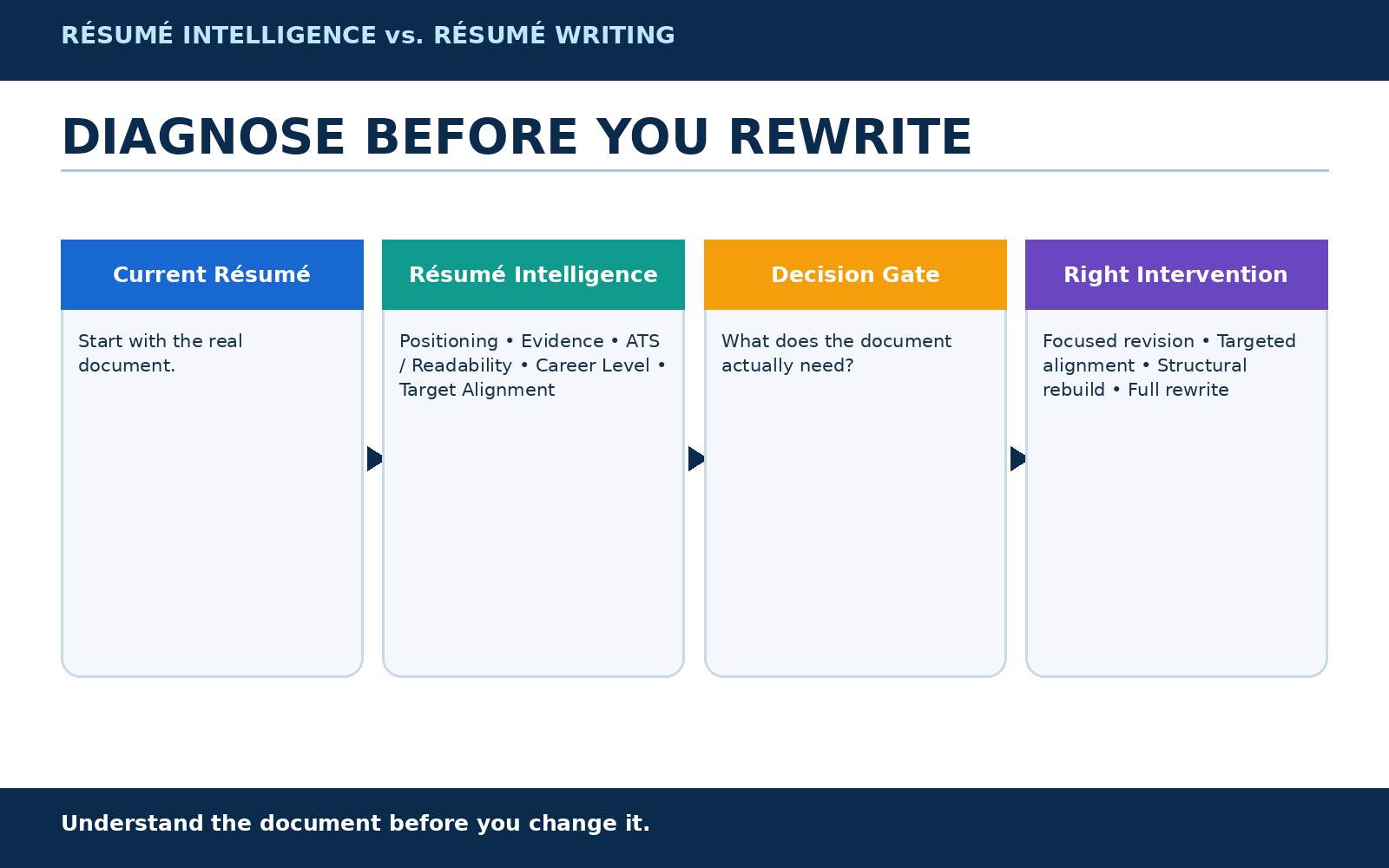
Résumé Intelligence tells you what the current document communicates. Professional résumé writing uses that diagnosis to rebuild the story, evidence, structure, and target alignment that need to change.
A résumé can look polished and still communicate the wrong thing.
It can use strong language and still hide the evidence that matters most.
It can be technically readable and still underrepresent the level of the professional behind it.
That is why résumé writing should begin with diagnosis.
Before changing the document, you need to understand what the current version actually communicates.
Résumé Intelligence and résumé writing solve different problems.
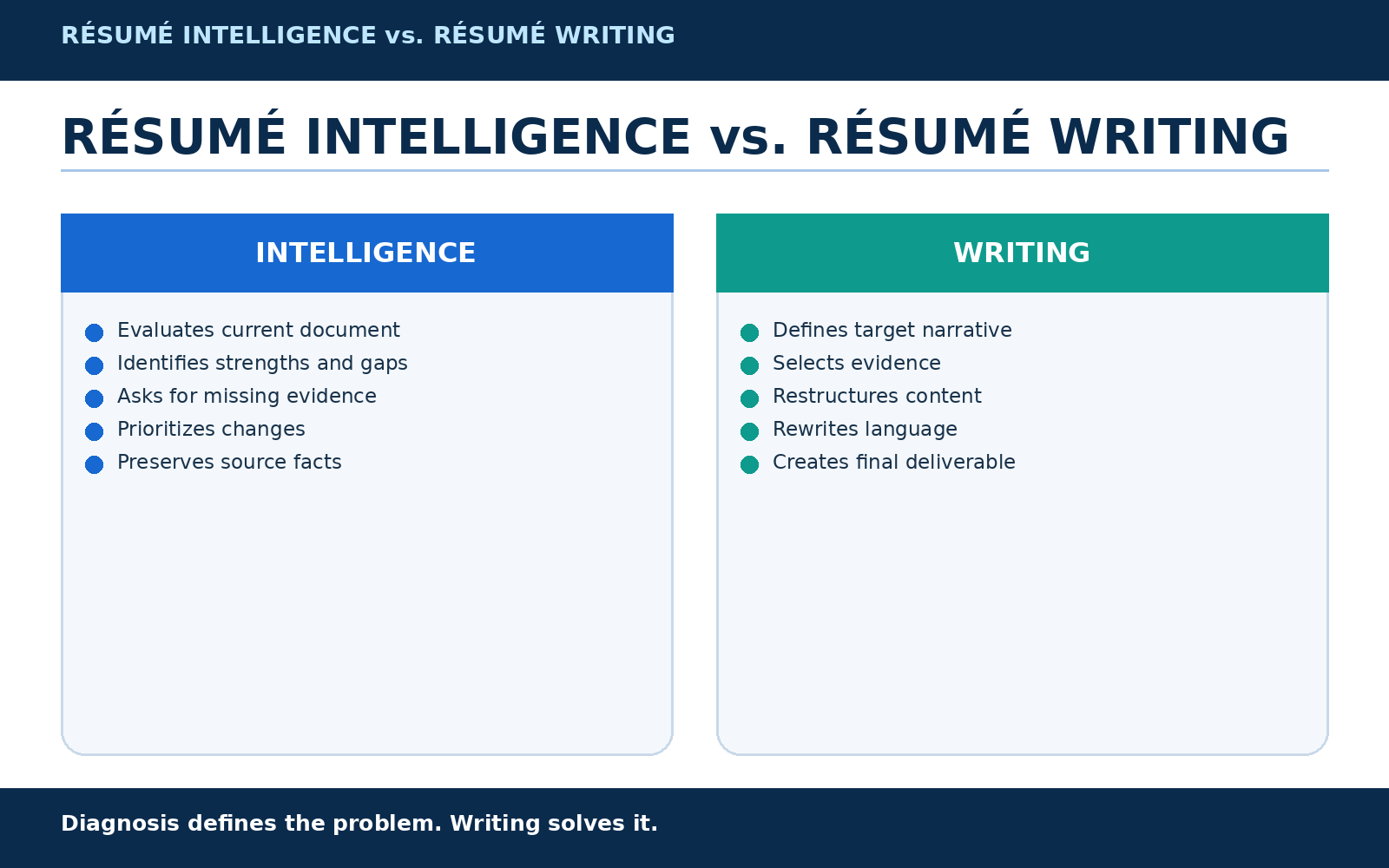
Résumé Intelligence examines the document.
Résumé writing changes the document.
The first tells you what is working, what is weak, what is missing, and what deserves attention first.
The second uses that understanding to build a stronger professional story.
When those steps happen in the right order, the rewrite becomes more focused, more accurate, and easier to justify.
Diagnosis Comes Before Construction
Professionals often approach résumé writing with a vague instruction:
“Make this better.”
That can mean many different things.
The document may need:
Stronger positioning
Better accomplishment evidence
Clearer career progression
More relevant keywords
Better ATS readability
A stronger summary
More business impact
Cleaner structure
A higher-level executive narrative
A clearer target
Better differentiation
Those are different problems.
A writer who begins without identifying the real problem may improve the wording while leaving the deeper issue untouched.
For example:
A résumé may have good accomplishments but weak career-level representation.
A résumé may have excellent formatting but poor positioning.
A résumé may contain strong experience but bury the evidence behind vague language.
A résumé may be well written for the wrong target.
The quality of the rewrite depends on the quality of the diagnosis.
What Résumé Intelligence Does
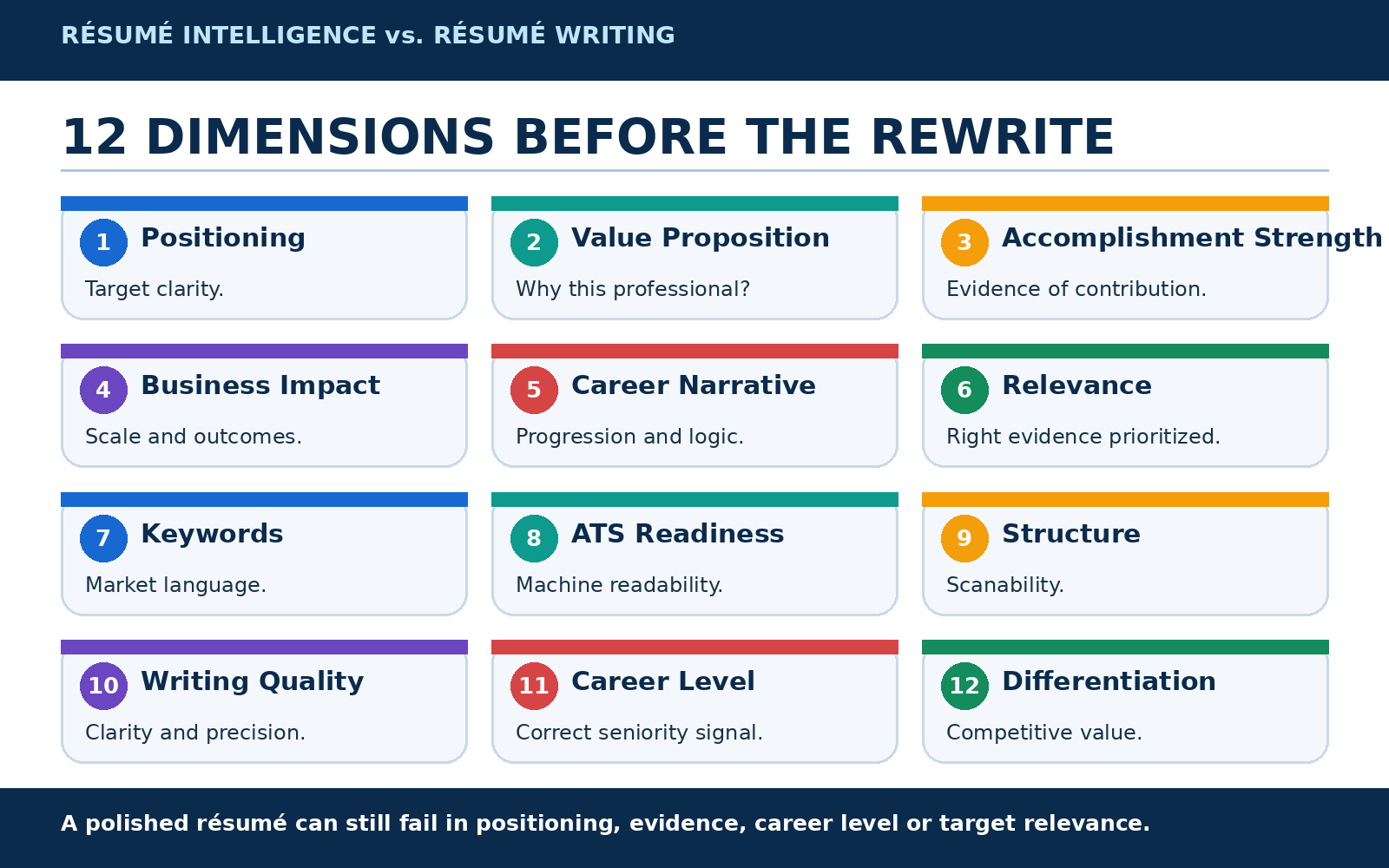
MyTopMatch’s current Résumé Intelligence Review examines what a résumé visibly communicates across twelve defined dimensions.
Those dimensions include:
Professional Positioning
Summary & Value Proposition
Accomplishment Strength
Quantification & Business Impact
Career Narrative & Progression
Experience Relevance & Prioritization
Keyword & Competency Alignment
ATS Readiness
Structure, Formatting & Scanability
Writing Quality & Clarity
Career-Level Representation
Differentiation & Competitive Value
The purpose is document diagnosis.
The review identifies:
What the résumé currently communicates
What appears strongest
What weakens the document
What information is missing
What changes deserve priority
MyTopMatch’s current method also keeps the analysis tied to the source document.
When stronger evidence may exist but is not present, the system asks for it.
It does not create employers, metrics, achievements, credentials, or responsibilities.
That boundary matters because résumé improvement should strengthen the communication of real evidence.
What Résumé Writing Does
Résumé writing begins after the problem is understood.
The writer has to decide:
What professional identity should be communicated?
Which target roles should guide the document?
Which evidence deserves prominence?
Which accomplishments carry the most weight?
Which details should be reduced or removed?
How should the career progression be explained?
What language will make the experience easier to interpret?
How should the document reflect the professional’s actual level?
Which format best supports readability?
Which keywords matter for the target?
What information still needs confirmation?
This is construction.
A writer is building an intentional representation of the professional.
That work requires judgment.
Two professionals can have similar experience and need very different résumés because their target, market, career level, evidence, and direction differ.
A diagnosis helps the writer see where those differences matter.
A Strong Résumé Can Still Need Better Positioning
One of the most common résumé problems is underrepresentation.
The professional may be capable.
The document may still make the person look narrower, more junior, or less differentiated than they are.
This often happens when:
The résumé reads like a job description
The bullets describe duties rather than outcomes
The title carries less meaning outside the current employer
The strongest scope is buried
The summary uses generic language
Career progression is unclear
Business impact is missing
The résumé does not connect past experience to the target role
The document lacks evidence of decision authority, leadership, complexity, or scale
In those cases, writing quality alone is not enough.
The résumé needs stronger positioning.
That means the document should make it easier for a reader to understand:
Who this professional is
What level they operate at
What they have repeatedly delivered
Why the experience matters
Where the experience fits next
Résumé Intelligence can identify where the current document fails to communicate those points.
The writer can then rebuild the document around the actual evidence.
Career Fit and Résumé Representation Are Different
A professional can be a strong fit for a role while the résumé communicates the fit poorly.
This distinction is important.
MyTopMatch’s current Targeted Résumé Alignment keeps broader TopMatch Career Fit separate from Résumé Representation.
Career Fit uses the broader professional record.
Résumé Representation asks what the current document shows for the specific opportunity.
Those two signals can diverge.
Imagine a professional whose experience strongly supports a Director of Operations role.
The broader career evidence includes:
Team leadership
Cross-functional operations
Process improvement
Budget participation
Multi-site responsibility
Executive communication
The résumé may only emphasize:
Customer service
Daily operations
Staff supervision
The professional may be qualified.
The document is underrepresenting the fit.
That is a document problem.
The solution is better representation of existing evidence.
The writer should not need to invent new capability.
The document should make the real capability easier to see.
ATS Readiness Is One Part of the Diagnosis
ATS concerns often dominate résumé conversations.
They matter.
They are also easy to exaggerate.
MyTopMatch’s current ATS Readiness Score evaluates document characteristics associated with machine readability, structure, and recruiter searchability.
It does not claim to reproduce a specific employer’s applicant tracking system.
It cannot see:
The employer’s ATS configuration
Ranking rules
Search logic
Applicant pool
Recruiter behavior
Hiring criteria
This distinction protects the professional from ATS mythology.
A résumé can be made more readable.
It can use recognizable headings.
It can improve text accessibility.
It can strengthen keyword and competency alignment.
Those improvements are useful.
They still do not guarantee that an employer’s system will rank or accept the document.
Résumé writing should therefore include ATS-conscious structure without turning the entire document into a keyword exercise.
The goal is a résumé that works for both machines and people.
The Résumé Is a Representation of a Larger Professional Record
The résumé should not have to carry every piece of career information.
MyTopMatch’s Professional Passport can hold a broader private record of:
Professional identity
Capabilities
Achievements
Career direction
Education
Credentials
Work preferences
Dealbreakers
Confirmed evidence
The résumé selects from that larger record.
That means the writer can ask:
Which evidence belongs in this document?
Which evidence belongs in another document?
Which private context should shape the target without appearing on the résumé?
Which accomplishments support the current direction?
This is another reason diagnosis matters.
The résumé should represent the professional strategically.
It should not become a storage file for every career fact.
When a Full Rewrite May Be Unnecessary
Some résumés do not need complete reconstruction.
A diagnostic review may reveal that the document is already strong in several areas.
The highest-value changes may be:
A clearer headline
A stronger summary
More specific accomplishments
Better prioritization
A stronger target-specific keyword set
Improved career-level language
Cleaner formatting
A few missing metrics
A more coherent progression story
In those cases, a focused revision may be more appropriate than a complete rewrite.
This is one of the practical benefits of diagnosis.
The professional can choose the scope of work based on the actual condition of the document.
Ivy League Résumés currently offers a Digital Résumé Audit specifically for professionals who want prioritized expert feedback before deciding whether to invest in a rewrite.
The purpose is clarity before construction.
When a Full Rewrite Makes Sense
A more substantial rewrite may be appropriate when the document has deeper structural problems.
Examples include:
The résumé is written for the wrong target
The professional is changing careers
The current document does not reflect the current level
The strongest accomplishments are missing
The document is mostly responsibility statements
The career story is fragmented
The résumé mixes several unrelated directions
The formatting interferes with readability
The document lacks a coherent value proposition
The professional has significantly expanded scope since the résumé was created
An executive résumé may need even deeper work because the document has to communicate:
Enterprise impact
Leadership scope
Decision authority
Transformation
Financial responsibility
Organizational complexity
Stakeholder influence
Strategic direction
A complete rewrite is useful when the architecture of the document needs to change.
The writer is rebuilding the story rather than editing a few sentences.
Human Writing Adds Judgment
Automated analysis can identify document patterns.
Professional writing adds judgment about how the professional should be represented.
That judgment can include:
Which achievement should lead the document
Which evidence best supports the target
How much detail belongs in older roles
How to explain an unusual transition
How to represent executive scope
How to avoid exaggerating the evidence
How to balance ATS clarity with human readability
How to preserve the professional’s voice
How to determine whether the target itself needs to change
This is where expert résumé development differs from automated document scoring.
The analysis helps define the problem.
The writer decides how the document should solve it.
Ivy League Résumés currently uses a strategy-first process that begins with target roles and positioning goals before building the résumé.
That sequence is consistent with the same principle.
Understand the objective before writing.
A Better Résumé Workflow
A strong résumé-development process can follow six steps.
Step 1: Diagnose the current document
Identify strengths, weaknesses, evidence gaps, ATS/readability issues, positioning problems, and career-level representation.
Step 2: Clarify the target
Define the role family, level, industry, and direction the résumé needs to support.
Step 3: Confirm the evidence
Gather accomplishments, scope, metrics, credentials, responsibilities, and examples that support the target.
Step 4: Decide the scope of change
Choose whether the résumé needs focused revision, retargeting, restructuring, or a full rewrite.
Step 5: Write the document
Build the narrative, structure, language, evidence hierarchy, and target alignment.
Step 6: Verify the final result
Check readability, ATS-conscious structure, evidence accuracy, target alignment, formatting, and consistency across versions.
This sequence reduces guesswork.
The writer knows what problem is being solved.
The professional understands why the document changed.
Before-and-After Review Matters
A final résumé should be evaluated against the original problem.
If the initial diagnosis identified weak career-level representation, the final document should communicate level more clearly.
If accomplishments were weak, the new document should include stronger evidence.
If the target was unclear, the positioning should become more specific.
If ATS readability was poor, the structure should become cleaner.
The rewrite should produce a visible correction.
This creates accountability.
The goal is not merely to produce different wording.
The goal is to solve the diagnosed document problem.
What to Ask Before You Rewrite Your Résumé
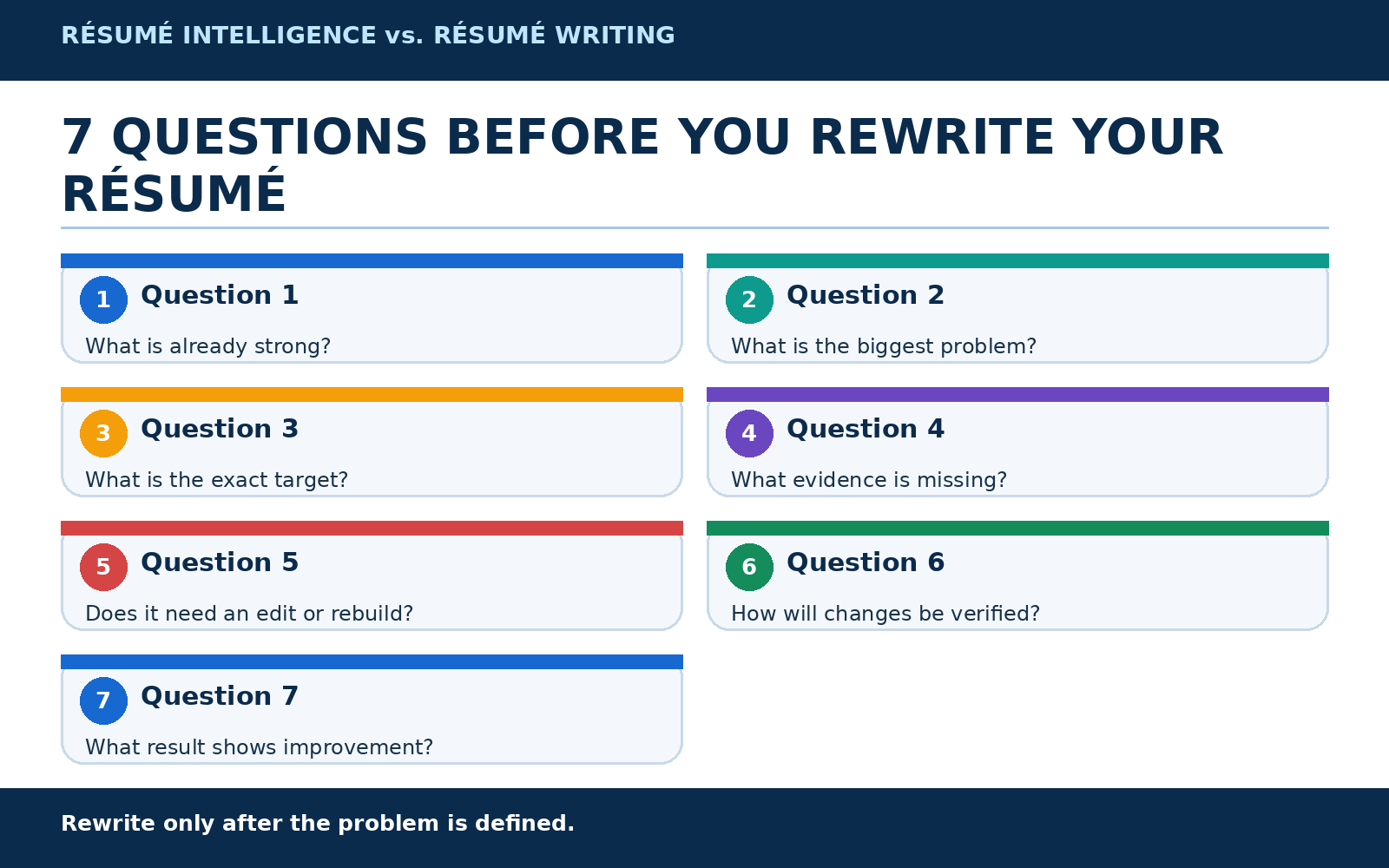
Before rewriting the document yourself or hiring a professional, ask seven questions.
1. What does my current résumé already do well?
Keep the strengths.
2. What is the most important problem?
Positioning, evidence, target, readability, career level, narrative, or another issue?
3. What target should guide the rewrite?
A résumé without a target often becomes generic.
4. What evidence is missing?
Metrics, scope, leadership examples, outcomes, credentials, projects, or other proof may need to be gathered before writing.
5. Does the problem require editing or rebuilding?
Choose the scope that matches the diagnosis.
6. How will I verify the final document?
Review ATS-conscious structure, evidence accuracy, target alignment, clarity, and formatting.
7. What result would tell me the document is better?
Look for clearer market response, better-fit recruiter conversations, stronger interview themes, and fewer repeated misunderstandings about your level or experience.
Diagnosis Helps You Buy the Right Amount of Help
Résumé services can vary from a focused review to a complete professional portfolio.
The professional should understand which level of intervention the document actually needs before choosing the service.
A useful diagnosis can place the résumé into one of four broad paths.
Focused revision
The document is fundamentally sound. A few high-priority changes may improve the headline, summary, accomplishments, keywords, career-level language, or formatting.
Targeted alignment
The résumé works reasonably well as a general document but underrepresents the evidence required for one specific opportunity or role family.
Structural rebuild
The evidence is useful, but the document architecture is weak. Sections may be misordered, the narrative may be fragmented, important achievements may be buried, or career progression may be difficult to follow.
Full professional rewrite
The target, positioning, narrative, evidence hierarchy, and language all need substantial reconstruction.
These paths have different levels of work.
They should also have different expectations.
A focused revision should improve a defined weakness.
A targeted alignment should make relevant evidence easier to find for the chosen role.
A structural rebuild should make the whole career story easier to understand.
A full rewrite should create a new representation of the professional around a confirmed target and evidence base.
This matters financially.
Professionals can spend too much when they purchase a full rewrite for a document that needs several focused corrections.
They can also spend too little when they keep buying small edits for a résumé whose underlying architecture is failing.
Diagnosis helps match the investment to the problem.
It also creates a clearer pass/fail standard.
Before spending, define the expected result:
Which document problem should be corrected?
Which evidence should become easier to see?
Which target should the new version support?
How will the final document be verified?
The service decision becomes more disciplined when the professional knows what success should look like before the work begins.
The Résumé Should Be Understood Before It Is Rewritten
Résumé writing is valuable because the document shapes how the market interprets professional experience.
That makes diagnosis important.
A professional should understand:
What the résumé communicates
What it hides
What it overemphasizes
What evidence is missing
What target it currently supports
What target it should support
What changes matter most
Then the writing can begin.
Résumé Intelligence helps identify the document problem.
Expert résumé writing solves the problem through strategy, evidence, narrative, structure, and language.
Those functions work best together.
If you are unsure what your résumé actually needs, start with a diagnosis. Understand the document first, then decide whether the right next step is a focused revision, a targeted alignment, or a complete professional rewrite.