Insights / Career Intelligence Series
What an Executive Career Portfolio Should Contain Beyond the Résumé
An executive résumé cannot serve every leadership context. A coordinated portfolio gives search firms, boards, advisors, networks, and other decision-makers the right evidence in the right format.
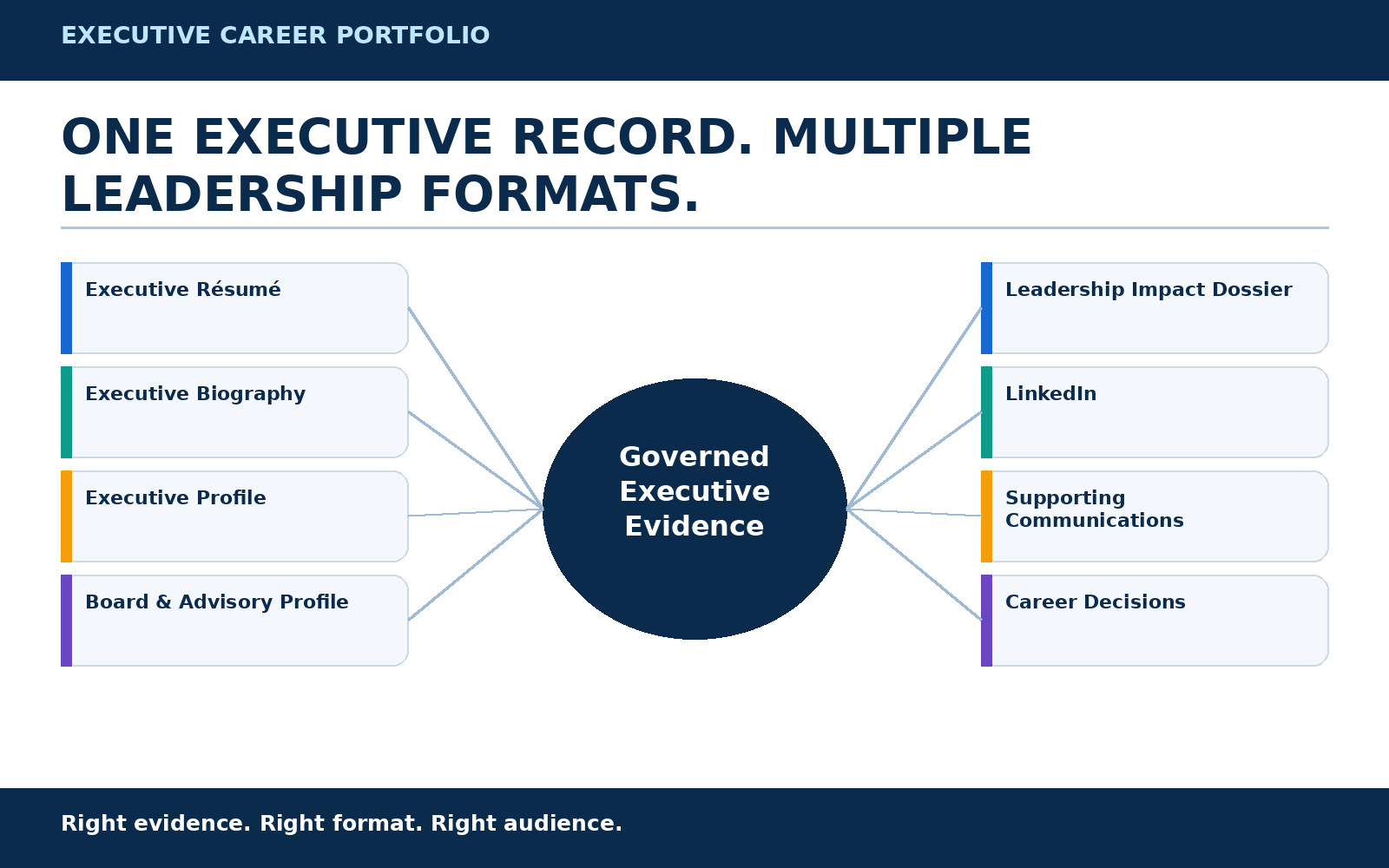
An executive résumé is important.
It is rarely the only document an executive needs.
Senior leaders are evaluated across several contexts:
Search firms
C-suite hiring teams
Boards
Advisory opportunities
Investor or stakeholder conversations
Speaking opportunities
Professional networking
Public leadership visibility
Internal succession discussions
Each audience asks a different question.
The résumé answers:
What leadership experience, scope, results, and career progression support this role?
An executive biography answers:
Who is this leader, what has shaped the career, and how should the leadership story be understood in narrative form?
A one-page executive profile answers:
What should a busy decision-maker understand in two minutes?
A board or advisory profile answers:
Which parts of this background are relevant to governance, strategic counsel, oversight, transformation, industry expertise, or advisory work?
A leadership impact dossier answers:
What evidence proves the scale and pattern of the executive’s impact?
A LinkedIn profile answers:
How should the executive be positioned in a persistent public professional environment?
These documents should reinforce the same professional truth.
They should not all look the same.
That is the purpose of an executive career portfolio.
One Leadership Record, Several Executive Formats
A strong executive portfolio starts with one governed evidence base.
That evidence can include:
Executive roles
Enterprise scope
Business units
Revenue or budget responsibility
Team size
Geographic responsibility
Transformation programs
Operating results
Growth outcomes
Risk and governance experience
M&A activity
Turnaround work
Board exposure
Industry expertise
Credentials
Selected public leadership activity
Career direction
MyTopMatch’s current Executive Career Portfolio is built from one governed evidence record and can include an executive hybrid résumé, leadership value brief, board and advisory profile, and leadership impact dossier.
The principle is useful beyond one product.
Executives should not rebuild their story independently every time they need a new document.
One confirmed record should support several formats.
That protects consistency.
It also makes the portfolio easier to update as the career changes.
The Executive Résumé Remains the Core Search Document
The résumé is still the central document for executive search and application use.
Its job is to show:
Leadership scope
Career progression
Enterprise impact
Transformation
Financial responsibility
Organizational complexity
Decision authority
Stakeholder influence
Relevant industry context
Evidence that supports the target role
The résumé should be selective.
It should prioritize the evidence that matters for the executive’s current direction.
MyTopMatch’s current executive résumé product treats the résumé as a role-targeted search and networking document.
That boundary matters.
The résumé should not be forced to carry every story, every leadership philosophy, every board-relevant theme, and every accomplishment the executive has accumulated.
Other portfolio documents can carry those functions more effectively.
The Executive Biography Serves a Different Audience
An executive biography is a narrative document.
It is usually written in third person.
It can support:
Board introductions
Advisory opportunities
Speaking engagements
Organizational profiles
Conference materials
Media or public leadership contexts
Senior networking
Professional association use
A biography gives the executive more room to explain the arc of the career.
It can show:
How the leader developed
Which transformations shaped the career
What kinds of problems the executive is known for solving
Which industries or functions define the experience
How leadership philosophy has developed
Which accomplishments deserve narrative treatment
What professional direction now makes sense
MyTopMatch’s current executive-document architecture explicitly separates the executive résumé from the executive biography.
That is appropriate.
The résumé and biography answer different questions.
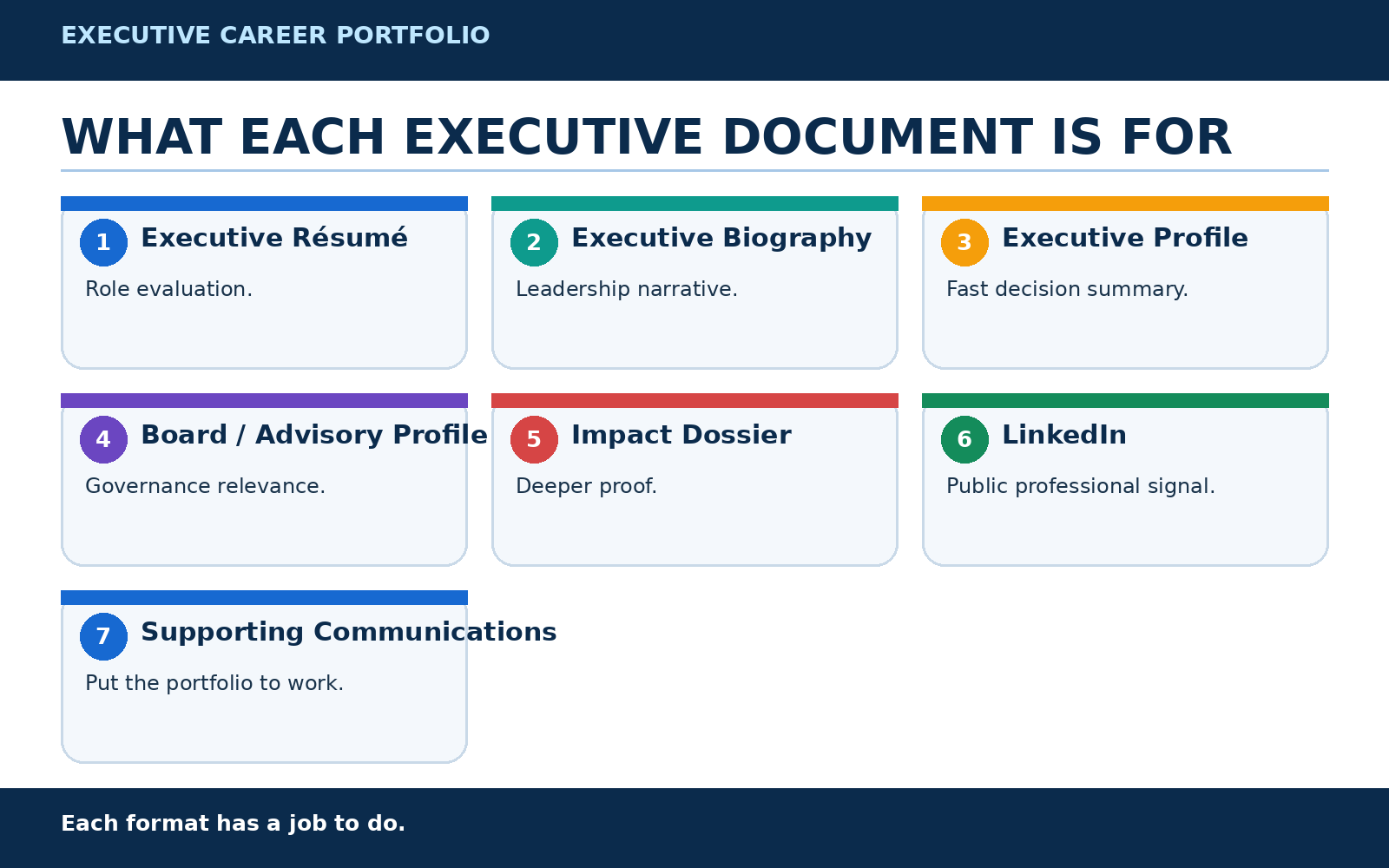
A résumé supports role evaluation.
A biography supports leadership understanding.
The biography should remain evidence-grounded.
Narrative freedom does not create permission to exaggerate leadership scope, board experience, transformation impact, or public influence.
The One-Page Executive Profile Creates a Fast Decision Document
Executives often need a shorter document than the full résumé.
A one-page executive profile or leadership value brief can help a decision-maker understand:
Who the executive is
What level the executive operates at
Which enterprise problems the executive solves
Which leadership themes repeat across the career
Which results are most important
Which industries or functions are most relevant
What the executive is targeting next
This document is useful when the reader has limited time.
Examples may include:
Executive networking
Search-firm conversations
Internal introductions
Board or advisory discussions
Referral conversations
High-level exploratory meetings
The one-page profile should not become a compressed two-page résumé.
It should work as a leadership summary.
The emphasis is pattern recognition.
What should the reader understand immediately about this executive?
That is the question the one-page profile should answer.
A Leadership Value Brief Makes the Executive Proposition Explicit
Some executives need a document focused specifically on leadership value.
A leadership value brief can organize themes such as:
Enterprise transformation
Growth
Operational discipline
Turnaround leadership
Commercial strategy
Talent development
Risk management
Digital transformation
Customer strategy
Financial stewardship
Global leadership
The value brief can connect those themes to evidence.
For example:
Enterprise transformation
Led a multi-year operating-model redesign across four business units.
Growth
Expanded a business line from one region to three while increasing revenue and margin.
Talent
Built a succession structure that developed several leaders into larger roles.
The purpose is clarity.
The executive’s value should not remain scattered across fifteen résumé bullets.
A leadership value brief can make the pattern visible.
Board and Advisory Positioning Requires Different Evidence
Board and advisory work should not be treated as an automatic extension of executive experience.
A strong operating executive may have valuable board potential.
The evidence still needs to support the positioning.
A board or advisory profile may emphasize:
Governance exposure
Enterprise risk
Audit or finance
Compensation
Cybersecurity
Regulatory oversight
M&A
Transformation
Capital allocation
Industry expertise
CEO or C-suite advising
Stakeholder management
Crisis leadership
Succession
Strategic planning
The document should show how the executive’s experience connects to board or advisory responsibilities.
It should also preserve an important boundary.
Board readiness cannot be manufactured.
An executive who has never served on a board should not be presented as if formal board experience already exists.
The profile can accurately show governance-relevant experience.
It can describe advisory relevance.
It can show committee-aligned expertise.
It can position the executive for the next opportunity without inventing the opportunity history.
MyTopMatch’s current Executive Career Portfolio includes a board and advisory profile as a distinct portfolio component.
That separation is useful because board positioning requires a different evidence hierarchy from executive employment search.
The Leadership Impact Dossier Preserves the Evidence Behind the Story
The leadership impact dossier can serve as the deeper evidence layer behind the executive narrative.
This is where major leadership stories can be organized in more detail.
Possible categories include:
Transformation
Growth
Turnaround
Profitability
Cost reduction
Operating-model design
M&A
Integration
Technology implementation
Risk reduction
Talent
Global expansion
Customer improvement
Innovation
Crisis response
Each impact story should answer:
What was the situation?
What responsibility did the executive hold?
What action did the executive lead?
What changed?
What measurable result followed?
What scale was involved?
Which stakeholders mattered?
What does the example prove about the executive?
This evidence can support several other documents.
A résumé bullet may use the short version.
A biography may use the narrative version.
An interview may use the full story.
A board profile may extract the governance-relevant part.
A LinkedIn experience section may use a public-facing version.
The evidence remains the same.
The format changes.
Leadership Accomplishment Narratives Strengthen Interview and Networking Readiness
Executives frequently need more than résumé bullets.
A leadership accomplishment narrative can turn a major result into a structured story.
That is useful for:
Executive interviews
Board conversations
Search-firm discussions
Investor or stakeholder meetings
Networking
Speaking
Internal succession discussions
The narrative can include context, challenge, decision, resistance, stakeholders, execution, result, and leadership lesson.
This creates a deeper level of readiness.
The executive does not need to improvise the full meaning of a major accomplishment in every conversation.
The portfolio preserves the story in a usable form.
Ivy League Résumés’ current executive-transition work includes leadership accomplishment narratives alongside résumé, biography, LinkedIn positioning, and executive-profile materials.
That is a practical model.
A portfolio should help the executive communicate consistently across several decision environments.
LinkedIn Is the Public-Facing Portfolio Layer
LinkedIn serves a different function from private executive documents.
It is persistent.
It is discoverable.
It is visible to recruiters, peers, colleagues, clients, employees, partners, and people outside an active search.
The profile should therefore balance:
Executive positioning
Target direction
Public credibility
Professional visibility
Privacy
Career stability
Evidence
Searchability
MyTopMatch’s current LinkedIn Profile Development product builds the headline, About section, experience content, and skills from confirmed career evidence.
It does not log in or publish on the member’s behalf.
That is an important control.
The executive should know exactly what becomes public.
The LinkedIn profile should align with the portfolio while respecting the fact that public positioning may need to be broader than one confidential search target.
The Executive Portfolio Can Include Supporting Communications
The core portfolio may also be supported by additional documents.
Depending on the engagement and target, those can include:
Cover communication
Recruiter outreach
Networking messages
Thank-you messages
Negotiation preparation
Executive presentation materials
Target-company research
Search-firm talking points
Opportunity-specific résumé versions
These items serve the campaign around the portfolio.
They should remain connected to the same executive evidence and positioning.
A recruiter note should not describe a different leader from the résumé.
A cover message should reinforce the same value themes.
An executive presentation should use the same verified business outcomes.
The portfolio should feel coordinated.
What Should Stay Consistent Across the Portfolio?
Executives often work with several documents at once.
Consistency matters.
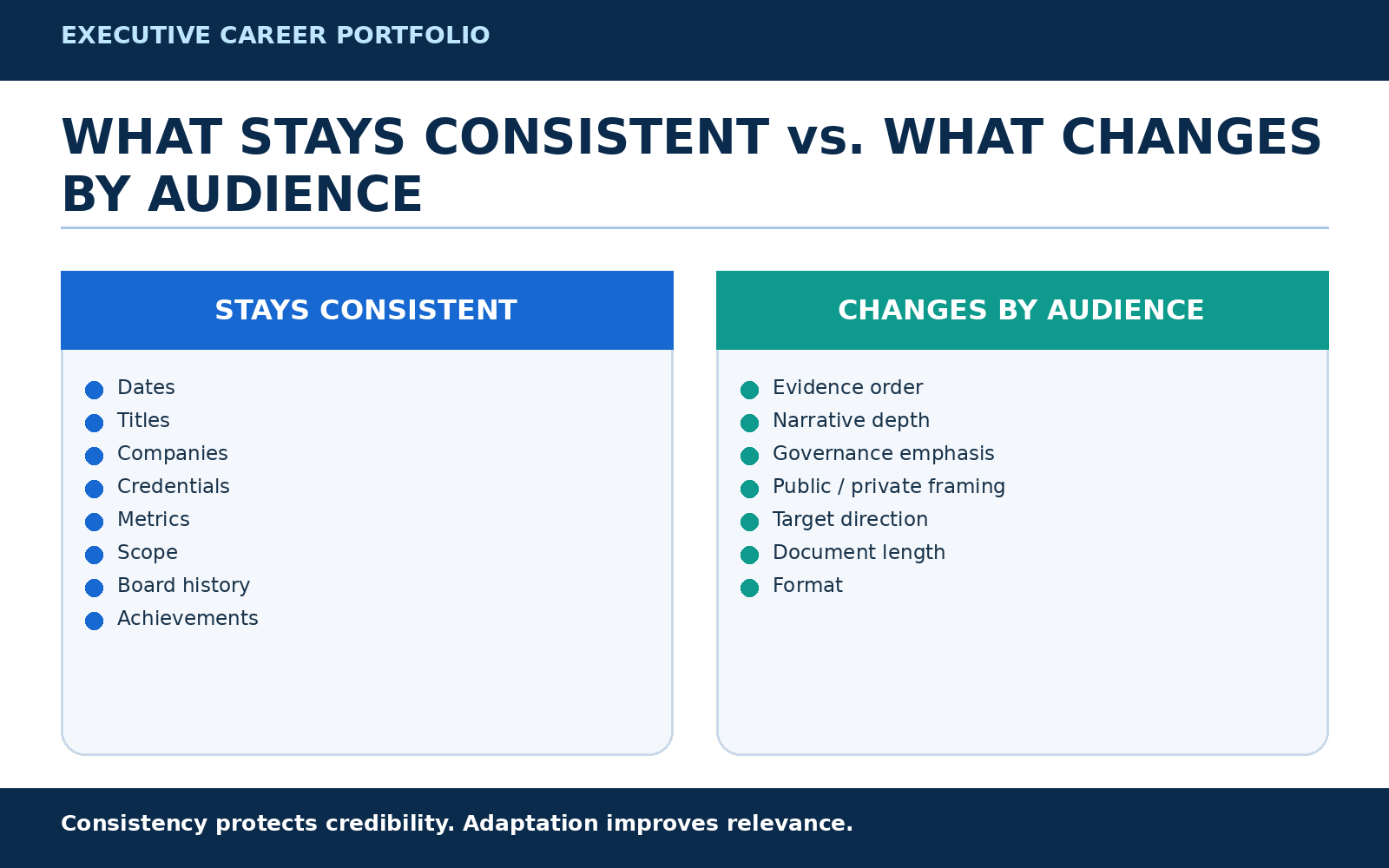
The following should remain aligned:
Employment dates
Titles
Company names
Credentials
Board history
Scope
Team size
Budget or revenue responsibility
Metrics
Major accomplishments
Career chronology
Industry history
Leadership themes
Target level
A biography may use more narrative.
A résumé may use tighter bullets.
A board profile may emphasize governance.
The underlying facts should still agree.
Inconsistency creates risk.
Search firms and senior decision-makers may compare several sources.
The executive should not have to remember which version contains which claim.
One governed evidence base reduces that problem.
What Should Change by Audience?
Audience changes the framing.
For executive search
Lead with role fit, enterprise scope, transformation, financial responsibility, and relevant business outcomes.
For board or advisory conversations
Lead with governance-relevant expertise, strategic judgment, risk, oversight, industry knowledge, and enterprise perspective.
For speaking or public leadership
Lead with subject-matter authority, leadership themes, career arc, and relevant public expertise.
For networking
Lead with professional identity, target direction, and the few leadership themes most relevant to the relationship.
For internal advancement
Lead with enterprise contribution, organizational influence, succession readiness, and evidence of operating at the next level.
The executive remains the same.
The audience determines what deserves emphasis.
An Executive Portfolio Is Not One Universal Bundle
The phrase “executive portfolio” can sound as though every executive needs the same collection of documents.
That would create unnecessary work.
A portfolio is a coordinated set of formats selected for the executive’s actual direction.
One executive may need:
A résumé
A one-page executive profile
Another may also need:
An executive biography
Board and advisory profile
Leadership impact dossier
Speaking biography
Search-firm communication materials
MyTopMatch’s current executive résumé page makes a useful product boundary explicit: the résumé and executive biography are separately scoped documents, and a portfolio is a different coordinated product with its own stated contents and eligibility.
That distinction should carry into career strategy.
Do not assume a biography is automatically included with a résumé.
Do not assume a board profile is appropriate because the professional is senior.
Do not assume a leadership dossier creates value if no audience will use it.
The portfolio should be defined before the work begins.
The executive should know:
Which documents are included
Which audiences each document serves
Which evidence feeds each format
Which documents are public
Which versions are opportunity-specific
Which revisions or updates are in scope
A portfolio becomes useful through purpose and coordination.
Document volume is not the objective.
A Portfolio Should Reflect the Executive’s Actual Direction
An executive portfolio should not become a collection of documents created because executives are “supposed” to have them.
Every component should serve a real decision.
Before building a board profile, ask:
Is board or advisory work genuinely part of the direction?
Before writing an executive biography, ask:
Which audiences need a narrative document?
Before creating a leadership dossier, ask:
Which leadership stories need deeper evidence?
Before building several résumé versions, ask:
Are there multiple credible target families?
The portfolio should match the career strategy.
More documents do not automatically create more value.
The right documents create clarity for the right audiences.
One Portfolio Can Support Several Executive Opportunity Types
Executives often evaluate more than full-time employment.
MyTopMatch’s current executive positioning recognizes:
Executive employment
Board work
Advisory work
Fractional work
Consulting
Interim work
Teaching
Adjacent leadership opportunities
A portfolio can support those directions without forcing one document to serve all of them.
The résumé may support executive employment.
The board profile may support governance opportunities.
The biography may support speaking or advisory conversations.
The leadership dossier may support consulting or fractional credibility.
LinkedIn may carry the public professional identity across several directions.
That is the advantage of a portfolio.
The executive can remain consistent while becoming more specific by context.
A Practical Executive Portfolio Structure
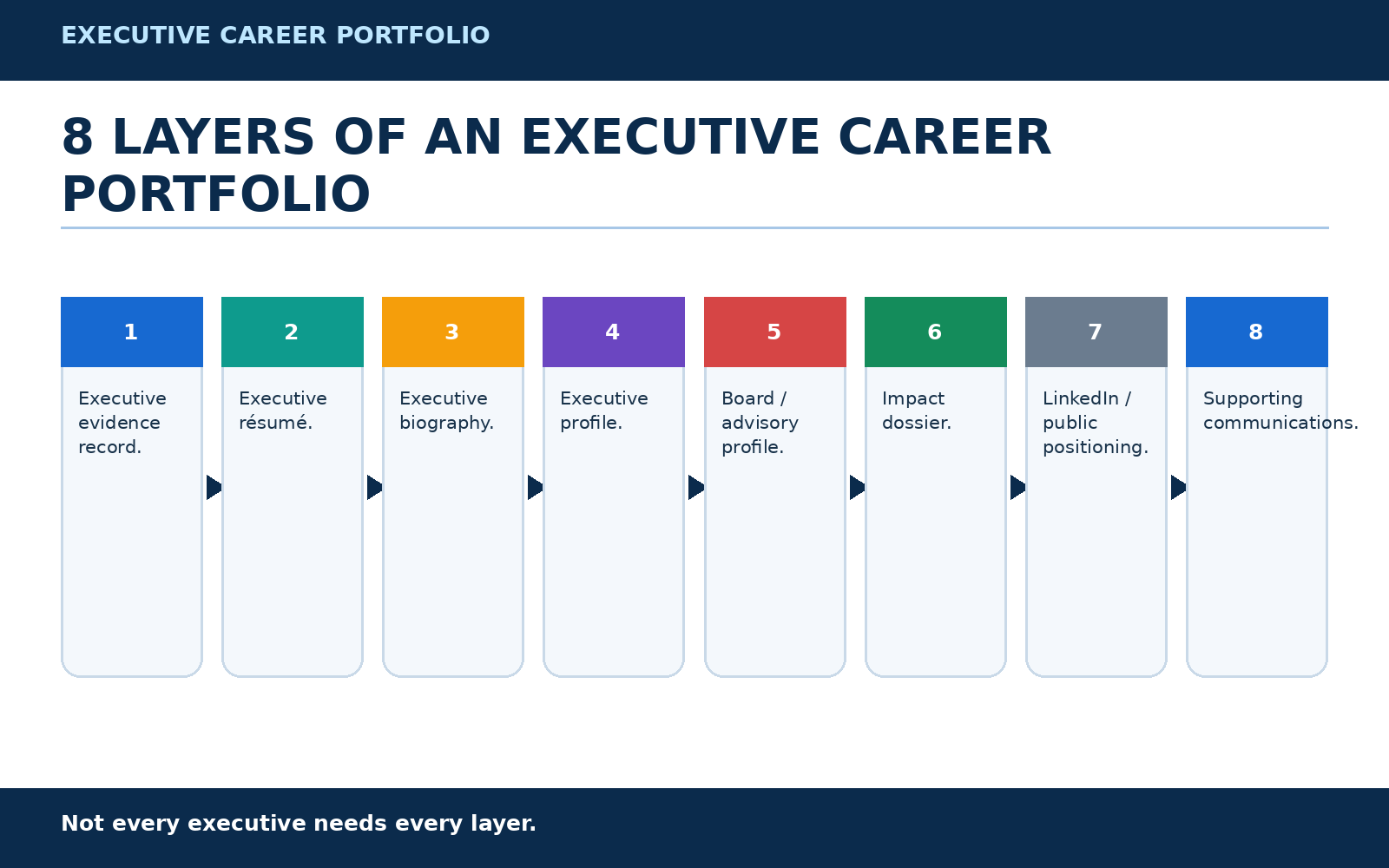
A useful portfolio can be organized in layers.
Layer 1: Master executive evidence record
The complete governed source of truth.
Layer 2: Executive résumé
The role-targeted search document.
Layer 3: Executive biography
The third-person leadership narrative.
Layer 4: One-page executive profile or leadership value brief
The fast decision-maker summary.
Layer 5: Board and advisory profile
The governance and advisory relevance document where supported.
Layer 6: Leadership impact dossier
The deeper collection of transformations, outcomes, scope, and leadership evidence.
Layer 7: LinkedIn profile
The public-facing professional positioning layer.
Layer 8: Supporting communications
Recruiter, networking, follow-up, negotiation, and opportunity-specific materials as needed.
Not every executive needs every layer.
The portfolio should be built around the decisions the executive is actually making.
Seven Questions Before You Build an Executive Career Portfolio
1. Which executive opportunities am I targeting?
Full-time leadership, board, advisory, fractional, consulting, speaking, or another direction?
2. Which audiences need different formats?
Search firms, boards, CEOs, investors, recruiters, associations, or internal decision-makers?
3. Which leadership themes define my value?
Transformation, growth, operations, finance, talent, risk, technology, commercial strategy, or another pattern?
4. Which evidence proves those themes?
Use scope, metrics, enterprise impact, decision authority, and outcomes.
5. Which document should carry each message?
Résumé, biography, executive profile, board profile, dossier, LinkedIn, or supporting communication?
6. What must stay consistent across every format?
Facts, chronology, scope, metrics, credentials, and confirmed achievements.
7. Which documents actually improve a real decision?
Build the portfolio around the career strategy, not around document volume.
Beyond the Résumé Means Better Context, Not More Paper
An executive résumé remains important.
The executive career is larger than one document.
Leadership value may need to be understood by recruiters, boards, advisors, peers, employees, clients, and other senior decision-makers.
Those audiences need different forms of evidence.
A strong executive portfolio solves that problem through coordinated formats built from one professional truth.
The résumé targets the role.
The biography explains the leader.
The executive profile creates a fast leadership summary.
The board profile shows governance relevance.
The leadership dossier proves the impact.
LinkedIn carries the public professional signal.
Supporting communications help put the portfolio to work.
The value comes from coherence.
Build the executive evidence once.
Then use the right format for the right audience.