Insights / Career Intelligence Series
LinkedIn, Résumé and Professional Positioning Should Tell the Same Career Story
Your résumé and LinkedIn profile should tell the same career story without becoming copies of each other. Align the facts, level, evidence, and direction while letting each format do its own job.
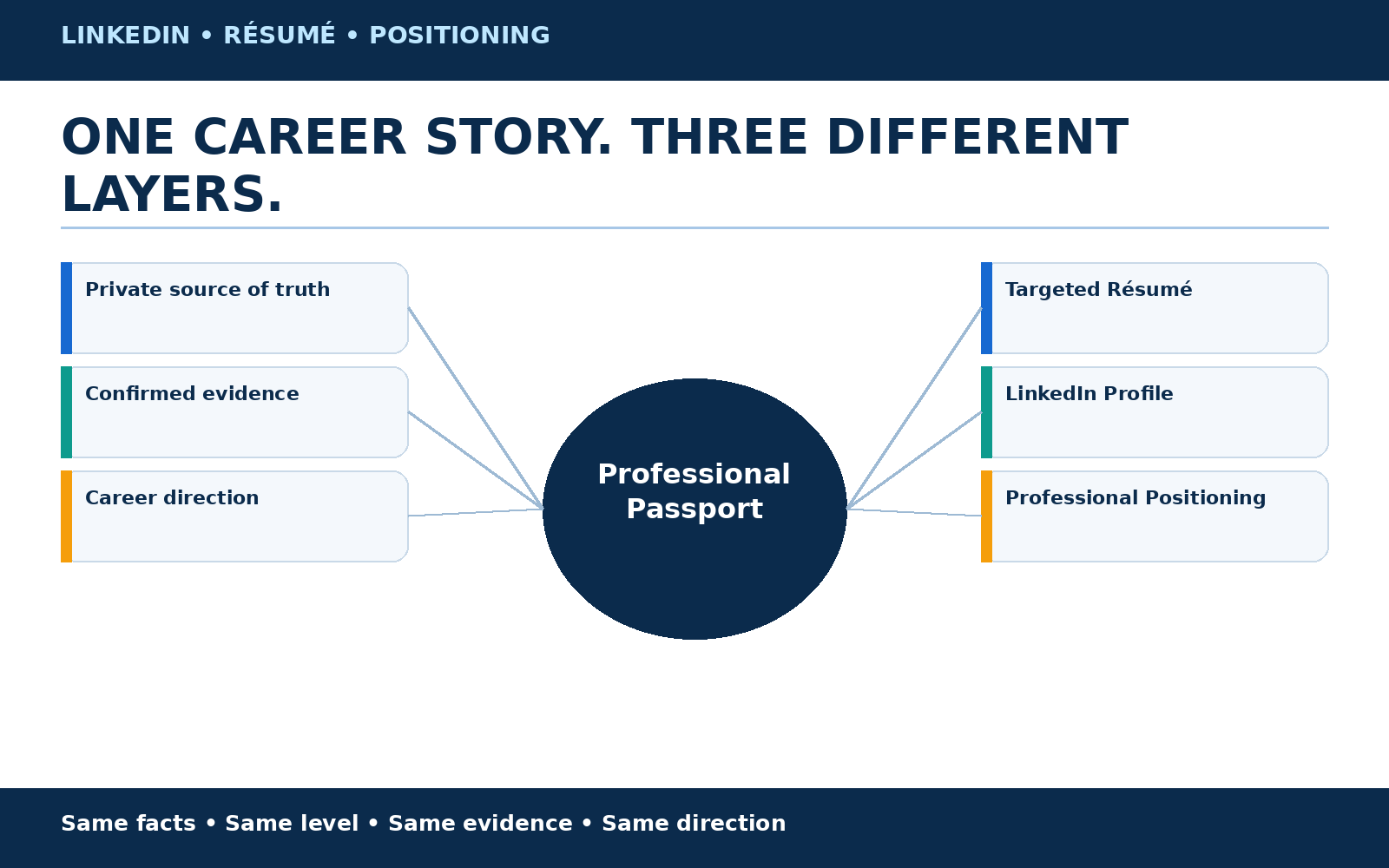
A résumé and LinkedIn profile should agree about who you are.
They do not need to say everything the same way.
That distinction matters.
A résumé is usually a targeted document. It is built for a particular role family, opportunity, or career direction.
LinkedIn is broader and public. It has to represent the professional across many conversations, searches, recruiters, colleagues, clients, and future opportunities.
The Professional Passport is broader still. It is private and can preserve more context than either public-facing document should carry.
These three layers serve different purposes.
They should still reinforce the same professional truth.
When the résumé says “enterprise operations leader,” LinkedIn should not read like an entry-level task list.
When LinkedIn claims transformation leadership, the résumé and underlying career evidence should support it.
When the Professional Passport shows a different target direction than the public profile, the professional should understand why.
Professional positioning becomes stronger when the story is coherent across documents.
Consistency Is About Facts, Level and Direction
Professional consistency does not mean copying one document into another.
It means the major signals agree.
Those signals include:
Employment history
Dates
Titles
Career level
Leadership scope
Major capabilities
Credentials
Key accomplishments
Industry or functional experience
Professional direction
The wording can change.
The amount of detail can change.
The audience can change.
The core facts should not.
A hiring team should not have to decide which version of the professional is accurate.
That is especially important when the résumé and LinkedIn profile are reviewed together.
LinkedIn Is a Credibility Checkpoint
Ivy League Résumés currently describes LinkedIn as a credibility checkpoint in a selective hiring market.
That is a useful way to think about it.
Recruiters and hiring managers may review LinkedIn before, during, or after reading a résumé.
They may compare:
Career history
Employment dates
Titles
Professional identity
Leadership level
Industry relevance
Recommendations
Shared connections
Communication style
Public professional activity
A strong résumé can create interest.
A weak or inconsistent LinkedIn profile can introduce uncertainty.
The problem is not that every sentence must match.
The problem is contradiction.
If the résumé describes strategic enterprise leadership while LinkedIn only shows routine operational duties, the professional appears less coherent.
If employment dates conflict, the issue becomes more serious.
If the résumé emphasizes one career direction and LinkedIn presents a completely unrelated identity, the professional may look unfocused.
Consistency removes unnecessary doubt.
The Résumé Is the Targeted Career Document
A résumé should answer:
Why does this professional fit this target?
That requires selectivity.
The résumé can emphasize:
The most relevant accomplishments
The strongest evidence
The target role family
Career-level scope
Business impact
Relevant keywords and competencies
Opportunity-specific language
Recent and material experience
It does not need to carry every piece of professional context.
A résumé can be narrower than LinkedIn because it is serving a narrower decision.
A Director of Operations résumé may lead with operational scope, team leadership, process improvement, budget responsibility, and executive reporting.
The same professional may have other relevant experience in customer success, transformation, change management, or consulting.
Those capabilities may remain visible in LinkedIn even if they receive less space in the targeted résumé.
The résumé narrows the story.
It should not contradict the broader one.
LinkedIn Is the Broader Public Professional Layer
LinkedIn has to work across a larger range of situations.
A public profile can support:
Recruiter discovery
Professional networking
Industry visibility
Client credibility
Executive positioning
Career-change signaling
Thought leadership
Speaking
Board or advisory conversations
Longer-term professional identity
That means LinkedIn can be broader than one application résumé.
The headline can reflect the professional identity rather than one job title.
The About section can explain the through-line across several roles.
Experience sections can show scope and outcomes without copying every résumé bullet.
Skills can help make the professional easier to understand across several relevant directions.
MyTopMatch's current LinkedIn Profile Development product is built around that broader positioning function.
It develops headline, About, experience, and skills from confirmed career evidence.
The profile remains public-facing, while the professional controls what is actually published.
LinkedIn Should Reinforce the Résumé Without Duplicating It
Copying the résumé into LinkedIn is usually a weak approach.
The formats are different.
Résumé bullets are compact.
LinkedIn allows more narrative context.
The résumé may be highly targeted.
LinkedIn may need to preserve broader professional range.
A useful alignment might look like this:
Résumé
Operations executive with multi-site leadership and transformation experience.
LinkedIn headline
Operations & Transformation Executive | Multi-Site Leadership | Process Improvement | Customer & Business Operations
Résumé experience
Three or four tightly selected bullets emphasizing results relevant to the current target.
LinkedIn experience
A broader description showing scope, leadership, selected outcomes, and adjacent capabilities.
The messages agree.
The formats do different work.
The Professional Passport Is the Private Source of Truth
MyTopMatch's Professional Passport serves a different role.
It is designed as a private member-reviewed career record.
It can include:
Professional identity
Capabilities
Achievements
Career direction
Education
Credentials
Work preferences
Dealbreakers
Confirmed evidence
That record can be more complete than the résumé or LinkedIn profile.
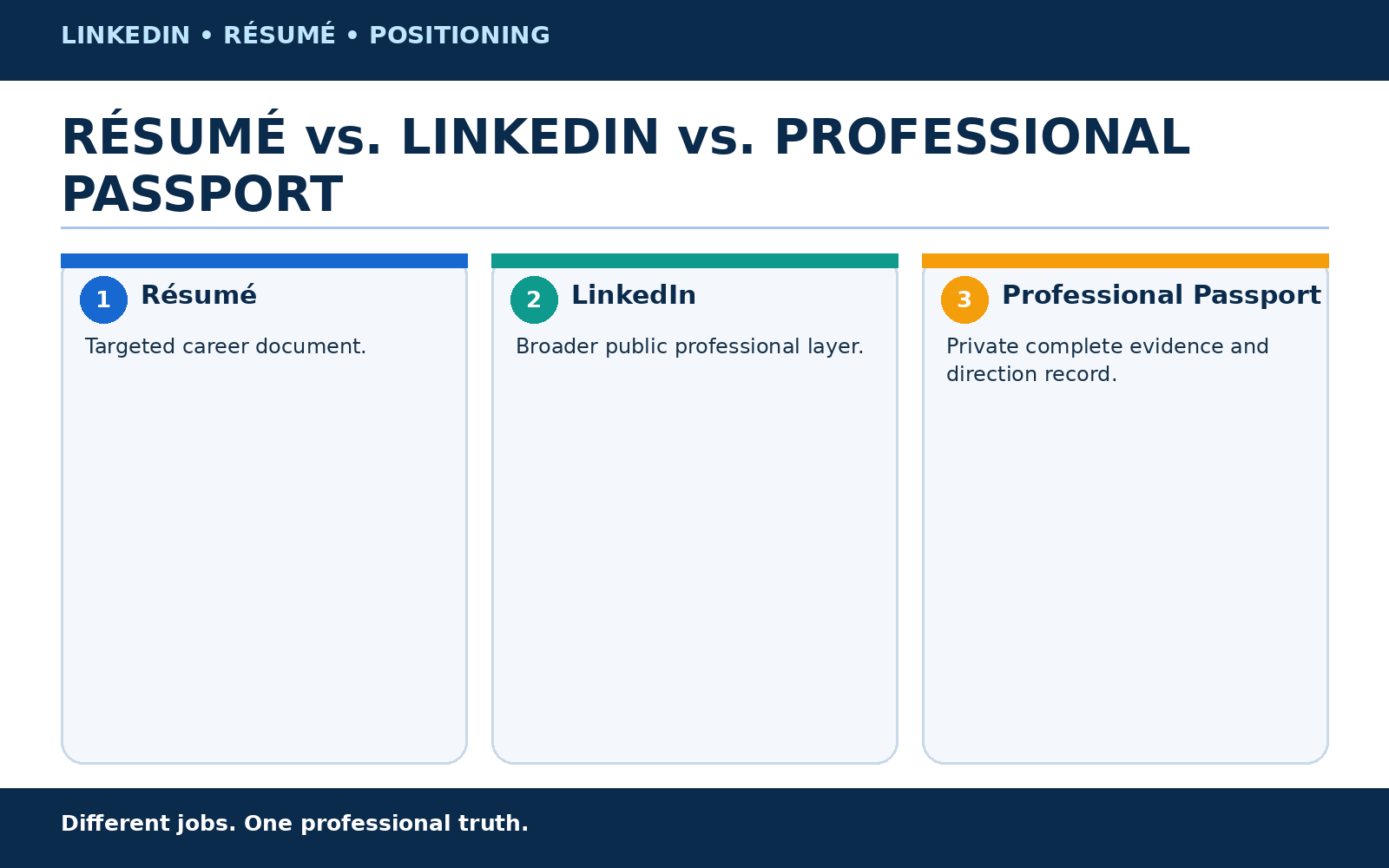
This creates a useful hierarchy.
Professional Passport
The broader private evidence and direction layer.
Résumé
The targeted career document.
The broader public professional signal.
Each layer draws from the same underlying career evidence.
The professional does not have to force every detail into every format.
Career Positioning Connects the Three
MyTopMatch's current Career Positioning framework separates:
Capability
Evidence
Label
Narrative
Recognition
That framework applies directly to résumé and LinkedIn alignment.
Capability
What can the professional actually do?
Evidence
What proves it?
Label
What titles, functions, and professional language describe the work?
Narrative
How does the career story connect the past to the next direction?
Recognition
How is the market currently interpreting the professional?
A résumé can improve one signal while LinkedIn weakens another.
For example:
The résumé may use a strong target headline.
LinkedIn may still default to an internal title that the market does not understand.
The résumé may show measurable accomplishments.
LinkedIn may describe responsibilities only.
The résumé may present the professional at the correct level.
LinkedIn may make the person appear more junior.
Professional positioning improves when the signals reinforce each other.
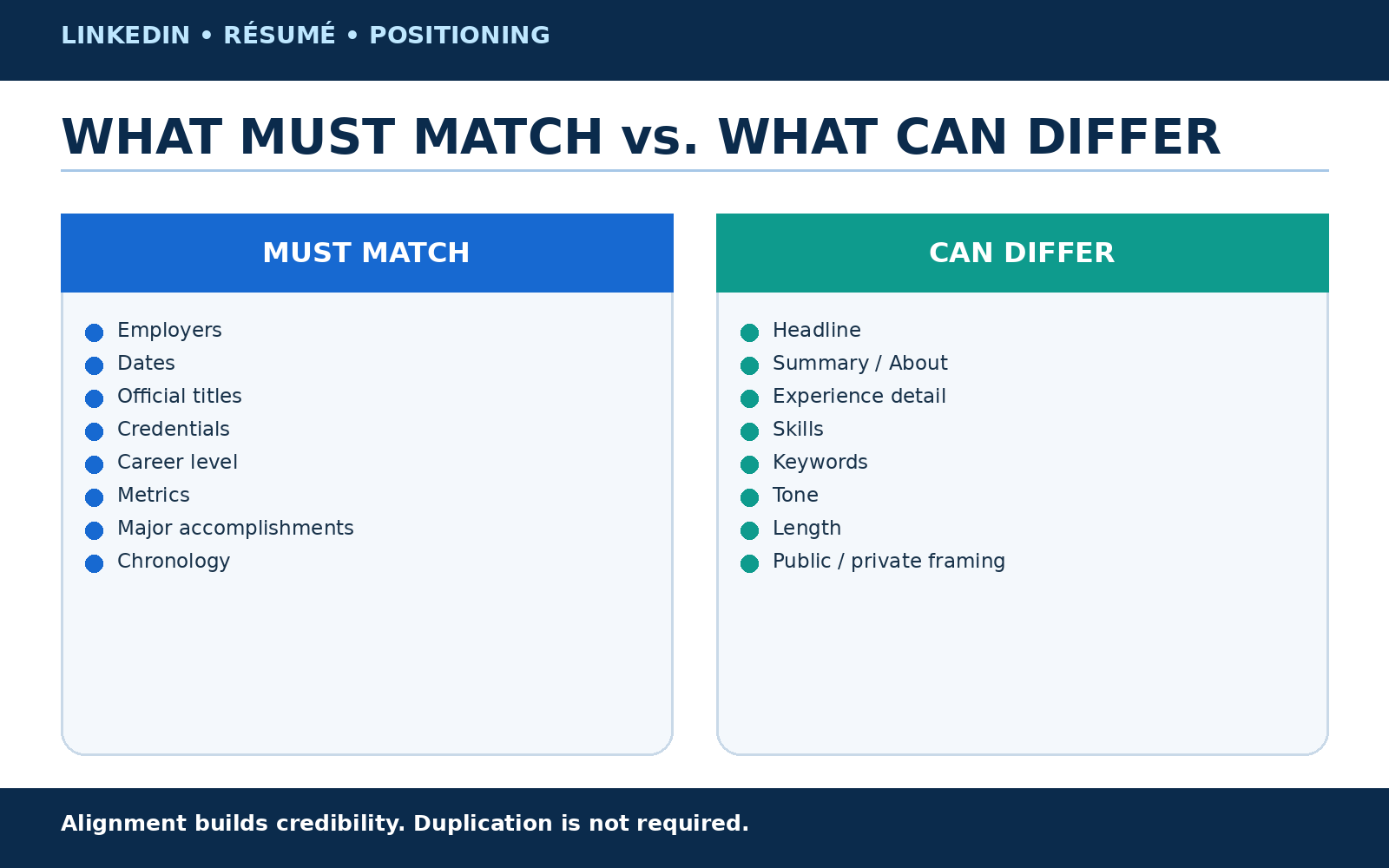
What Must Stay Consistent?
Several elements should usually remain aligned.
Employment dates
Major discrepancies create credibility questions.
Official job titles
Titles can sometimes be clarified with parenthetical context, but the official title should remain honest.
Employers
Organization names should remain consistent.
Credentials
Degrees, certifications, licenses, and qualifications should agree.
Career chronology
The sequence of roles should make sense across both documents.
Leadership level
The professional should not appear senior in one place and junior in another without a clear reason.
Metrics and accomplishments
The numbers should remain accurate and consistent.
Professional direction
The résumé can be narrower, but LinkedIn should not point toward a completely incompatible direction unless the professional is intentionally managing separate markets.
What Can Differ?
Several elements can differ legitimately.
Headline
LinkedIn can be broader and more discoverable.
Summary versus About section
The résumé summary can be more target-specific. LinkedIn can explain the broader career narrative.
Experience detail
The résumé may prioritize selected evidence. LinkedIn can preserve a wider range of responsibilities and outcomes.
Keywords
Each format can use language appropriate to its audience and search function.
Skills
LinkedIn can surface a larger set of relevant skills than the résumé needs to show.
Tone
The résumé is usually more compressed and formal. LinkedIn can sound more conversational while remaining professional.
Length
LinkedIn has room for context that would make a résumé too dense.
Consistency means alignment.
It does not mean duplication.
Career Changers Need an Especially Clear Through-Line
Career changers often create the greatest mismatch between résumé and LinkedIn.
The résumé may be rewritten for the new target.
LinkedIn may still reflect the old identity.
That creates friction.
The solution is not to erase the past.
The professional needs a bridge.
For example:
A customer-operations leader moving toward business operations may update the résumé to emphasize process improvement, cross-functional execution, analytics, implementation, and operating discipline.
LinkedIn can preserve the customer-operations history while also making the broader operations direction visible.
The Professional Passport can preserve the full underlying evidence and target intent.
The transition becomes easier to understand.
The market sees continuity rather than reinvention.
Executives Need Alignment Across More Than Two Documents
Senior leaders often have additional public and private materials:
Executive biography
Board profile
Leadership value brief
Speaking biography
Professional website
Media biography
Executive résumé
The same principle applies.
Dates, titles, enterprise scope, board history, metrics, credentials, and major achievements should agree.
Audience-specific framing can differ.
A board profile may emphasize governance, risk, capital allocation, and strategic oversight.
LinkedIn may emphasize executive leadership and public credibility.
The résumé may emphasize role fit and business outcomes.
The biography may explain the career arc.
The executive remains one person.
The portfolio tells one coherent story through several formats.
LinkedIn Development Should Begin With Evidence
MyTopMatch's current LinkedIn Profile Development workflow begins by reviewing the existing profile, résumé, or both.
It audits:
Headline
About
Experience
Skills
Evidence
Gaps
Then it develops coordinated role-relevant copy from confirmed evidence.
This is the correct order.
The goal is not simply to make the profile sound better.
The goal is to make the public signal more accurate, clear, and aligned with the next professional direction.
MyTopMatch also does not log in or publish changes on the member's behalf.
The professional controls the public profile.
That is especially important because LinkedIn is a visible identity layer.
A Practical Alignment Example
Consider a senior professional with the internal title:
Director, Client Service Operations
The person leads 80 employees across three sites, manages process-improvement initiatives, owns several operating metrics, works closely with technology and finance, and wants broader operations leadership.
The résumé headline becomes:
Director of Operations | Multi-Site Leadership | Process Improvement | Cross-Functional Execution
The résumé emphasizes:
Multi-site leadership
Process improvement
Operating metrics
Cross-functional programs
Business results
LinkedIn headline becomes:
Operations & Customer Experience Leader | Multi-Site Operations | Process Improvement | Cross-Functional Transformation
The About section explains that the professional has built a career at the intersection of operations, customer experience, transformation, and team leadership.
The LinkedIn experience section preserves the actual title:
Director, Client Service Operations
Then it explains the broader scope underneath the title.
The Professional Passport stores the broader capability and evidence record.
Nothing is fabricated.
The professional is easier to interpret.
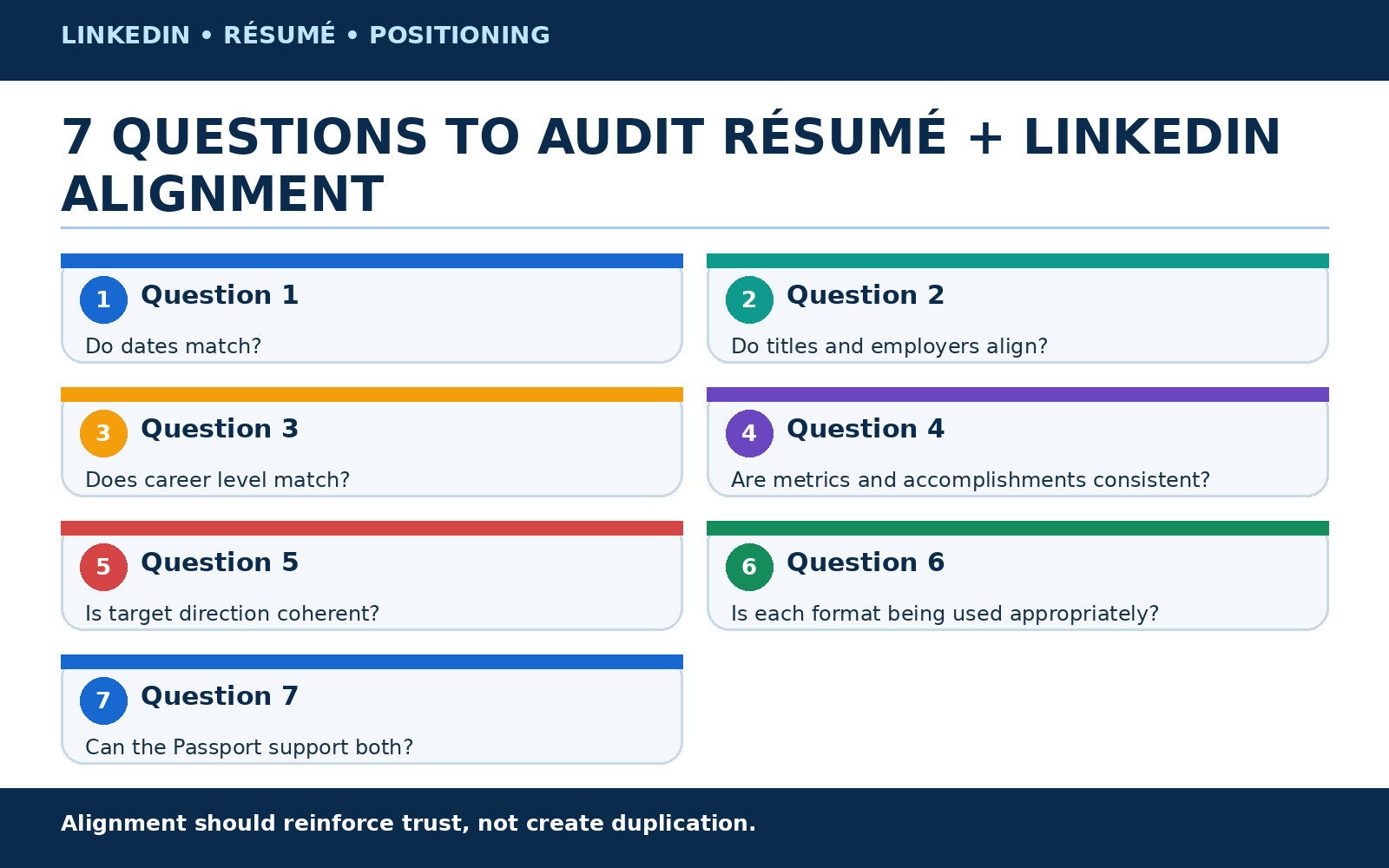
Seven Questions to Check Résumé and LinkedIn Alignment
1. Do the employment dates agree?
Fix factual discrepancies first.
2. Do the titles and employers match?
Clarify titles where necessary without changing the underlying fact.
3. Do both documents reflect the same career level?
Leadership scope should be recognizable across formats.
4. Do the major accomplishments and metrics agree?
Numbers should never drift between documents.
5. Does LinkedIn support the direction the résumé is targeting?
It can be broader, but the two should not compete.
6. Does each format use its space appropriately?
Avoid copying the résumé word for word into LinkedIn.
7. Does the Professional Passport support both?
Use the broader evidence record to confirm identity, capability, achievements, credentials, and direction.
Alignment Builds Credibility
Professional positioning becomes stronger when the major signals agree.
The résumé tells the employer why you fit the target.
LinkedIn tells the broader market who you are.
The Professional Passport preserves the private evidence and direction behind both.
They should work together.
The résumé can be selective.
LinkedIn can be broader.
The Professional Passport can be more complete.
The facts should remain stable.
The career level should remain credible.
The professional direction should make sense.
That is how consistency improves trust without forcing every document to become identical.
Align the evidence first.
Then let each format tell the same career story in the way its audience needs to hear it.