Insights / Career Intelligence Series
Why One Résumé Cannot Properly Target Every Opportunity
You do not need a full rewrite for every job. You need one confirmed evidence base, a strong role-family résumé, and selective retargeting when the opportunity materially changes what deserves emphasis.
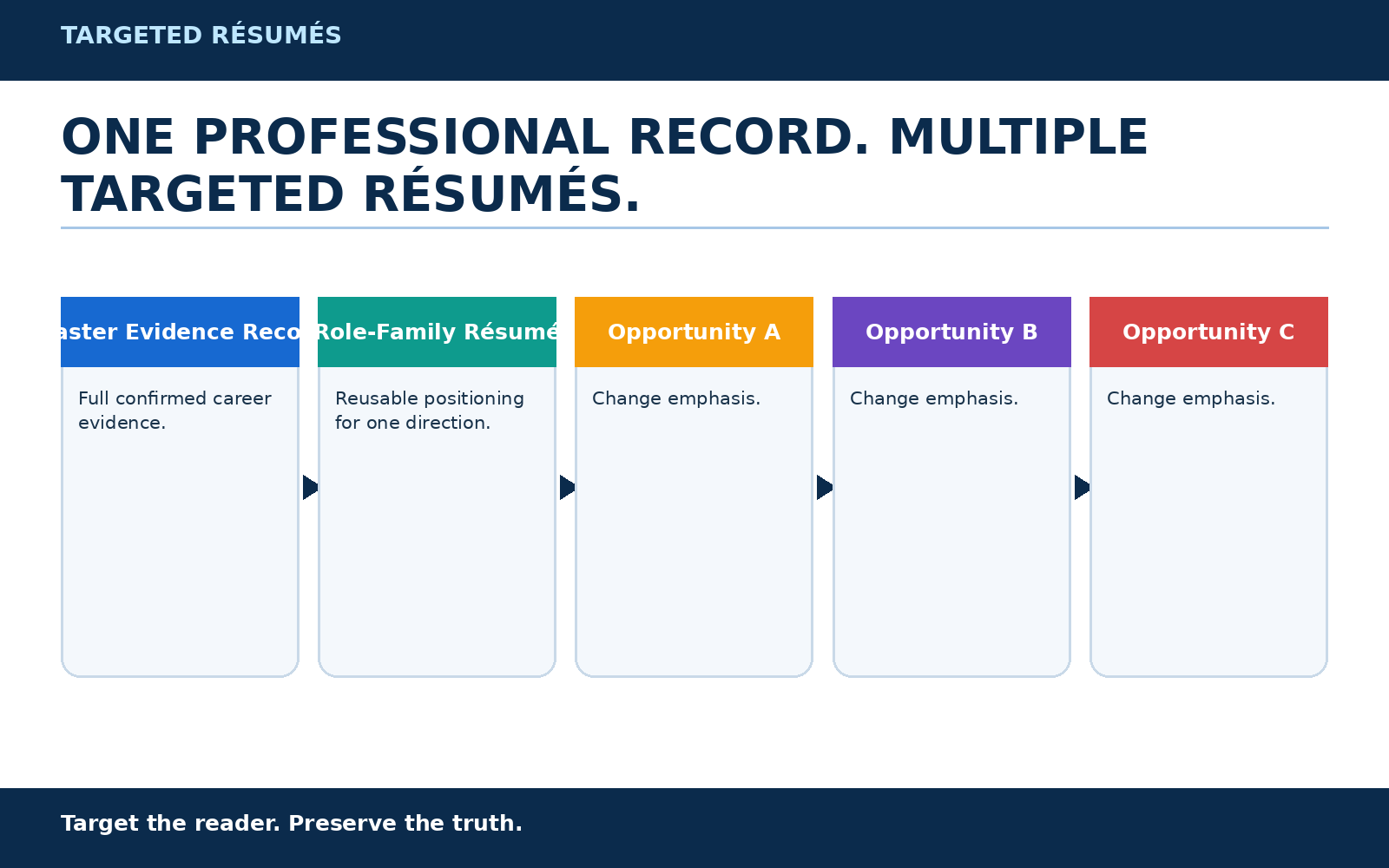
A single résumé can represent one professional truth.
It cannot give equal emphasis to every possible target.
That distinction matters because many professionals hear “tailor your résumé” and assume they must rebuild the document from scratch for every application. That is inefficient and often creates inconsistency.
The stronger approach is to maintain one confirmed professional evidence base, then retarget the document when a specific opportunity materially changes what the reader needs to see first.
The professional does not change.
The evidence does not change.
The emphasis can.
A Director of Operations role may need leadership scope, process improvement, multi-site responsibility, and financial impact near the top of the document.
A Customer Experience leadership role may draw from the same career history while giving greater prominence to service strategy, customer outcomes, team development, and cross-functional execution.
Both versions can be truthful.
They are answering different questions.
That is the purpose of résumé retargeting.
A Résumé Is a Selection, Not the Entire Career Record
A professional career contains more evidence than one résumé can carry comfortably.
The broader record may include roles, achievements, capabilities, credentials, projects, leadership scope, business results, industry knowledge, functional experience, career direction, work preferences, and private constraints.
A résumé selects the evidence that matters for a particular market purpose.
MyTopMatch’s Professional Passport is designed to preserve a broader private professional record. The résumé can then draw from that evidence without becoming a storage document for every career fact.
This makes targeting easier.
The professional keeps one source of truth.
Different résumé versions can emphasize different parts of that truth.
Targeting Changes the Emphasis, Not the Facts
Good retargeting is evidence-preserving.
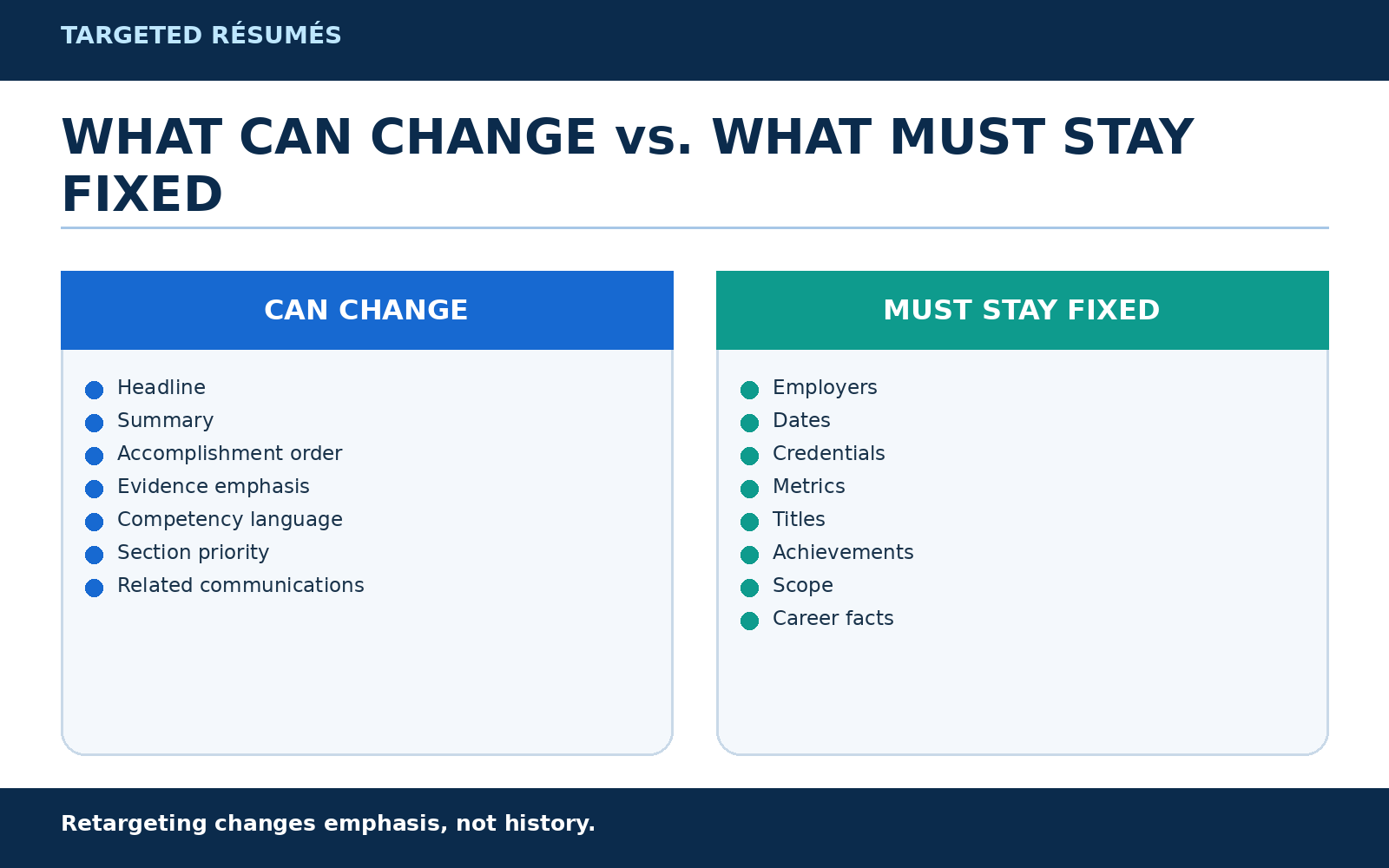
It can change the headline, summary, order of accomplishments, prominence of individual achievements, capability emphasis, market language, keyword emphasis, section priority, and related career communications.
It should preserve employers, dates, credentials, metrics, titles, accomplishments, scope, responsibilities, and other career facts.
This distinction protects credibility.
A targeted résumé should make the most relevant evidence easier to recognize.
It should never manufacture fit.
Career Fit and Résumé Representation Are Different
A professional can fit a role more strongly than the résumé suggests.
MyTopMatch’s current Targeted Résumé Alignment makes this distinction explicit by keeping broader TopMatch Career Fit separate from Résumé Representation.
Career Fit asks whether the professional’s broader evidence, direction, priorities, and constraints align with the opportunity.
Résumé Representation asks whether the current document visibly communicates the evidence that matters for that specific role.
Those two signals can diverge.
Consider a professional with strong evidence in operations leadership, multi-site responsibility, process improvement, budgeting, and executive communication.
The résumé may have been written several years ago for customer-service leadership.
A Director of Operations opportunity appears.
The professional’s broader evidence may support the role.
The résumé may still underrepresent the fit because it emphasizes customer-service language and buries operations evidence.
That is a representation problem.
Retargeting should surface the evidence that already exists.
One Base Résumé Can Support a Role Family
Retargeting does not mean every application needs a unique document.
Many opportunities are similar enough to share one strong base version.
A professional targeting closely related roles such as Director of Operations, Senior Operations Manager, Business Operations Director, and Regional Operations Leader may be able to use one primary operations résumé for much of the market.
The base document should already reflect the target level, core role family, professional value proposition, strongest recurring evidence, likely market language, and relevant career narrative.
Retargeting becomes more valuable when an opportunity differs meaningfully from that base.
The role may emphasize multi-site leadership more heavily.
The employer may require a specific industry capability.
The opportunity may place unusual weight on transformation.
The job description may highlight a technical requirement the professional can genuinely support.
The role may be adjacent rather than identical to the current target family.
The application may be high-stakes enough to justify opportunity-specific preparation.
This is a much more manageable system than rewriting the résumé for every posting.
Retargeting Should Start With a Real Opportunity
A résumé should be retargeted around a specific opportunity rather than a vague idea of a job.
MyTopMatch’s current Document Retargeting service is built around one verified opportunity.
That makes sense because the document needs something concrete to respond to.
Useful inputs can include the actual job description, employer, role level, stated responsibilities, required and preferred qualifications, work model, location, compensation information if visible, known concerns or unknowns, and the professional’s broader Career Fit.
The retargeting process can then ask:
Which existing evidence is most relevant?
Which requirements are already supported?
Which requirements are missing from the current résumé even though the evidence exists elsewhere?
Which requirements are genuinely unsupported?
Which terms should be reflected naturally?
What should move higher in the document?
What should receive less emphasis?
The opportunity creates the lens.
The professional evidence remains the source.
The First Step Is Diagnosis
Retargeting should not begin with keyword replacement.
Start by understanding the current résumé.
MyTopMatch’s Résumé Intelligence Review evaluates positioning, accomplishments, business impact, career narrative, relevance, keyword alignment, ATS readiness, structure, writing quality, career-level representation, and differentiation.
That diagnosis helps answer two different questions.
What is already strong?
What fails to represent the professional for this opportunity?
A résumé may already communicate leadership well.
There is no reason to rebuild that section simply because the job description uses slightly different wording.
Another section may be the real problem.
The document may bury a required capability.
The summary may point toward the wrong target.
The accomplishment hierarchy may not reflect the employer’s priorities.
Diagnosis keeps the retargeting focused.
Keyword Alignment Should Follow Evidence
Keywords matter because employers and recruiters use language to describe work.
The problem begins when professionals treat the job description as a word bank.
A posting may use terms such as operational excellence, transformation, cross-functional leadership, vendor management, continuous improvement, or data-driven decision making.
A professional should use those terms when the underlying evidence supports them.
If the professional led process-improvement initiatives across several functions, “operational excellence” may be a useful translation.
If the professional never owned vendor relationships, adding “vendor management” because the employer wants it would be misleading.
The goal is semantic alignment with real evidence.
Keyword targeting should help the market recognize the work.
It should never create work that did not happen.
ATS Readability Should Stay Stable Across Versions
Opportunity-specific retargeting should not destroy document readability.
A base résumé should already use ATS-conscious structure with recognizable headings, accessible text, clear chronology, consistent dates, readable formatting, appropriate section order, and target-relevant terminology.
Each retargeted version should preserve those qualities.
MyTopMatch’s ATS Readiness methodology is intentionally limited to characteristics associated with machine readability, structure, and recruiter searchability.
It does not claim to predict how one employer’s ATS will rank a document.
That is important.
Retargeting should improve relevance while preserving readability.
It should not become an attempt to reverse-engineer an invisible algorithm.
Different Opportunities May Need Different Evidence Hierarchies
A résumé is partly an exercise in priority.
The same achievement can matter differently depending on the target.
Imagine an operations leader who reduced operating costs by 18 percent, expanded a customer-support team from 25 to 60, led implementation of a new CRM, managed three regional sites, reduced service response time by 30 percent, and built executive dashboards.
For a Director of Operations role, cost reduction, multi-site responsibility, systems implementation, and executive reporting may lead.
For a Customer Experience Director role, team scaling, response-time improvement, CRM implementation, and customer operations may lead.
The facts stay the same.
The evidence hierarchy changes.
That is one of the most legitimate forms of tailoring.
The reader sees the parts of the professional record that matter most to the opportunity.
Adjacent Career Moves Need More Translation
Retargeting becomes especially important when the professional is moving into an adjacent role family.
Examples include Customer Operations to Business Operations, Recruiting to Talent Strategy, Project Management to Program Management, Finance to Business Operations, or Consulting to Corporate Strategy.
The transition may require translation.
The résumé should help the reader see which capabilities transfer, which evidence supports the transfer, which outcomes are relevant, which gaps remain, and why the move is credible.
This is different from forcing the résumé to imitate the target job description.
The professional still needs a coherent story.
The document should explain the bridge.
When Retargeting Is Not Enough
Some opportunities reveal a deeper issue.
A targeted résumé cannot solve a missing required license, a capability the professional has never developed, a major career-level scope gap, a role that conflicts with the professional’s direction, a compensation or location dealbreaker, a weak overall career fit, or a target that requires substantially different experience.
In those cases, the broader career decision needs attention before document retargeting deserves more time.
This is another reason MyTopMatch keeps Career Fit and Résumé Representation separate.
A stronger document cannot turn a weak opportunity into a strong one.
Too Much Tailoring Can Create Identity Drift
Over-tailoring creates its own problems.
If every résumé version uses a completely different identity, the professional may begin to look inconsistent.
One version says operations leader.
Another says customer-experience executive.
Another says transformation strategist.
Another says program-management specialist.
Those directions may all contain some truth.
The market still needs a coherent professional identity.
A good retargeting system therefore preserves a stable foundation: core professional identity, career level, confirmed evidence, major accomplishments, chronology, credentials, and primary direction.
The opportunity-specific version adjusts emphasis around that foundation.
The professional should still sound like the same person.
A Three-Level Résumé System Is Easier to Manage
Professionals can simplify targeting by thinking in three levels.
Level 1: Master evidence record.
This is the broad professional source of truth. It includes the strongest confirmed experience, achievements, metrics, credentials, scope, and capabilities. The Professional Passport can serve this role privately.
Level 2: Role-family résumé.
This is the primary résumé for a target direction such as operations leadership, product management, finance leadership, or talent strategy. It reflects the recurring expectations of that role family.
Level 3: Opportunity-specific retargeting.
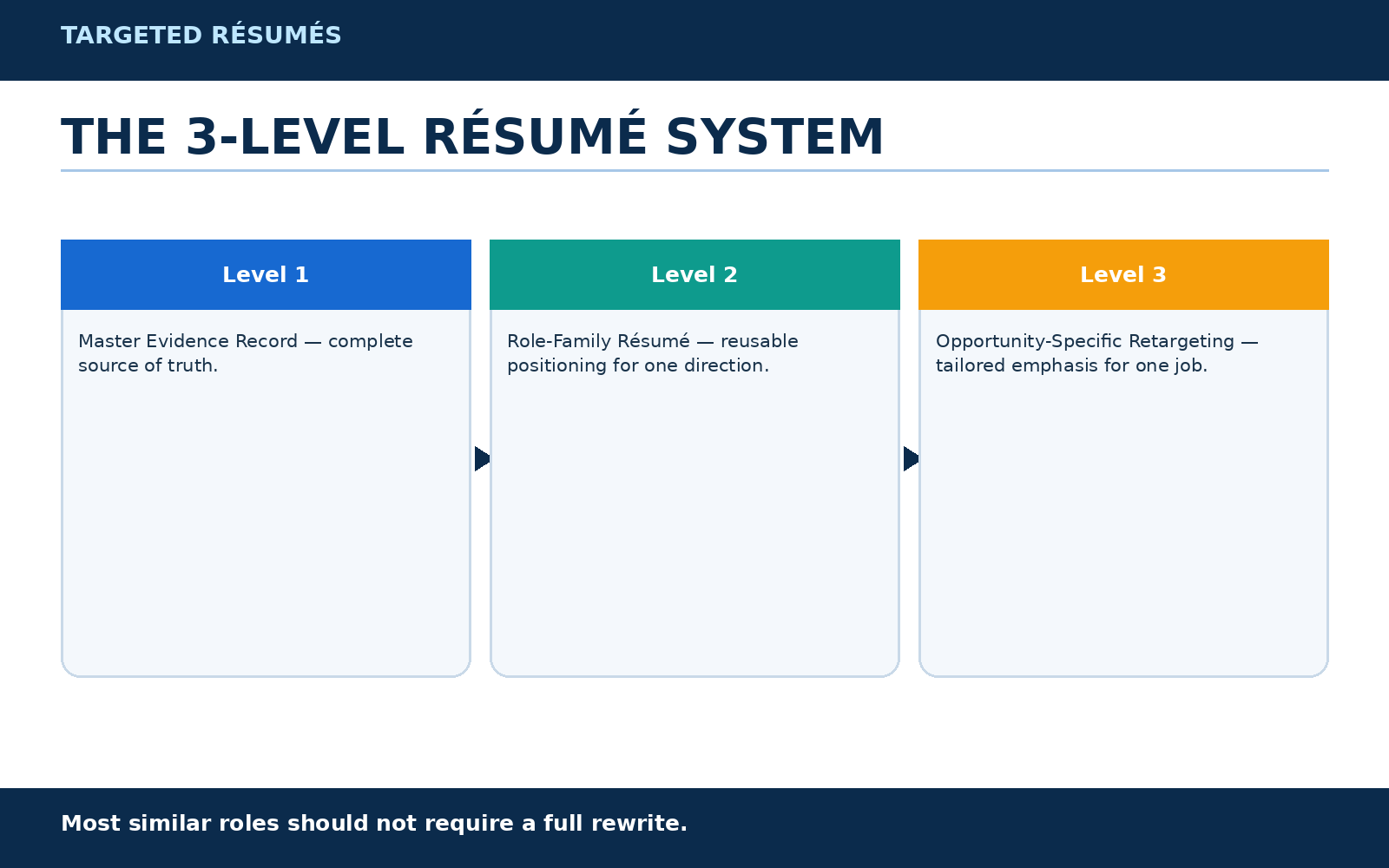
This version adjusts emphasis for one verified opportunity when the role materially differs from the role-family base or is important enough to justify deeper preparation.
This structure reduces unnecessary rewriting.
It also protects consistency.
What Document Retargeting Should Produce
A strong opportunity-specific retargeting process should produce a document that is more relevant to the target, factually identical to the source record, clearer about the evidence that supports the role, honest about what is missing, readable by people and machines, consistent with the professional’s broader identity, and connected to the actual opportunity.
MyTopMatch’s current Document Retargeting model also connects the résumé to a broader communications portfolio for the verified opportunity.
That can include related application and follow-up materials using the same confirmed evidence base.
The benefit is consistency.
The résumé, cover communication, recruiter message, and interview preparation should not describe different versions of the professional.
A Practical Example
Consider a senior operations professional applying to two opportunities.
Opportunity A is Director of Operations for a multi-site service organization. The role emphasizes multi-site leadership, cost control, process improvement, workforce management, and executive reporting.
Opportunity B is Director of Customer Experience Operations for a technology company. The role emphasizes customer operations, service quality, team scaling, CRM systems, and cross-functional customer strategy.
The professional’s master evidence includes all of these capabilities.
The base operations résumé can support both roles.
The retargeted version for Opportunity A might lead with multi-site scope, cost reduction, operational process improvement, workforce leadership, and executive dashboards.
The retargeted version for Opportunity B might lead with customer operations leadership, team scaling, service improvement, CRM implementation, and cross-functional customer work.
The employment history remains the same.
The accomplishments remain the same.
The hierarchy and translation change.
That is strategic retargeting.
Seven Questions Before You Retarget a Résumé
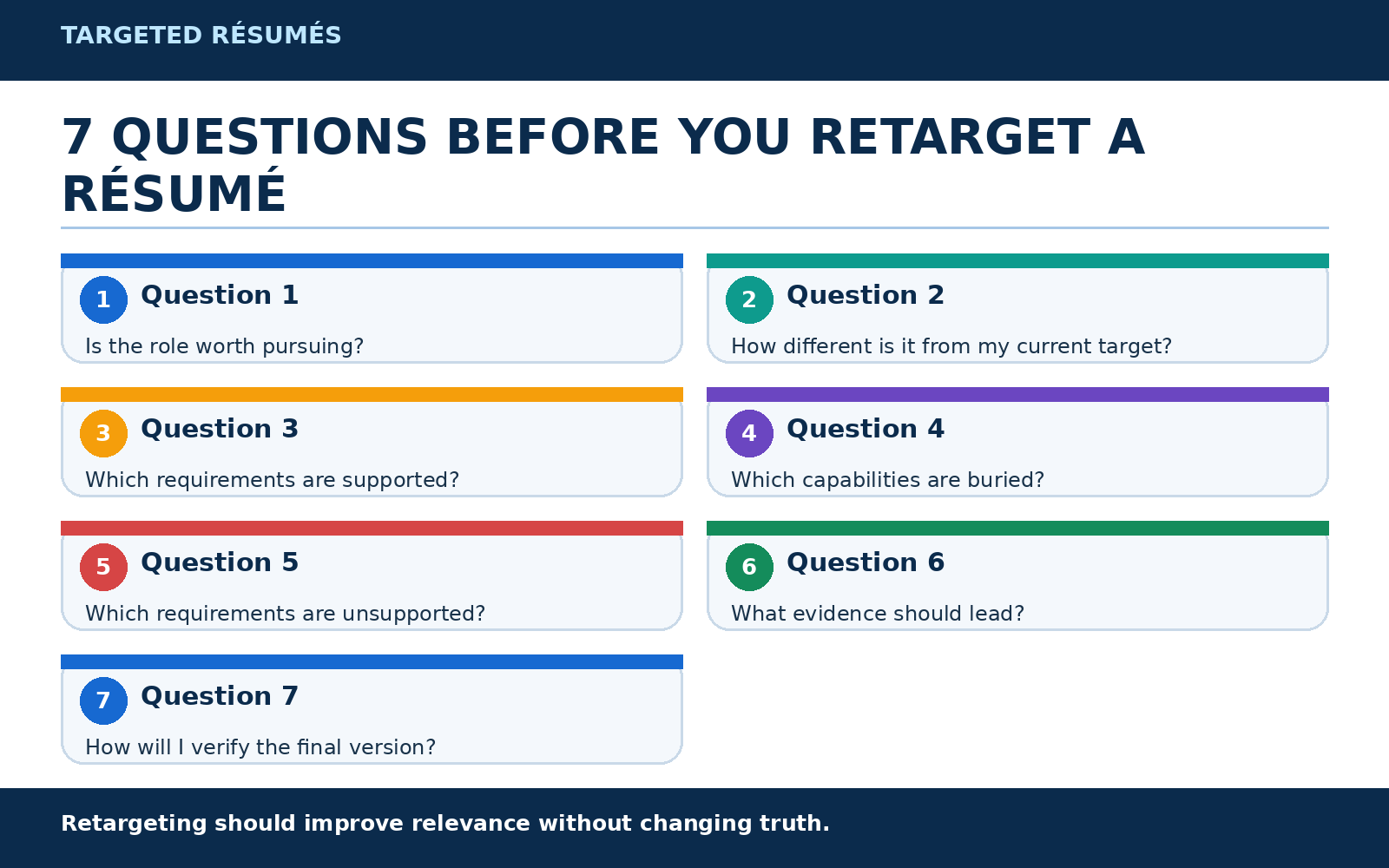
1. Is this opportunity genuinely worth pursuing?
Confirm broader fit before spending time on the document.
2. How different is this role from my current role-family résumé?
Small differences may not require a separate version.
3. Which requirements are already supported by my evidence?
Identify the strongest proof first.
4. Which supported capabilities are missing or buried in the current résumé?
Those become retargeting priorities.
5. Which requirements are genuinely unsupported?
Leave them unsupported. Do not manufacture fit.
6. What should change in the evidence hierarchy?
Decide what should move higher, receive more space, or use clearer target-market language.
7. How will I verify the final version?
Confirm facts, ATS-conscious readability, career-level representation, target alignment, and consistency with the broader professional record.
One Professional Record. Several Targeted Documents.
A résumé should be consistent.
It does not have to be identical for every opportunity.
The strongest system preserves one confirmed professional record and uses it to build documents for different decision contexts.
A strong role-family résumé handles much of the market.
Opportunity-specific retargeting is valuable when the target materially changes the evidence that should be emphasized.
The facts stay fixed.
The hierarchy changes.
The language becomes easier for the target reader to interpret.
The professional identity stays coherent.
That is how résumé targeting can become strategic without turning every application into a complete rewrite.
Start with one confirmed evidence base, maintain a strong résumé for your primary role family, and retarget only when the opportunity gives you a clear reason to change what the reader should see first.