Insights / Career Intelligence Series
When AI Résumé Tools Are Enough—and When Expert Résumé Development Adds Value
AI can diagnose, compare, draft, and generate strong résumé content when the target and evidence are clear. Expert development adds value when the problem requires discovery, judgment, strategic challenge, or complex positioning.
AI résumé tools can solve real problems.
They can also reach a point where the professional needs judgment rather than more automation.
The useful question is not whether AI or a professional résumé writer is “better.”
The useful question is:
What level of help does this résumé problem actually require?
A professional with a clear target, strong evidence, a coherent career history, and a fundamentally sound document may need diagnosis, targeted revisions, or an automated résumé build.
Another professional may be changing careers, pursuing executive roles, struggling to explain complex scope, carrying several conflicting targets, or missing the evidence needed to support the next move.
Those situations require different levels of intervention.
The smartest résumé decision is usually the smallest level of support that can credibly solve the problem.
Start With the Problem, Not the Tool
Résumé support exists on a spectrum.
At one end, a professional can work independently with a résumé diagnostic or AI-assisted review.
At the other end, the professional may need a credentialed expert to interview them, uncover evidence, challenge the target, rebuild the narrative, and create several coordinated documents.
Between those points are useful middle options.
The right choice depends on the problem.
Ask:
Is the target clear?
Is the current résumé fundamentally sound?
Is the evidence already available?
Does the document represent the correct career level?
Is the career story easy to understand?
Does the move require translation across industries or functions?
Can I judge whether generated language is accurate?
How important is this opportunity?
The answers tell you more than the label on the tool.
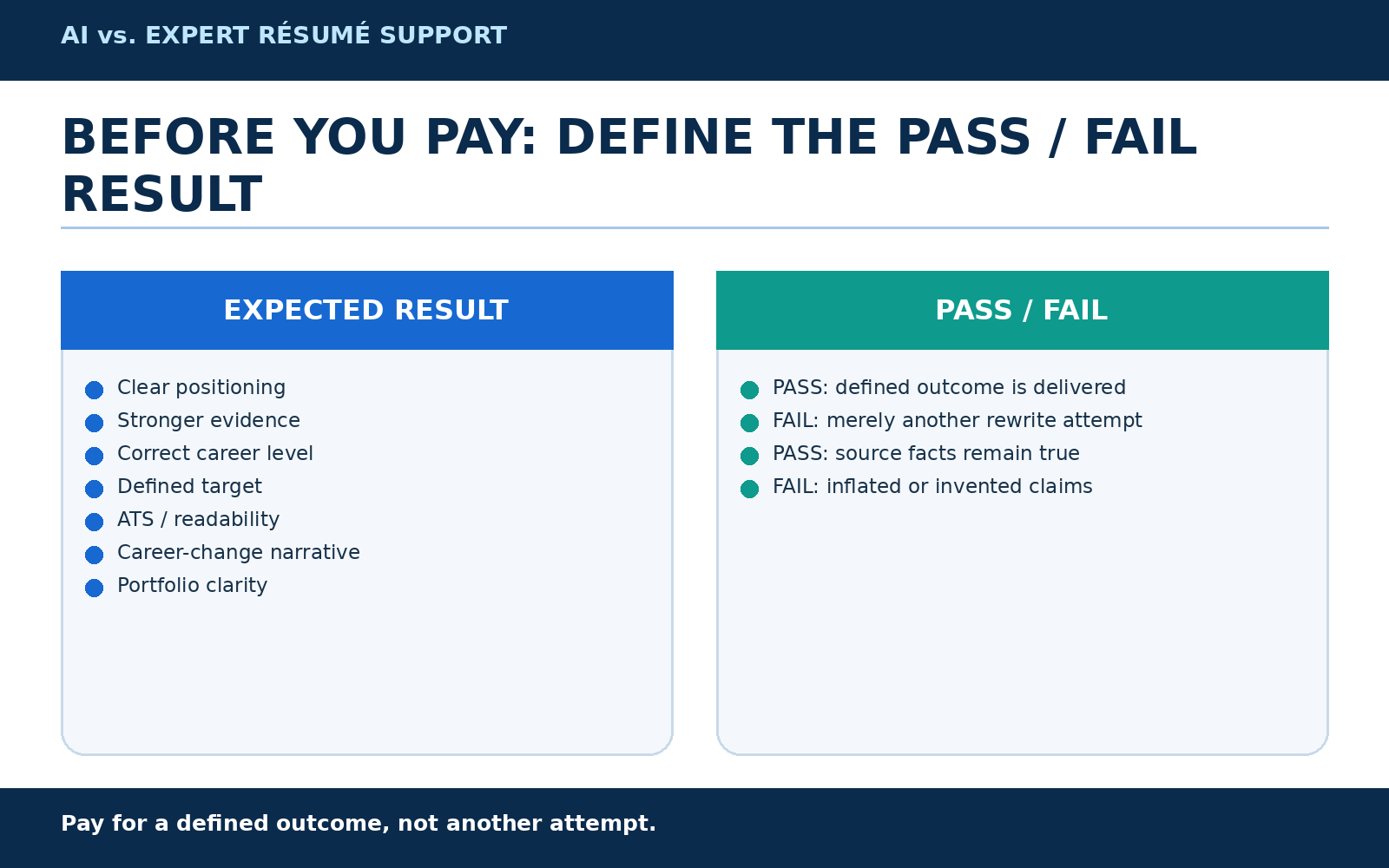
When AI Résumé Tools Can Be Enough
AI tools can be highly useful when the professional already understands the target and the evidence is reasonably complete.
Several situations are especially well suited to self-service support.
The résumé is already structurally sound
If the document has clear chronology, readable formatting, appropriate length, and a coherent professional identity, the highest-value changes may be focused.
AI can help identify:
Weak accomplishments
Missing metrics
Generic language
Keyword gaps
ATS-readability issues
Redundant content
Unclear summaries
Sections that deserve more or less emphasis
The professional can then make targeted corrections.
MyTopMatch’s current Résumé Intelligence Review is designed for this type of diagnosis. It evaluates the document across twelve defined dimensions, ties conclusions to evidence already present, and asks questions when stronger information may exist.
That type of tool can be enough when the professional needs clarity more than reconstruction.
The target role is clear
AI works better when the question is specific.
“Improve my résumé” is vague.
“Compare this résumé with a Director of Operations role and show me which supported capabilities are underrepresented” is much more useful.
MyTopMatch’s current Targeted Résumé Alignment follows that logic.
It compares the existing document with a supplied opportunity after the broader résumé review, while keeping Career Fit separate from Résumé Representation.
That gives the professional a concrete editing problem.
The document may need better representation.
The career itself does not have to be reinvented.
The professional can evaluate the output critically
AI-generated résumé language still needs human review.
A professional who knows the career history well can often identify:
Inflated wording
Incorrect assumptions
Unsupported metrics
Wrong emphasis
Generic language
Terms that do not sound authentic
Claims that exceed the actual scope
That makes self-service work safer.
The tool can accelerate drafting.
The professional remains the quality-control layer.
The career path is relatively straightforward
A professional moving from one operations-management role to a similar operations-management role may not need deep narrative reconstruction.
The résumé can often be improved through:
Stronger accomplishment language
Better evidence hierarchy
More relevant terminology
Cleaner positioning
Targeted retargeting
Improved ATS/readability structure
AI or automated document generation can handle much of that work when the evidence is already clear.
Automated Résumé Generation Can Also Be Enough
Diagnosis and generation are different.
A résumé-analysis tool tells you what the document communicates.
An automated résumé-generation tool creates a new document from confirmed information.
That can be enough when:
The professional has a clear target
The underlying record is complete
The experience is easy to interpret
The career level is straightforward
The professional wants a clean, competent document
The professional can review and revise the result
MyTopMatch currently offers automated professional résumé formats from one confirmed evidence base.
That is useful for professionals who need an efficient document build and do not require substantial evidence discovery or complex positioning work.
The strongest use case is clarity plus complete input.
When the source information is strong, automation has more to work with.
Human Expert Review Is a Useful Middle Step
The choice does not have to jump directly from AI to a full expert rewrite.
A human expert review can be the right intermediate option.
MyTopMatch currently offers Human Expert Review for documents, interviews, executive positioning, and negotiation.
Ivy League Résumés also offers a Digital Résumé Audit for professionals who want prioritized written feedback before investing in a rewrite.
This middle step is useful when the professional wants to know:
Is the AI diagnosis right?
Am I targeting the correct roles?
Is the document underrepresenting my level?
Does the résumé need editing or rebuilding?
Are my accomplishments strong enough?
Is the problem the résumé or the target?
Would professional writing materially improve the result?
The answer may be:
Keep the résumé and make several focused changes.
That can save money.
The answer may also be:
The document needs a complete strategic rebuild.
In that case, the expert review creates a better reason to invest.
When Expert Résumé Development Adds More Value
Expert work becomes more valuable as the problem becomes less mechanical and more interpretive.
The target is unclear
A résumé cannot be positioned well when the professional is trying to pursue several incompatible directions at once.
For example:
Operations leadership
Project management
Customer experience
Consulting
Chief of Staff
Business development
One résumé may become too broad to communicate any of those directions strongly.
An expert can help determine which target is credible, which evidence supports it, and whether separate role-family documents are needed.
The problem is strategic before it is editorial.
The career story is complex
Some careers require explanation.
Examples include:
Career changes
Industry transitions
Multiple short tenures
Consulting periods
Entrepreneurship
Return to work
Major promotions
Demotions or resets
International moves
Military-to-civilian transitions
Portfolio careers
Long gaps
Mergers or acquisitions that changed company names
Several simultaneous roles
An AI tool can reorganize text.
The harder question is how the reader should interpret the career.
That requires judgment.
The professional is underrepresented at the current level
Senior and executive professionals often have responsibilities that are difficult to capture through generic prompts.
The résumé may need to show:
Enterprise scope
Decision authority
P&L or budget responsibility
Transformation
Organizational complexity
Stakeholder influence
Board exposure
M&A
Risk
Turnaround
Succession
Leadership across functions or geographies
An expert can probe for evidence the professional has stopped noticing because it feels routine.
That evidence discovery can be more valuable than the writing itself.
The professional does not know which evidence matters
Many people describe responsibilities because they do not know which results should lead.
An expert can ask:
What changed because you were there?
What did you inherit?
What did you fix?
What scale was involved?
What did you own?
What decisions did you make?
What resistance did you overcome?
What measurable result followed?
What does this prove about your level?
The conversation can surface evidence that an automated tool cannot extract because it was never written down.
The résumé is for a high-stakes move
The cost of a weak document rises when the opportunity matters more.
Examples include:
Executive search
Board-related positioning
A major promotion
A career change with compensation risk
A highly selective employer
A confidential search
A return after a long absence
A role representing a substantial increase in scope
In those situations, professional judgment may justify the added cost.
The document is part of a larger career-positioning system.
The professional needs challenge, not just assistance
AI often works with the assumptions it is given.
An expert can challenge them.
You may believe the problem is formatting.
The real problem may be an unrealistic target.
You may believe the résumé needs more keywords.
The real problem may be missing evidence.
You may believe the current title is hurting you.
The real problem may be weak career-level representation.
You may believe you need a certification.
The real problem may be positioning.
The value of expert work can come from correcting the diagnosis before rewriting the document.
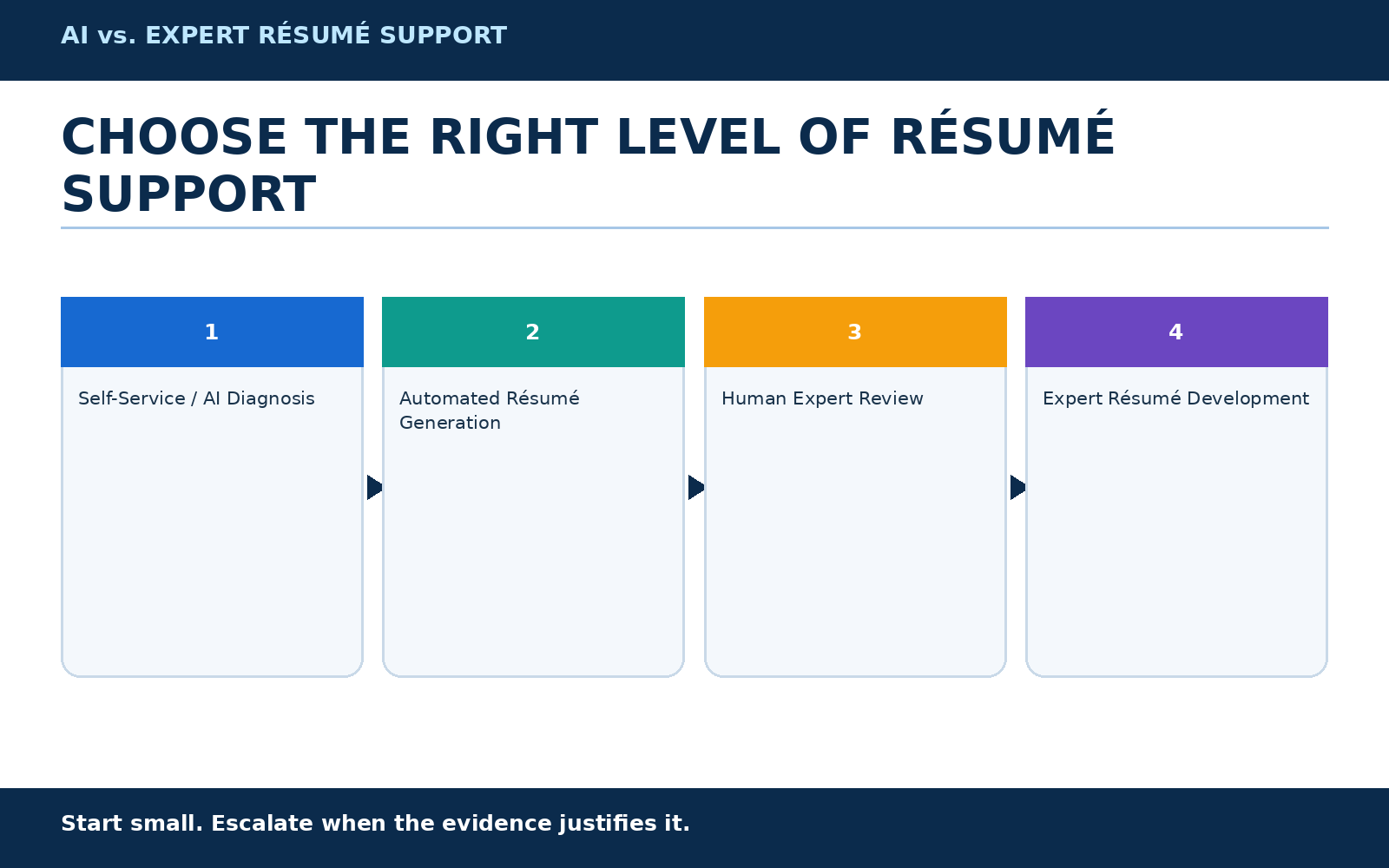
Four Levels of Résumé Support
A useful way to choose support is to think in four levels.
Level 1: Self-service diagnosis
Best when the professional has a strong source document and wants to understand what to improve.
Typical tools:
Résumé Intelligence
ATS/readability review
Target comparison
Keyword review
Fact-preserving rewrite examples
Level 2: Automated document generation
Best when the target and evidence are clear and the professional wants a clean résumé built efficiently from confirmed information.
The professional still reviews every claim.
Level 3: Human expert review
Best when the professional needs judgment about the target, document quality, career level, evidence gaps, or whether a rewrite is worth buying.
This can function as a lower-cost diagnostic before a larger engagement.
Level 4: Expert résumé development
Best when the résumé requires evidence discovery, career-positioning strategy, complex narrative work, senior/executive judgment, or a coordinated document portfolio.
The work can include discovery, positioning, writing, revisions, and related communications depending on the service scope.
The support level should match the complexity.
When Paying for Expert Help May Be Unnecessary
Expert writing is not automatically the best economic choice.
A full professional engagement may be unnecessary when:
The résumé is already strong
The target is clear
The career path is straightforward
The document only needs several focused changes
The professional writes well
The evidence is complete
The professional can evaluate AI output accurately
The stakes are modest
The application volume is high and role differences are small
In those cases, start smaller.
Run the diagnosis.
Make the changes.
Retarget only when needed.
Escalate if the document problem remains unresolved.
This protects money and time.
When Repeated AI Attempts Stop Making Sense
The opposite mistake also occurs.
A professional can spend hours regenerating the same résumé because each version feels slightly wrong.
That is a signal.
If repeated AI attempts produce:
Generic language
Conflicting positioning
Unclear career level
Overstated claims
Weak executive narrative
Different identities in every version
No improvement in the underlying evidence
No clarity about the target
the next step should not simply be another prompt.
The likely problem needs to be identified.
A human review can determine whether the issue is the source evidence, target, positioning, scope, or document architecture.
Another automated attempt should follow only when there is new evidence about why the previous attempt failed.
That is a more disciplined use of both time and money.
Define the Expected Result Before You Pay
Before purchasing any résumé service, define what the service is supposed to improve.
Possible outcomes include:
Clarify professional positioning
Strengthen accomplishment evidence
Improve career-level representation
Create a targeted résumé
Build an executive narrative
Improve ATS-conscious readability
Resolve a career-change story
Create several coordinated document formats
Identify missing evidence
Validate whether a full rewrite is necessary
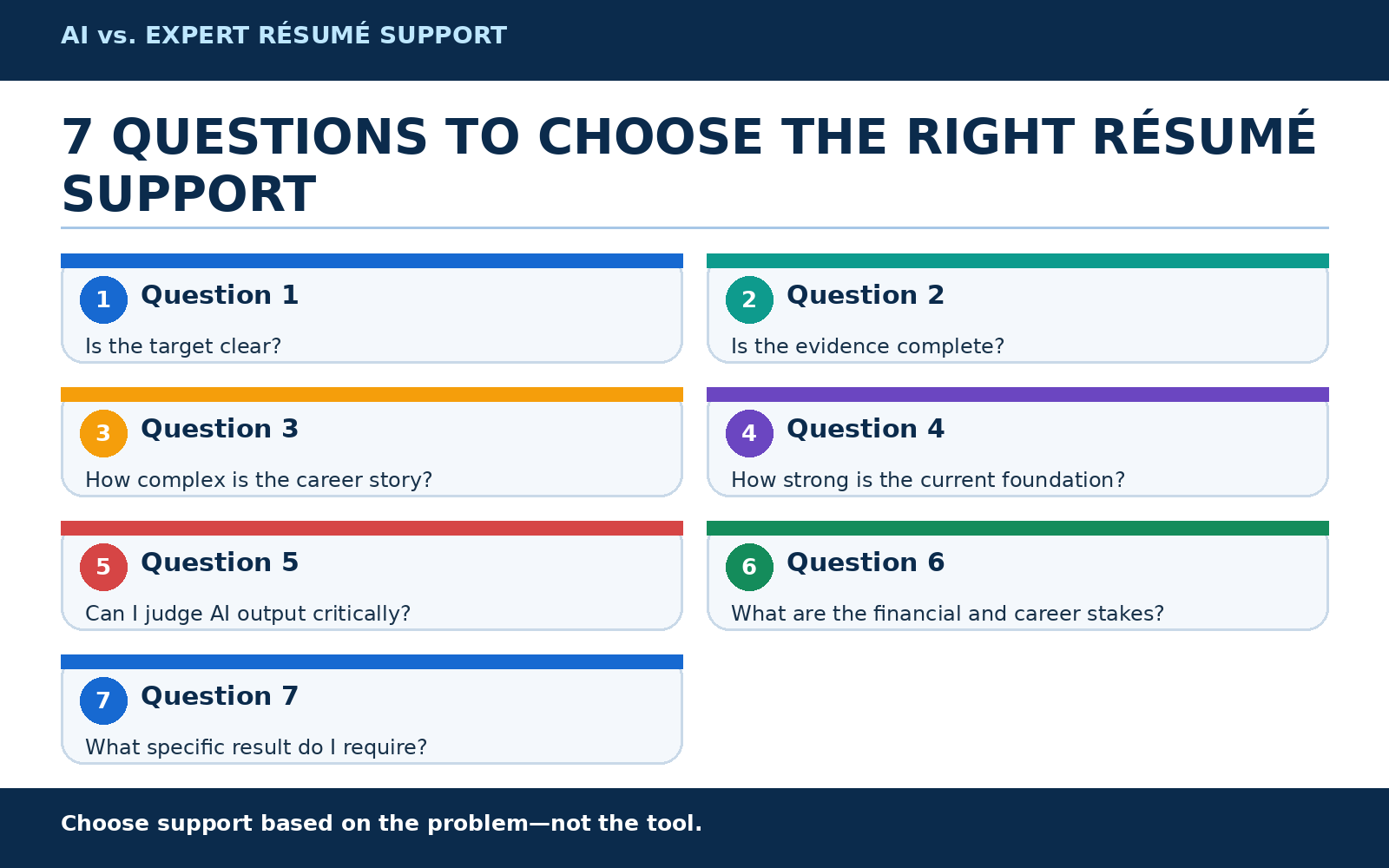
Then define the pass condition.
For example:
PASS: I can clearly explain my target and the résumé now supports it.
PASS: The document shows the leadership scope that was previously buried.
PASS: The expert identifies missing evidence and the final résumé includes confirmed proof.
PASS: The career-change narrative connects my prior experience to the target without inventing fit.
FAIL: The new résumé mainly changes adjectives and formatting.
FAIL: I still cannot explain the target.
FAIL: The document contains claims I cannot defend in an interview.
FAIL: The service does not address the problem identified in the diagnosis.
That creates accountability.
It also makes price comparisons more meaningful.
Price Should Be Compared With Scope
Résumé services can look similar while offering very different levels of work.
A self-service AI review may cost very little.
An automated résumé build may cost more.
A human audit may add professional judgment.
A customized writing engagement may include:
Discovery
Target clarification
Evidence gathering
Positioning
Writing
Several résumé formats
Cover communication
Recruiter outreach
Thank-you communication
Negotiation materials
Revisions
Direct access to the writer
The prices should not be compared as if the products are identical.
Compare the work.
Compare the decision problem being solved.
Ivy League Résumés currently offers several levels of support, including a Digital Résumé Audit, Resume Wizard, and direct customized résumé services.
MyTopMatch similarly separates automated Résumé Intelligence, automated professional résumé formats, Human Expert Review, and specialist Expert Résumé Development.
A Practical Decision Example
Consider two professionals.
Professional A
Seven years of experience
Clear target: Senior Financial Analyst
Strong metrics
Stable career progression
Current résumé is readable
Needs stronger accomplishments and better target alignment
A sensible path may be:
Résumé Intelligence
Targeted comparison
Automated or self-directed revision
Final human review only if uncertainty remains
Professional B
Fifteen years of experience
Moving from operations into Chief of Staff roles
Several promotions inside one company
Title understates enterprise scope
Strong leadership experience is poorly documented
Needs executive-level positioning and a new narrative
A sensible path may be:
Human expert review
Target and evidence discovery
Expert résumé development
LinkedIn alignment
Opportunity-specific retargeting later
The difference is not intelligence.
The difference is complexity.
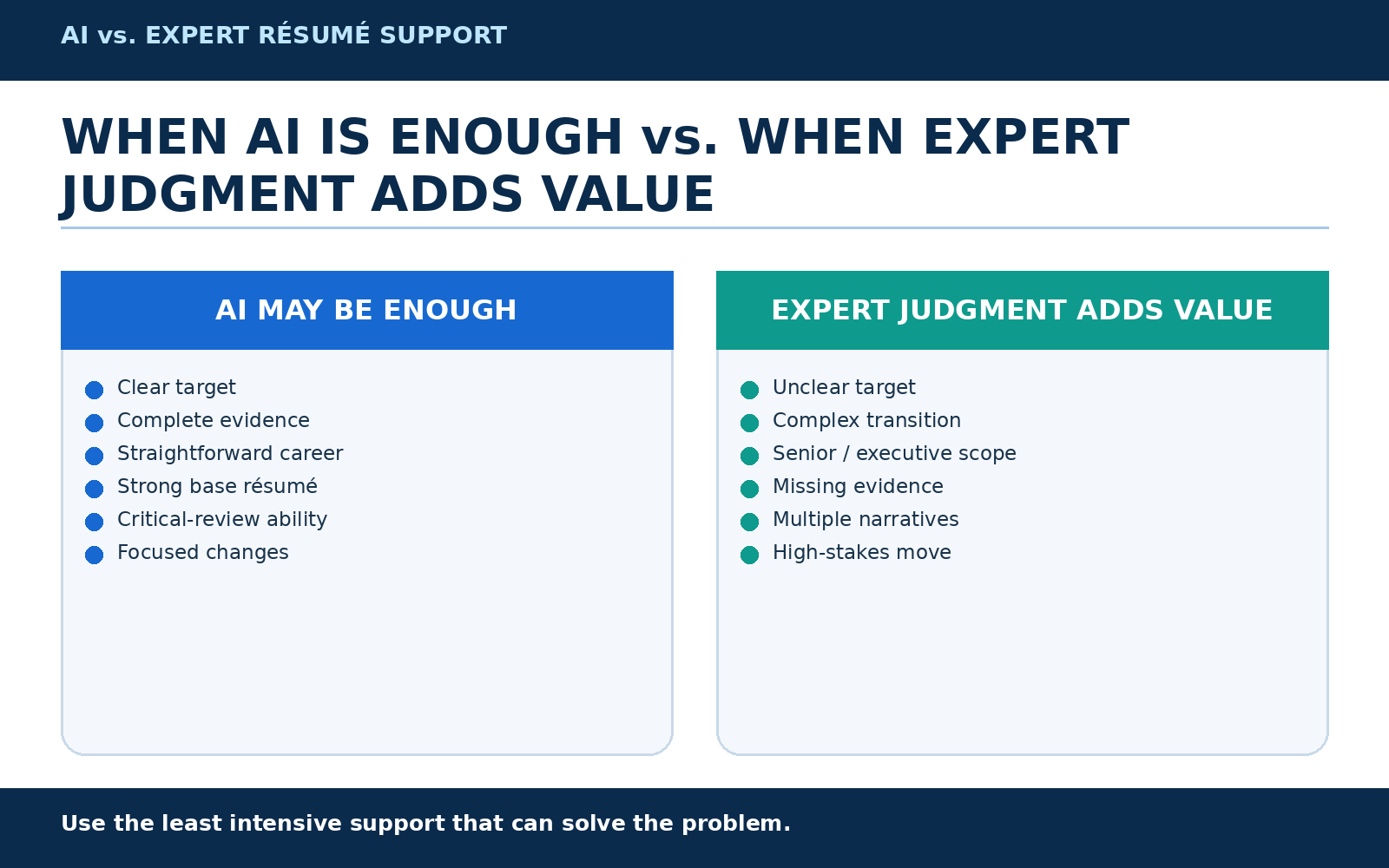
Seven Questions to Choose the Right Résumé Support
1. Is my target clear?
If the target is unclear, solving that may matter more than rewriting.
2. Is my evidence complete?
AI can only use the evidence available to it.
3. Is my career story straightforward?
Complex transitions often benefit from human interpretation.
4. Does my current résumé already have a strong foundation?
If yes, focused improvement may be enough.
5. Can I judge AI output critically?
You need to recognize unsupported claims, weak positioning, and generic language.
6. What is the financial and career value of this move?
Higher-stakes decisions may justify deeper expert involvement.
7. What specific result should the service produce?
Define success before buying.
Use Technology for Leverage. Use Expertise for Judgment.
AI résumé tools can be enough.
They are especially useful for diagnosis, structured improvement, targeted comparison, drafting, and efficient document generation when the professional has a clear target and strong evidence.
Expert résumé development adds value when the problem requires discovery, interpretation, challenge, strategic positioning, narrative judgment, or high-stakes quality control.
Human expert review provides a useful middle option when the professional is unsure which level is necessary.
Start with the least expensive intervention that can credibly solve the problem.
Escalate when the evidence shows the problem is deeper.
The goal is not to buy the most résumé help.
The goal is to buy the right help for the career decision in front of you.