AI Did Not Create a Secret Club for AI-Written Résumés. It Raised the Standard.
Why one narrow hiring study became a misleading viral claim, what AI actually changed, and why professional résumé strategy matters more than ever.
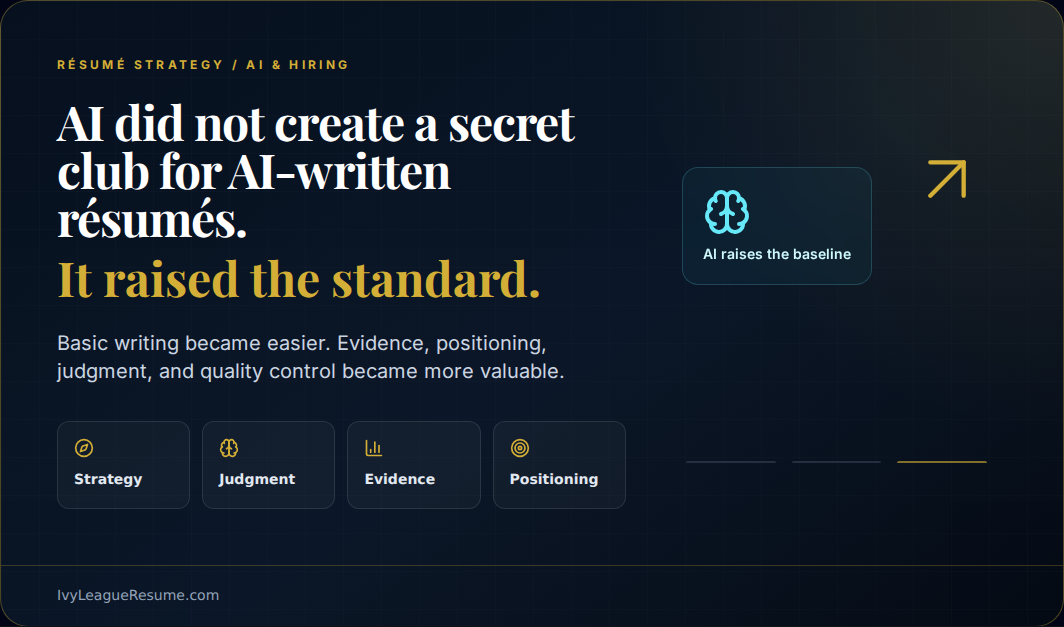
A new hiring headline is spreading quickly:
AI hiring systems prefer AI-written résumés.
The headline is simple, dramatic, and useful for engagement.
It is also much stronger than the evidence allows.
A research paper found that several large language models favored résumé summaries produced by the same model when those models were placed inside a controlled evaluation. That finding is worth examining. It is not proof that real employers have created an AI-only entrance requirement. It does not establish that production applicant-tracking systems are broadly rejecting human-written résumés because they do not sound artificial enough.
The more important change is easier to understand.
AI raised the quality floor.
Before generative AI, weak self-written résumés were already losing interviews. They were unclear, generic, poorly targeted, responsibility-heavy, achievement-light, and unable to communicate professional value. AI did not create that problem. It made competent baseline writing faster and more accessible, which raised the level against which every application is now compared.
That does not make professional résumé strategy less valuable.
It makes the right expertise more valuable.
A Data Point Is Not a Labor-Market Law
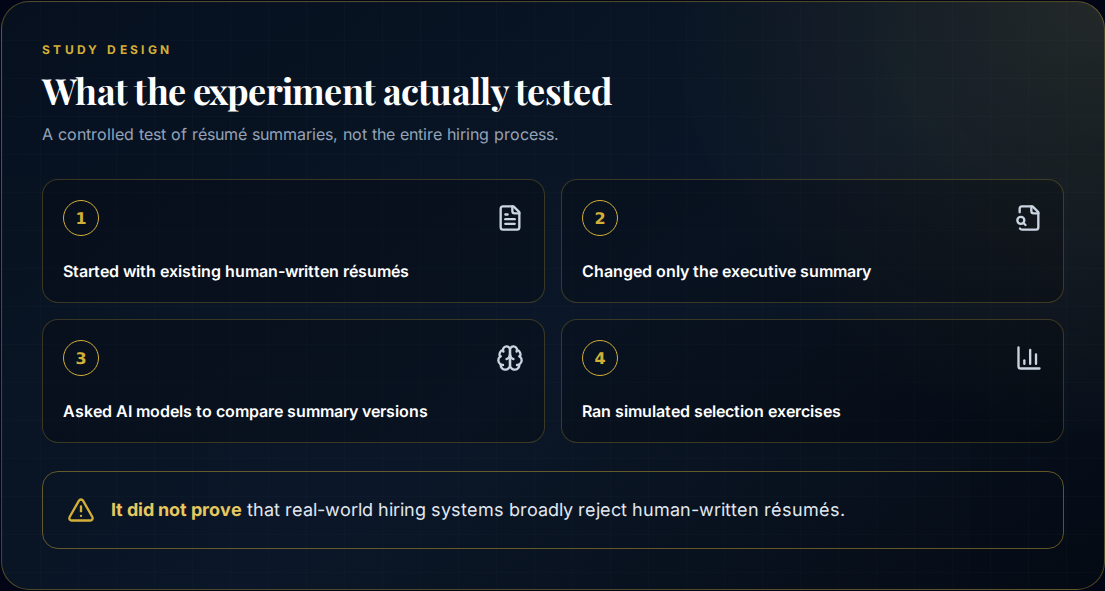
The study behind the viral claim used 2,245 human-written résumés from a public dataset. Researchers removed the original executive summary, asked different language models to generate replacement summaries, and kept the work history, education, and skills unchanged. The models then compared paired versions and selected the stronger candidate. The researchers also simulated shortlisting across 24 occupations. [1]
This is a legitimate way to isolate one variable. It is also a narrow representation of the actual hiring environment.
The experiment focused on the executive summary, one small section of a full résumé. It used pairwise model judgments and simulated hiring pipelines. It did not follow applicants through live employer systems, recruiter review, hiring-manager evaluation, interviewing, reference checks, and actual hiring outcomes.
The human-quality control deserves the same precision. The researchers used 18 annotators, with three annotators assigned to each comparison condition. The paper acknowledges that one of its strongest equal-opportunity findings relied on only 30 human-annotated résumé pairs and may have been influenced by the limited sample. [1]
That does not make the study worthless.
It makes the study a data point.
The result needs independent replication across different datasets, prompts, model versions, employers, applicant-tracking systems, occupations, résumé sections, and real hiring outcomes before anyone turns it into a general law of the labor market.
The viral headline skips that discipline.
It moves from:
Under these experimental conditions, some models favored summaries generated by themselves.
To:
AI hiring systems favor AI-written résumés.
Those are not the same claim.

Real Hiring Systems Are Not Designed Around “Sounds Like AI”
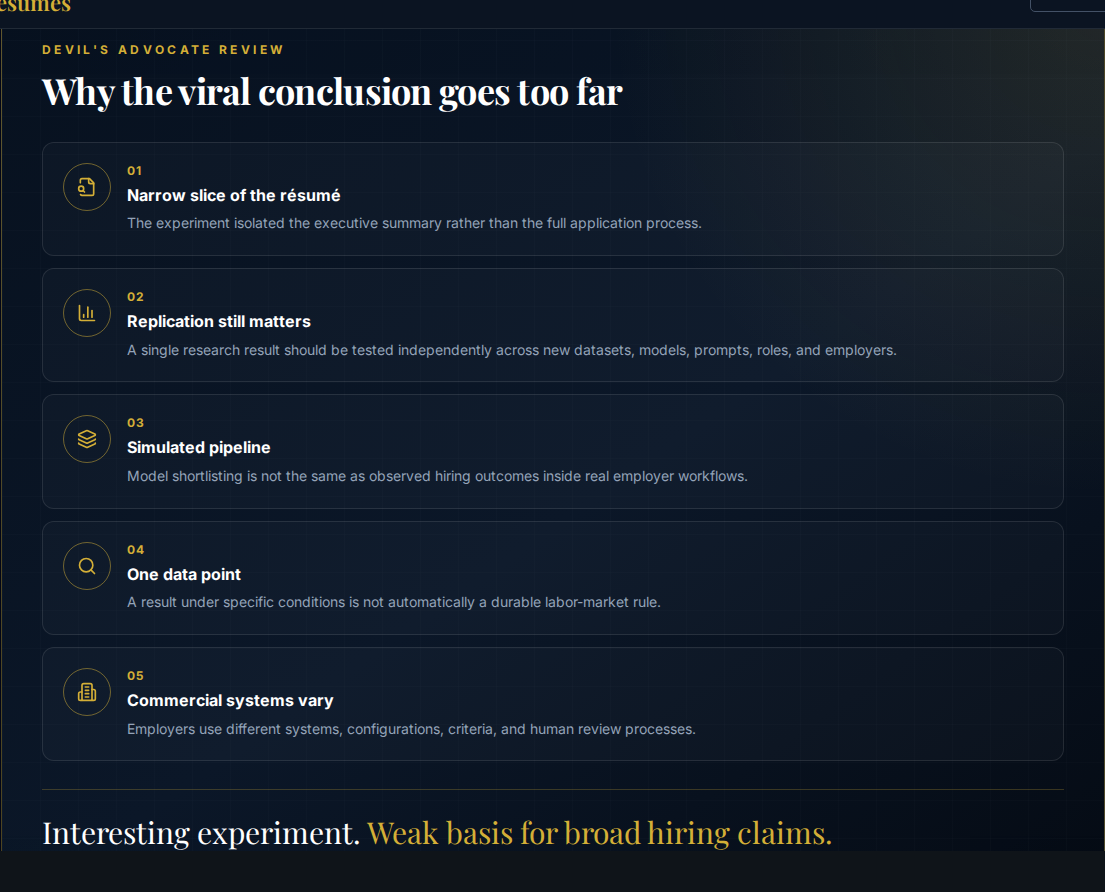
Recruiting technology varies considerably. Some systems rely heavily on structured fields, rules, keywords, and recruiter configuration. Others use language models to summarize, search, rank, or assist. Employers also apply their own requirements, weights, workflows, and human review.
LinkedIn's official description of Hiring Assistant, for example, says the system reviews applicants against recruiter-defined criteria and highlights candidates with the relevant skills and experience. LinkedIn also states that the system keeps humans involved in consequential hiring decisions. [2]
That does not prove automated hiring is free of bias. It does show why the viral interpretation is too broad.
These systems are not publicly described as screening for whether a résumé resembles the language model's preferred writing style. They are intended to evaluate employer-defined qualifications, experience, skills, and fit. Whether every system performs that work accurately is a separate and important question.
The headline should not become the conclusion before the real systems are studied.
The More Useful Explanation: AI Raised the Floor
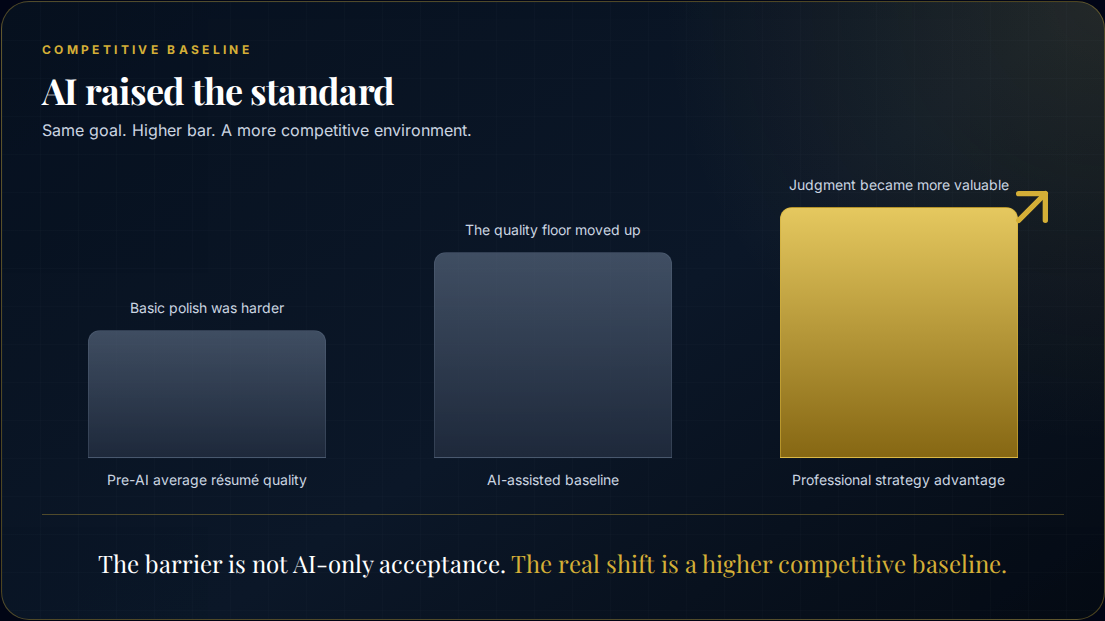
The résumé market changed because AI made basic writing support widely available.
A candidate can now generate a cleaner summary, reorganize bullets, reduce grammatical errors, identify common keywords, and improve sentence structure in minutes. The result may still be strategically weak, but it often looks more polished than an unaided first draft.
That changes the competitive environment.
A mediocre self-written résumé once competed against many other mediocre self-written résumés. Today, it competes against AI-assisted documents, professionally written documents, professionally directed AI-assisted documents, stronger LinkedIn profiles, portfolios, work samples, and candidates who understand how to present evidence.
A rising tide lifts all ships.
The standard rises with it.
This is not speculation about whether communication quality affects hiring. A large randomized field experiment involving nearly half a million job seekers found that non-generative algorithmic writing assistance produced résumés with fewer errors and greater readability. The treated job seekers were hired about 8% more often and at roughly 10% higher wages, with no evidence that employers were less satisfied with the people hired. The authors concluded that better writing helped employers identify underlying ability more accurately. [3]
The lesson is not that machines deserve credit for the candidate's qualifications.
The lesson is that poor communication can hide real ability.
That was true before ChatGPT. It remains true now.
Knowing Your Career Is Not the Same as Knowing How to Position It
Candidates know their own lives better than anyone.
They know what happened, what they endured, what they learned, and what they contributed.
That knowledge does not automatically include the knowledge, skills, and abilities required to build a competitive résumé.
A résumé is not a career autobiography. It is a compressed, evidence-based argument about professional relevance.
The document must determine:
- what belongs and what does not;
- what the target employer is actually evaluating;
- which responsibilities are routine and which accomplishments demonstrate value;
- how scope, authority, complexity, and seniority should be communicated;
- what can be quantified without exaggeration;
- how the candidate's background fits the target role;
- which keywords matter and which merely create noise;
- how the document performs in applicant-tracking systems and under human review;
- and whether every claim can survive questioning in an interview.
Those are professional judgments.
The candidate owns the raw material. That does not mean the candidate automatically knows how to engineer the final structure.
A Résumé Is a Career Foundation, Not a Writing Exercise
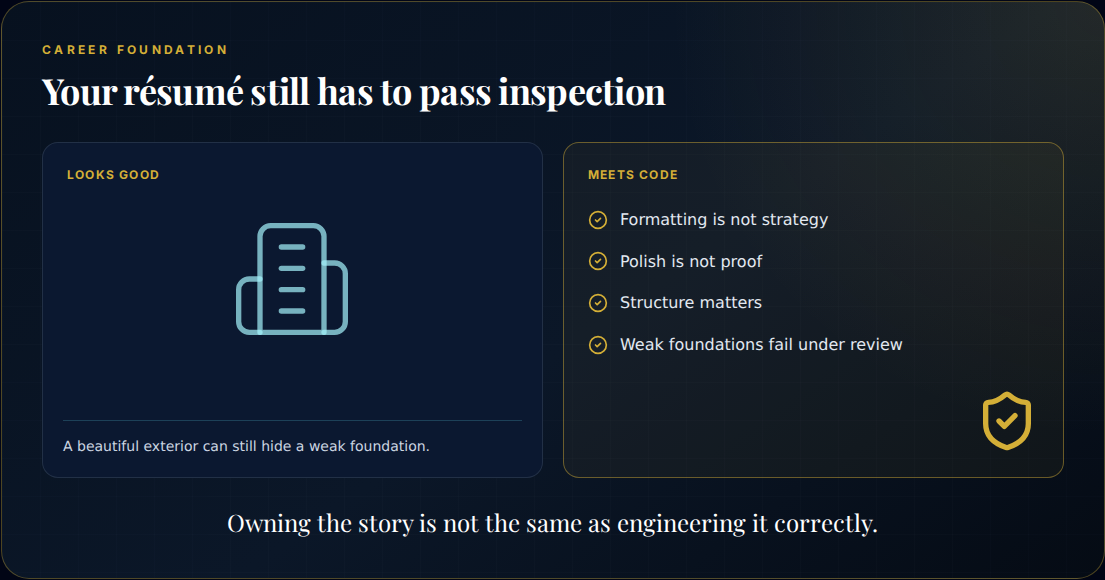
The house analogy is useful because it separates effort from expertise.
A person can buy materials, watch instructional videos, and build a house without hiring a professional. The finished structure can look impressive. The owner may have worked extremely hard.
The inspection still asks whether the foundation is sound, the load is supported, the wiring is safe, and the construction meets code.
Effort does not replace engineering.
A résumé works the same way.
The candidate can spend days writing it. AI can improve the language. A low-cost service can make the formatting attractive. None of that proves the document meets the standard required by the target market.
The application environment audits the structure.
Recruiters scan for relevance.
Hiring managers evaluate level and evidence.
Screening systems look for alignment.
Interviewers test the claims.
A weak career foundation eventually fails under scrutiny.
The standard is not unfair because the candidate built the document alone. The structure either holds or it does not.
Why Low-Cost Résumé Mills Can Be More Dangerous Than an Honest Draft
After more than a decade reviewing and developing résumés, I have seen the same pattern repeatedly.
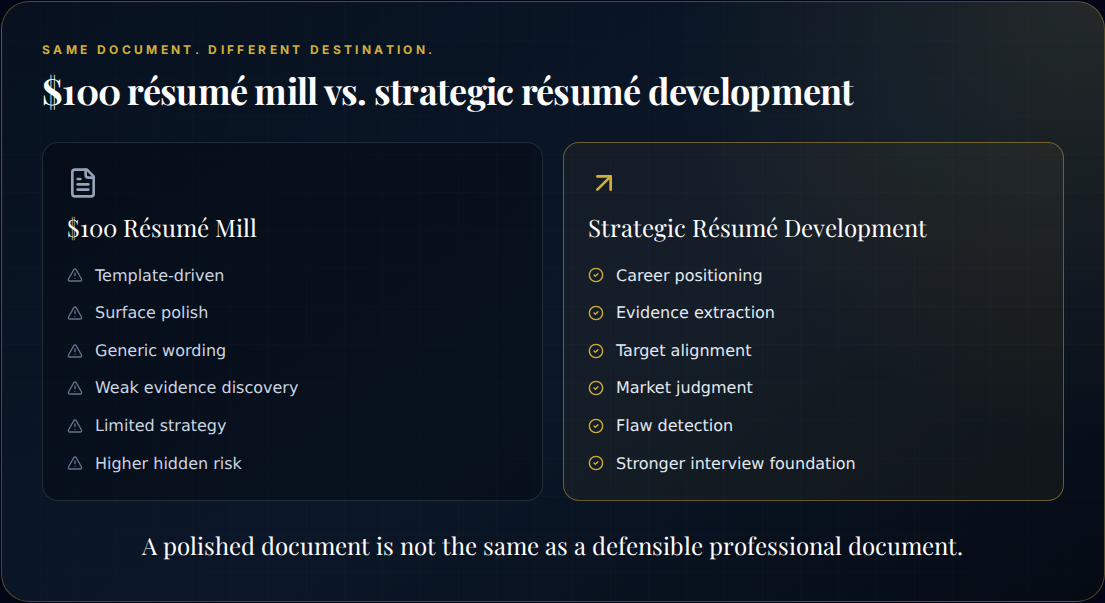
The majority of low-cost résumé-mill documents that reach me contain serious problems. This is a practitioner judgment based on repeated review, not a claim that every inexpensive service produces bad work.
The recurring defects include:
- generic summaries that could belong to almost anyone;
- responsibility lists presented as accomplishments;
- copied competency sections with little connection to the actual career;
- exaggerated language unsupported by evidence;
- invented or misleading metrics;
- identical sentence structures repeated across every position;
- keywords inserted without strategic relevance;
- senior professionals positioned below their actual level;
- career changers presented without a credible transition argument;
- excessive graphics or formatting that weaken readability;
- documents written in multiple voices because content was assembled from templates;
- and polished language that hides a weak professional position.
A plain self-written résumé may look unfinished, but the candidate often knows it needs work.
A résumé-mill document can be more dangerous because it creates false confidence.
It looks professional enough to trust.
The candidate applies for months without realizing the foundation is still weak.
The problem is not always bad grammar. The problem is that the document does not prove the candidate should be interviewed.
AI Can Produce a Strong Draft and Still Miss the Critical Flaw
The best AI, even with detailed guidance, still produces defects.
It can overstate responsibility.
It can flatten the difference between participation and leadership.
It can turn a team result into an individual claim.
It can introduce numbers that were never provided.
It can prioritize the wrong achievement.
It can use language that sounds senior while the underlying evidence remains junior.
It can remove technical detail that matters to the target employer.
It can preserve weak content because the user did not recognize that the content was weak.
It can produce a polished résumé for the wrong target.
The critical capability is not generating text.
The critical capability is recognizing what is wrong with the text.
That is where KSA matters.
Two people can use the same AI model and receive dramatically different results. The difference comes from the quality of the evidence supplied, the questions asked, the strategic direction given, and the ability to audit the output.
AI does not equalize professional judgment.
It amplifies the judgment already present in the process.
The Résumé Industry Did Not Die. The Low-Value Part Was Exposed.
The predicted death of the résumé industry was based on a misunderstanding of what professional résumé work actually is.
If the service consisted only of writing better sentences, AI created a serious replacement.
Basic rewriting became cheaper.
Templates became easier to generate.
Generic professional language became abundant.
That portion of the market lost value.
The high-value work remains:
- discovering evidence the client did not recognize as important;
- identifying the target and understanding its requirements;
- separating claims from proof;
- translating experience without fabricating it;
- building the correct professional architecture;
- communicating the candidate's actual level;
- aligning the résumé, LinkedIn profile, interview narrative, and career strategy;
- testing the document for technical and human-readability problems;
- and finding flaws before the employer finds them.
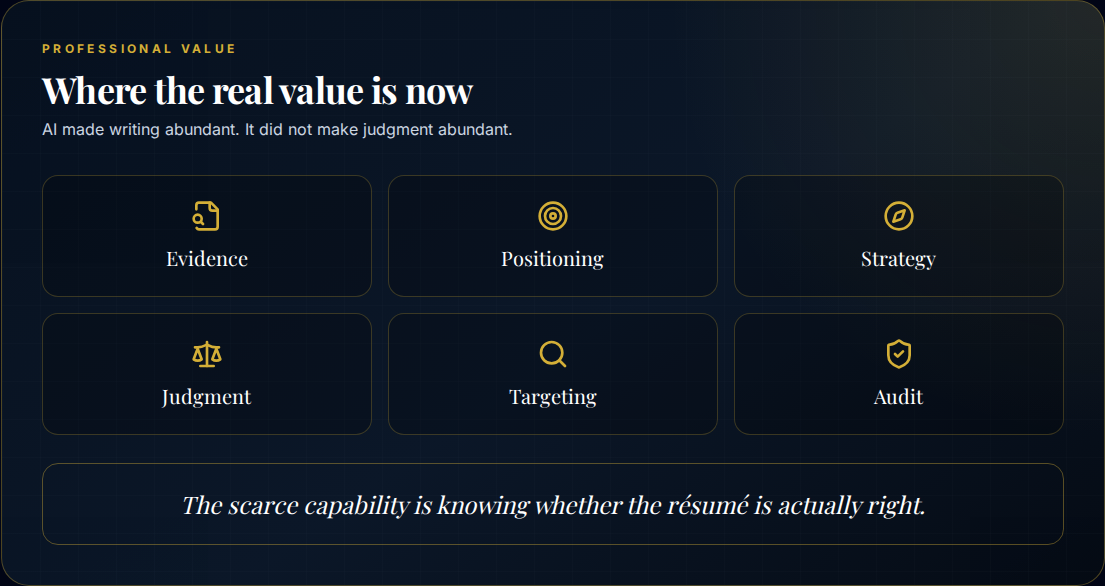
AI made writing abundant.
It did not make judgment abundant.
The résumé profession is more valuable when it operates at the level of strategy, evidence, positioning, and quality control.
The replacement strategy failed because people confused producing words with building a career document.
The Cheapest Résumé Can Become the Most Expensive Career Decision
Many professionals invest tens of thousands of dollars in education, certifications, technology, clothing, transportation, and relocation.
Then they resist investing $500 to $1,000 in the document and strategy used to convert that experience into opportunity.
The contradiction is difficult to ignore.
A résumé operates at a high-leverage point in the career process. One missed interview, one additional month of unemployment, one under-positioned offer, or one failed transition can cost more than the professional service the candidate decided was too expensive.
Price does not guarantee quality. A high fee does not excuse weak work.
The correct question is not whether the résumé is cheap or expensive.
The correct question is whether the person producing it has the knowledge, skills, and abilities required to build and audit the document properly.
A serious service should be able to explain:
- how the target was selected;
- how the evidence was discovered and verified;
- why the document is structured the way it is;
- how the candidate's level is communicated;
- what was removed and why;
- how applicant-tracking compatibility was tested;
- how the document performs in plain text and rendered form;
- and how the final claims can be defended in an interview.
The client is not paying for pages.
The client is paying for judgment applied to a consequential career decision.
What a Competitive Résumé Must Survive
A strong résumé should survive more than a spelling check.
It should survive an evidence audit.
Every major claim should be truthful, supportable, and proportionate to the person's actual role.
It should survive a market audit.
The content should reflect what the target role values rather than what the candidate happens to remember first.
It should survive a level audit.
An executive should not read like a supervisor. A career changer should not appear directionless. A technical expert should not lose the substance that establishes credibility.
It should survive a systems audit.
The formatting, structure, headings, chronology, keywords, and file behavior should not undermine the content.
It should survive a human scan.
The reader should understand the candidate's value quickly without decoding paragraphs of generic language.
It should survive the interview.
The candidate should be able to explain every achievement, number, responsibility, and transition without retreating from the language on the page.
That standard is difficult to meet.
Even good résumés have flaws. Getting the document right requires repeated review, disciplined questioning, market knowledge, technical controls, and judgment.
The Real Lesson From AI and Résumés
The viral story says AI screeners prefer AI-written résumés.
The research supports a narrower conclusion: some language models demonstrated self-preference under specific experimental conditions involving controlled résumé summaries and simulated selection. That finding should be replicated and tested in real hiring systems before anyone turns it into a universal explanation for candidate rejection. [1]
The labor-market reality is broader.
AI improved access to baseline writing support.
That raised expectations.
Weak self-written résumés were already failing before generative AI. They continue to fail now, but they are competing against a stronger baseline.
Professional résumé strategy did not become obsolete.
Commodity writing became easier to replace.
Expert discovery, evidence, positioning, architecture, validation, and quality control became more important.
The scarce capability is no longer producing polished language.
It is knowing whether the document is actually right.
That is the standard a serious career document must meet.
About the Author
Keith Lawrence Miller, M.A., BCC, PCC, NCRW, is the founder of Ivy League Résumés and Ivy League Coaching. His work focuses on résumé strategy, executive positioning, career development, organizational psychology, and evidence-based professional communication.
Your Résumé Should Withstand Audit
Your résumé should not merely sound better. It should withstand audit.
Have your résumé evaluated for evidence, positioning, level, applicant-tracking compatibility, and market alignment through Ivy League Résumés.
Sources
1. Jiannan Xu, Gujie Li, and Jane Yi Jiang, “AI Self-preferencing in Algorithmic Hiring: Empirical Evidence and Insights,” Proceedings of the AAAI/ACM Conference on AI, Ethics, and Society (2025), with the full working-paper version available through arXiv: https://arxiv.org/abs/2509.00462 and proceedings record at https://ojs.aaai.org/index.php/AIES/article/view/36755
2. LinkedIn, “LinkedIn Recruiter + Hiring Assistant,” official product description: https://business.linkedin.com/hire/recruiter
3. Emma Wiles, Zanele Munyikwa, and John J. Horton, “Algorithmic Writing Assistance on Jobseekers’ Resumes Increases Hires,” Management Science 71, no. 12 (2025): 10144–10164, https://doi.org/10.1287/mnsc.2024.04528