Career intelligence
Top 10 Verticals for Entrepreneurs
Investigate ten business verticals through specific customers, proposed services, operating challenges, and practical demand checks.

Where to Find Customers and Test a Business Offer
A business idea becomes useful when you can name the customer, explain the problem, and describe something that customer has a reason to buy. The next question is whether you can deliver the work at a price that covers your costs and rewards your effort.
That makes familiar markets worth examining closely. A homeowner needs a repair completed. A family needs dependable assistance for an older relative. A business owner needs accurate books, qualified employees, or reliable maintenance. Each situation gives an entrepreneur a concrete problem to investigate.
The ten verticals below offer practical starting points. The strongest choice for you will depend on your experience, qualifications, relationships, location, and ability to deliver a specific result.
This is an editorial ranking of U.S. business opportunities, selected for identifiable buyers, recurring needs, and the possibility of defining a focused initial service. The research establishes market context. The business models and demand checks are proposed examples that have not been tested as individual ventures. Local demand, startup costs, attainable prices, and profitability remain unknown until investigated.
Ten markets worth investigating
1. Essential home repair and skilled services Example customer: Homeowners and small property owners
2. Senior support and home assistance Example customer: Older adults and their families
3. Commercial cleaning and facility care Example customer: Office and commercial property managers
4. Rental-property operations and turnover services Example customer: Rental owners and property-management firms
5. Vehicle and small-fleet maintenance Example customer: Contractors and local fleet operators
6. Pet care and grooming Example customer: Pet owners in a defined service area
7. Specialized accounting and financial operations Example customer: Small businesses in one industry
8. Workforce training and business education Example customer: Employers with a specific skills need
9. Specialty recruiting and hiring support Example customer: Employers filling a defined type of role
10. Packaging, fulfillment, and seller operations Example customer: Product businesses selling online
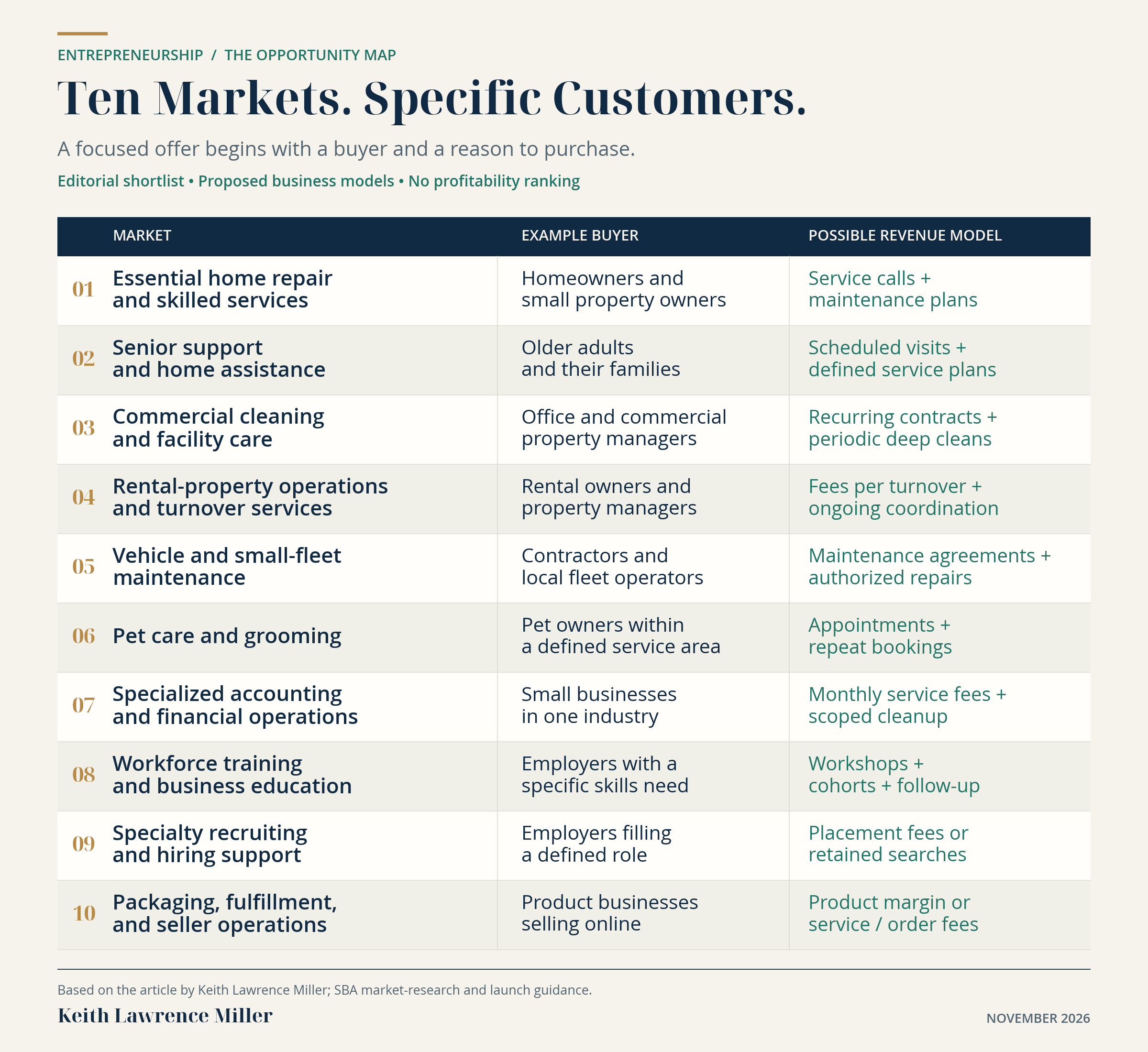
Ten markets paired with example buyers and possible revenue models in the article’s original order.
1 Essential Home Repair and Skilled Services
Homes provide an established base of maintenance and repair work. Harvard's Joint Center for Housing Studies reported that the median age of the U.S. housing stock reached 44 years in 2023. Its research also shows that affordability constrains owners' ability to complete needed work. A repair need still has to become an affordable purchase. Harvard housing research [1].
A focused business could serve homeowners within a manageable area through one qualified specialty, such as appliance repair, HVAC servicing, plumbing, or electrical work. Revenue could come from individual service calls and clearly defined maintenance agreements. Choose work you can competently perform, estimate, and stand behind.
The operating challenge is getting the whole job right. Pricing must account for travel, diagnosis, labor, materials, scheduling, and possible callbacks. A full calendar offers limited comfort if each appointment consumes more time than the quotation allowed. Clear estimates and reliable communication should be part of the offer.
First demand check: Ask local homeowners or property owners about recent repair purchases, unresolved problems, and upcoming work. Look for a specific job within your capabilities and a request for a written quotation. That creates a concrete next step. General enthusiasm about the idea provides much less evidence.
2 Senior Support and Home Assistance
The Census Bureau estimates that 64.6 million Americans were age 65 or older on July 1, 2025, an increase of 16.2% since April 1, 2020. This demographic change provides a reason to investigate assistance needs in your community. Individual preferences, health, family arrangements, and ability to pay will determine the service opportunity. Census population estimates [2].
A possible offer is a defined schedule of companionship, errands, household assistance, or appointment coordination. The customer may be an older adult arranging support directly or a family member organizing agreed assistance. Revenue could come from scheduled visits or a service plan specifying tasks and hours.
Dependability is central to the business. A client needs to know who will arrive, when the visit will occur, and what happens if the regular provider is unavailable. Clear boundaries also matter. Describing a service as nonmedical does not establish that it is exempt from local requirements; verify the rules for the exact work before accepting clients.
First demand check: Discuss a real week's needs with prospective clients and families. Establish the tasks, schedule, decision-maker, and payer. A useful early signal is a request for a proposal you can realistically fulfill. Needs outside your qualifications or available coverage should stop that proposed engagement.

A focused service starts with a specific customer need and an agreed scope.
3 Commercial Cleaning and Facility Care
Cleaning is an established service market. Census data published through the Federal Reserve Bank of St. Louis report approximately $77.5 billion in 2024 janitorial-services revenue among covered employer establishments. That broad category provides context; it does not establish the sales available to a new commercial cleaning business in a particular town. Census janitorial-services revenue [3].
A focused offer could serve small offices, retail locations, or commercial buildings within a compact area. Define the tasks, frequency, access arrangements, and standard for completed work. Revenue could combine recurring cleaning contracts with separately priced services such as a periodic deep clean.
The challenge is protecting quality while controlling delivery costs. Labor, supplies, travel, supervision, and rework all belong in the price. A seemingly attractive contract can become difficult if the client expects additional work that was never included in the agreement. A site visit and written task list make the proposal more concrete.
First demand check: Speak with nearby office managers or property owners about their current service, unresolved problems, and next buying decision. Request permission to assess a real location. Interest becomes more useful when an authorized buyer asks for a quotation covering an actual schedule and scope.
4 Rental-Property Operations and Turnover Services
The United States had approximately 46.3 million renter-occupied housing units in the third quarter of 2026, according to Census estimates. That is a substantial housing base to investigate for property services. The figure measures occupied rentals; it does not measure how frequently tenants move or how much owners outsource. Census housing inventory [4].
A possible starting offer is a defined turnover service for small rental owners or property-management firms. It could cover cleaning, condition photographs, a punch list, coordination with qualified vendors, and tracking completion. The proposed revenue model is a fee per turnover, with recurring coordination available where the responsibilities justify it.
Execution depends on timing and authorization. The owner should approve the work, budget, vendors, and treatment of unexpected problems. Delayed repairs and unclear responsibilities can disrupt the entire schedule. Establish who pays contractors and who approves extra work before the project begins. Confirm any requirements attached to the management functions you intend to perform.
First demand check: Ask owners about their most recent turnover and an upcoming vacancy. Look for a real unit, a defined problem, and a buyer willing to review a written scope and proposed price. Use that information to assess whether you can deliver the work reliably.
5 Vehicle and Small-Fleet Maintenance
S&P Global Mobility's 2025 analysis counted 289 million U.S. light vehicles with an average age of 12.8 years. Those figures describe the national light-vehicle base. They give a prospective operator a reason to examine local maintenance needs, while the age and condition of each customer's vehicles require separate assessment. S&P Global Mobility research [5].
A focused customer group could be contractors, delivery businesses, or other companies operating small light-vehicle fleets. A proposed service might combine scheduled maintenance, reminders, service records, and repair coordination. Revenue could come from defined maintenance agreements and separately authorized repairs, with hands-on work limited to the operator's qualifications and equipment.
The central challenge is keeping the customer's vehicles available while performing accurate, dependable work. Parts, diagnostic time, equipment, insurance, and skilled labor affect the economics. Mobile service also needs careful costing; travel and vehicle requirements can create substantial obligations.
First demand check: Talk to fleet owners about missed service intervals, downtime, inconvenient appointments, and current suppliers. Seek a real maintenance requirement you can scope. Before proposing a paid trial, identify the tools, labor, parts, and other costs needed to complete that specific assignment.

Careful service and customer trust belong at the center of a pet-care offer.
6 Pet Care and Grooming
The American Pet Products Association reports that 95 million U.S. households owned a pet in 2025. Its research also found that 22% of pet owners reported reducing pet spending that year. A large customer base therefore needs to be considered alongside price sensitivity and the value of the particular service. APPA industry findings [6].
Choose a service you can deliver well, such as grooming, scheduled dog walking, or in-home pet visits. A defined neighborhood or service area gives the offer a practical boundary. Revenue could come from appointments, standing bookings, or packages that clearly specify the included care.
The work requires capable animal handling, owner trust, and realistic scheduling. Travel between scattered customers can consume the time available for paid appointments. Intake procedures should establish the animal's needs, relevant behavior, the requested service, and how the owner can be reached if a problem occurs.
First demand check: Ask owners what they already purchase, how frequently they need it, and where existing arrangements fall short. Seek requests for specific appointments or recurring care within a schedule you can support. Assess demand for the service itself before considering premises, specialized vehicles, or other major commitments.
7 Specialized Accounting and Financial Operations
In the Federal Reserve Banks' 2025 Small Business Credit Survey, 50% of surveyed employer firms reported uneven cash flow as a financial challenge. The question included collecting receivables. This identifies an operating problem worth discussing with business owners; willingness to pay for outside help requires its own investigation. 2026 Report on Employer Firms [7].
A possible offer is bookkeeping and financial administration for one customer group, such as small trade contractors or professional practices. Services could include account reconciliation, invoice follow-up, and a consistent monthly reporting package. A fixed monthly fee could cover defined recurring tasks, with historical cleanup scoped separately.
Specialization should make the service more relevant. A contractor may need a clearer view of unpaid invoices and job-related expenses. A professional practice may need a more reliable monthly close. The provider must also manage confidential information, inconsistent client records, and requests that exceed the agreement. Offer only services you are qualified and authorized to perform.
First demand check: Ask owners which financial tasks fall behind and what the delays prevent them from doing. Present a sample deliverable using fictional information. Look for a buyer who can identify a recurring problem, provide the necessary records appropriately, and evaluate a clearly priced scope.
8 Workforce Training and Business Education
The Association for Talent Development's 2026 report draws on 340 participating organizations and their 2025 activity. Common subjects included managerial and supervisory training and communication skills. Average direct learning expenditure per employee declined, making budget discipline part of the opportunity. These findings describe participating organizations rather than every employer. ATD report highlights [8] and training content findings [9].
A focused offer could help new supervisors conduct difficult conversations, improve customer-service responses, or teach a repeatable onboarding process. The buyer is an employer with a specific performance problem and someone authorized to fund the solution. Revenue could come from a workshop, a defined cohort, or follow-up practice sessions.
The main challenge is demonstrating useful learning. Broad promises about leadership or business success leave too much open to interpretation. Define what participants should be able to do afterward and how the employer will assess it. The instructor also needs relevant knowledge and the ability to teach it effectively.
First demand check: Show relevant managers a short outline and a sample exercise using existing tools. Seek a sponsor who identifies an actual work problem, an appropriate audience, and a budget decision. Agree on an observable result, such as performance in a realistic work simulation, before recommending a paid pilot.
9 Specialty Recruiting and Hiring Support
The Federal Reserve Banks' 2025 survey found that 46% of surveyed employer firms reported difficulty hiring or retaining qualified staff. That combined measure identifies a business concern. A recruiting offer must address a current hiring need that an employer is prepared to act on. 2026 Report on Employer Firms [7].
A focused business could serve one job family in one industry and region. For example, a recruiter with relevant knowledge might support industrial maintenance hiring for regional manufacturers. Possible revenue arrangements include employer-paid placement fees or a defined retained search, with payment terms agreed in writing.
The operating challenge is converting substantial work into a completed engagement. A vacancy can be delayed, requirements can change, or the employer can stop hiring. Establish the decision-maker, approved compensation range, interview process, payment terms, and any replacement obligations before investing heavily in a search. Candidates also deserve accurate information and consent over how their details are shared.
First demand check: Speak with hiring decision-makers about a currently approved vacancy. Ask what they have tried, what remains unresolved, and whether they would consider outside support. A written brief and willingness to discuss terms provide a more concrete basis for evaluation than a general complaint about staffing.
10 Packaging Fulfillment and Seller Operations
The Census Bureau estimates that e-commerce accounted for 17.9% of U.S. retail sales in the third quarter of 2026, using seasonally adjusted figures. That establishes the scale of online retail activity. The opportunity for a particular packaging or operations provider depends on a seller's actual orders, products, and service problems. Census retail e-commerce report [10].
A proposed starting offer could handle one activity for a defined group of sellers: sourcing packaging, assembling product kits, preparing a limited batch of orders, or processing returns. Choose a bounded task you can perform accurately. Revenue might come from a clearly disclosed product margin, a service fee, or a fee per completed order.
The challenge is understanding every delivery cost. Packaging materials, freight, storage, handling time, mistakes, damage, and delayed customer payments can affect the economics. An attractive selling price is incomplete information until the full cost of serving that order is understood. Specify who owns inventory and who pays for errors.
First demand check: With permission, review a prospective customer's actual order requirements and a recurring operational problem. Develop a written scope for a small, bounded assignment. Establish demand and delivery economics before considering inventory purchases, a warehouse lease, or a broader fulfillment operation.
Choose the market you can understand and serve
Start with the vertical where you can reach real buyers and understand their work. Existing experience, relevant qualifications, and relationships can help you ask better questions and judge whether a proposed service is realistic. The SBA recommends examining demand, location, competition, and pricing as part of market research. SBA market research guidance [11].
Use conversations and sample scopes first. These require your time, but they can often be completed with existing communication tools and without buying advertising, subscriptions, or equipment. The demand checks above are editorial suggestions for gathering evidence. They are not proven thresholds for business success.
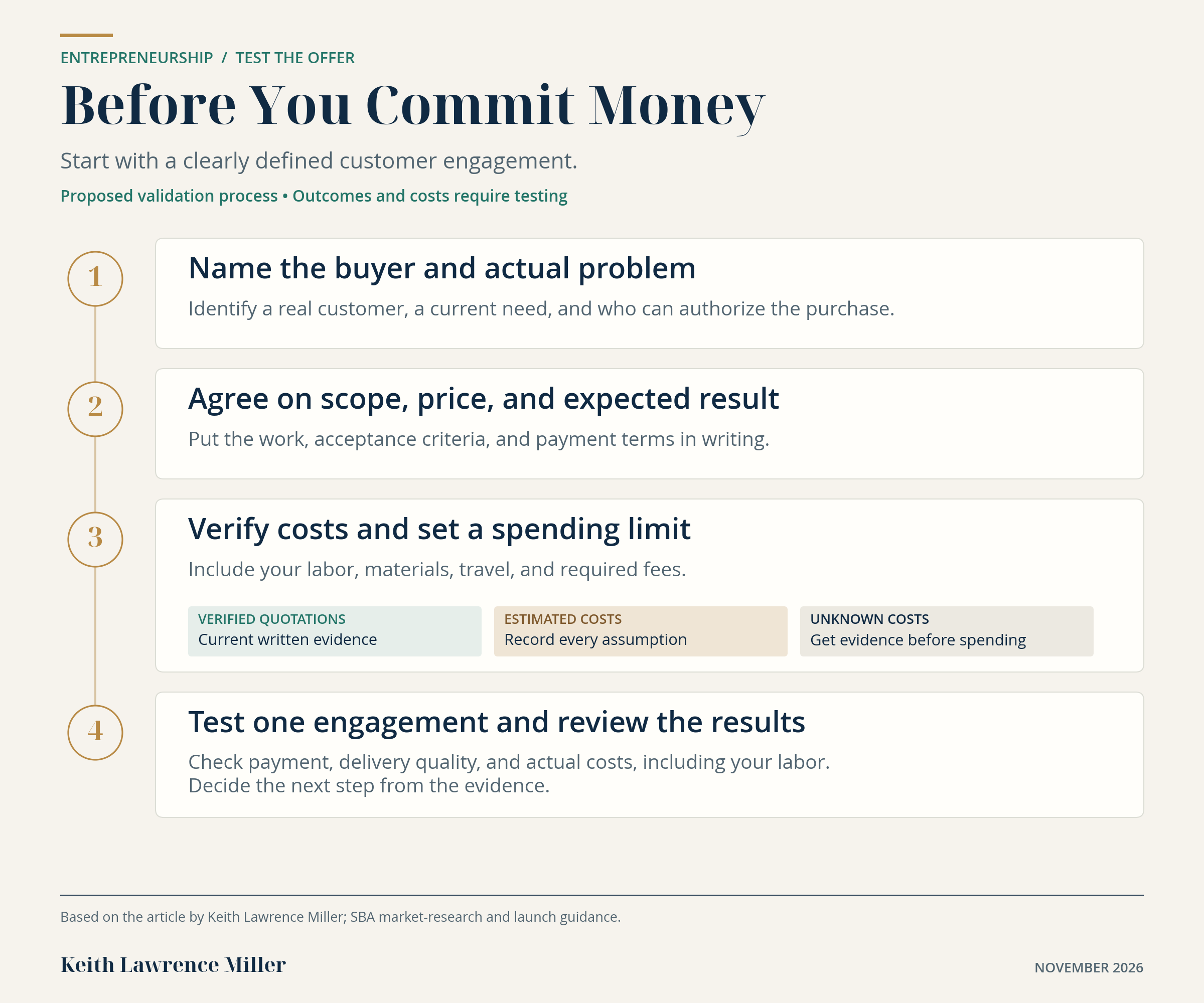
A proposed four-step process for defining a buyer, agreeing a scope, checking costs, and evaluating an initial engagement.
Before committing money to a pilot, write down the expected result, the scope, the customer's price, and a spending limit. Identify which costs are verified by current quotations, which are estimates, and which remain unknown. Include your own labor, materials, travel, administration, and any required insurance, equipment, or fees. Business requirements vary by activity and location, so verify those that apply to the exact service. SBA launch guidance [12].
Set a clear pass or fail condition in advance. For a proposed first engagement, define success as delivering the agreed result, receiving the agreed payment, and covering actual delivery costs, including your labor, within the spending limit. Delays, rework, unpaid invoices, or missing costs should trigger review before another expenditure. A single successful engagement supports another measured step; repeat purchases and repeatable economics provide stronger evidence for expansion.
The most useful opportunity is one you can make concrete: a reachable customer, a problem you understand, a service you can deliver, and a price that makes the work worthwhile. Choose one, investigate it carefully, and let customer commitments and actual results guide what you build next.
Sources and research notes
1. Harvard housing research
https://www.jchs.harvard.edu/blog/many-owners-cannot-afford-maintain-aging-homes
2. Census population estimates
https://www.census.gov/newsroom/press-releases/2026/vintage-2025-pop-estimates.html
3. Census janitorial-services revenue
https://fred.stlouisfed.org/series/AIES56172RCT00US
4. Census housing inventory
https://www.census.gov/housing/hvs/files/qtr326/Q326press.pdf
5. S&P Global Mobility research
6. APPA industry findings
7. 2026 Report on Employer Firms
8. ATD report highlights
https://www.td.org/content/atd-blog/highlights-from-atd-s-2026-state-of-the-industry-report
9. training content findings
https://www.td.org/content/atd-blog/2026-state-of-the-industry-report-indicates-latest-td-trends
10. Census retail e-commerce report
https://www.census.gov/retail/eCommerce.html
11. SBA market research guidance
https://www.sba.gov/counseling/plan-your-business/
12. SBA launch guidance