Career intelligence
Top 10 Industries Doing the Most Hiring
Explore ten private-industry groups ranked by September 2026 monthly hires, with practical steps for connecting the data to your job search.

Where Private Employers Are Hiring and How to Focus Your Search
Knowing where employers are hiring can help you make better decisions about where to invest your job search effort. It can introduce you to employers you have overlooked, show where your experience might transfer, and help you build a more focused list of opportunities.
The latest U.S. hiring figures place professional and business services, accommodation and food services, healthcare and social assistance, and retail at the top of the private-industry groups compared here. Together, they offer very different kinds of work, from customer service and operational support to licensed care and specialized professional services.
The practical question is where your abilities fit. A large industry can contain opportunities for people entering the workforce, skilled workers, managers, and experienced executives. To use the numbers well, connect the industry's hiring activity to a specific role, employer, and location.
What this ranking measures
This article uses the Bureau of Labor Statistics' Job Openings and Labor Turnover Survey, known as JOLTS. The latest release available on November 22, 2026 covers September 2026 and was published on November 3, 2026. Figures are preliminary, seasonally adjusted estimates and may be revised. Seasonal adjustment accounts for regularly recurring seasonal patterns. BLS September release [1].
The ranking measures hires during the month. BLS counts additions to payroll, including newly hired and rehired employees, full-time and part-time workers, and seasonal employees. Vacancies are measured separately. An industry's hiring total also differs from its net employment growth because workers may leave while others join. BLS hiring definitions [2].
For a useful comparison, this article ranks nonoverlapping private industry groups. Broad trade, education and health, and leisure and hospitality totals are separated into their published component groups; manufacturing remains one category. Government hiring is outside the ranking. These grouping choices are editorial, while the hiring estimates come from BLS.
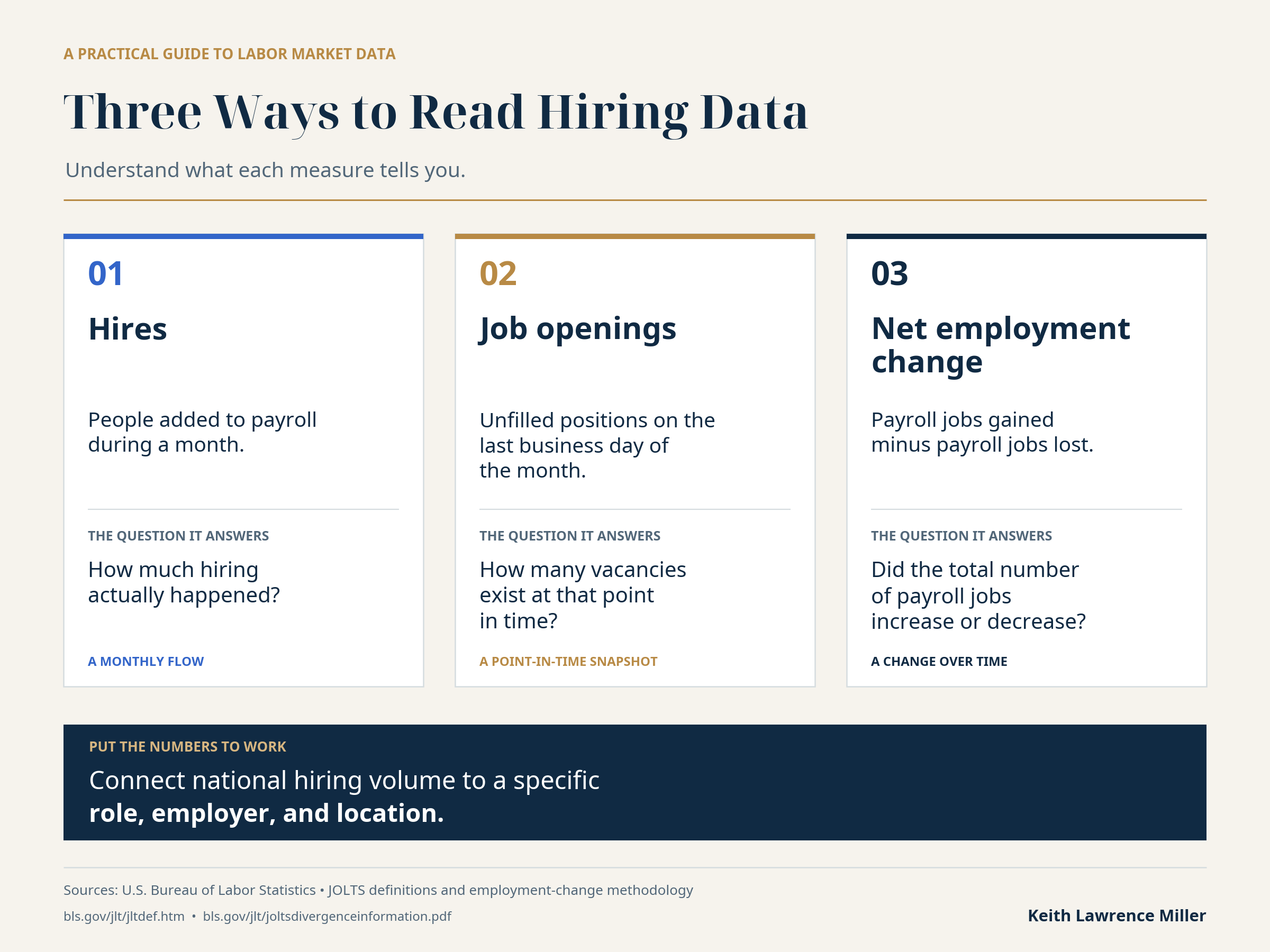
A comparison of hires during a month, job openings at a point in time, and net employment change.
The ten leading private industry groups
1. Professional and business services September 2026 hires: 927,000
2. Accommodation and food services September 2026 hires: 879,000
3. Health care and social assistance September 2026 hires: 705,000
4. Retail trade September 2026 hires: 704,000
5. Construction September 2026 hires: 356,000
6. Manufacturing September 2026 hires: 313,000
7. Transportation, warehousing, and utilities September 2026 hires: 290,000
8. Other services September 2026 hires: 211,000
9. Wholesale trade September 2026 hires: 169,000
10. Arts, entertainment, and recreation September 2026 hires: 162,000
Source: BLS Table 2, November 3, 2026 release [1]. These are monthly estimates, not an annual ranking. The narrow gap between healthcare and retail should not be interpreted as a meaningful advantage for one over the other.
For context, federal, state, and local government employers together recorded an estimated 324,000 hires in the same month. Readers interested in public employment should investigate that market separately.
The job examples below illustrate work found within each industry. JOLTS does not report which occupations account for an industry's monthly hires. BLS survey questions and answers [3].
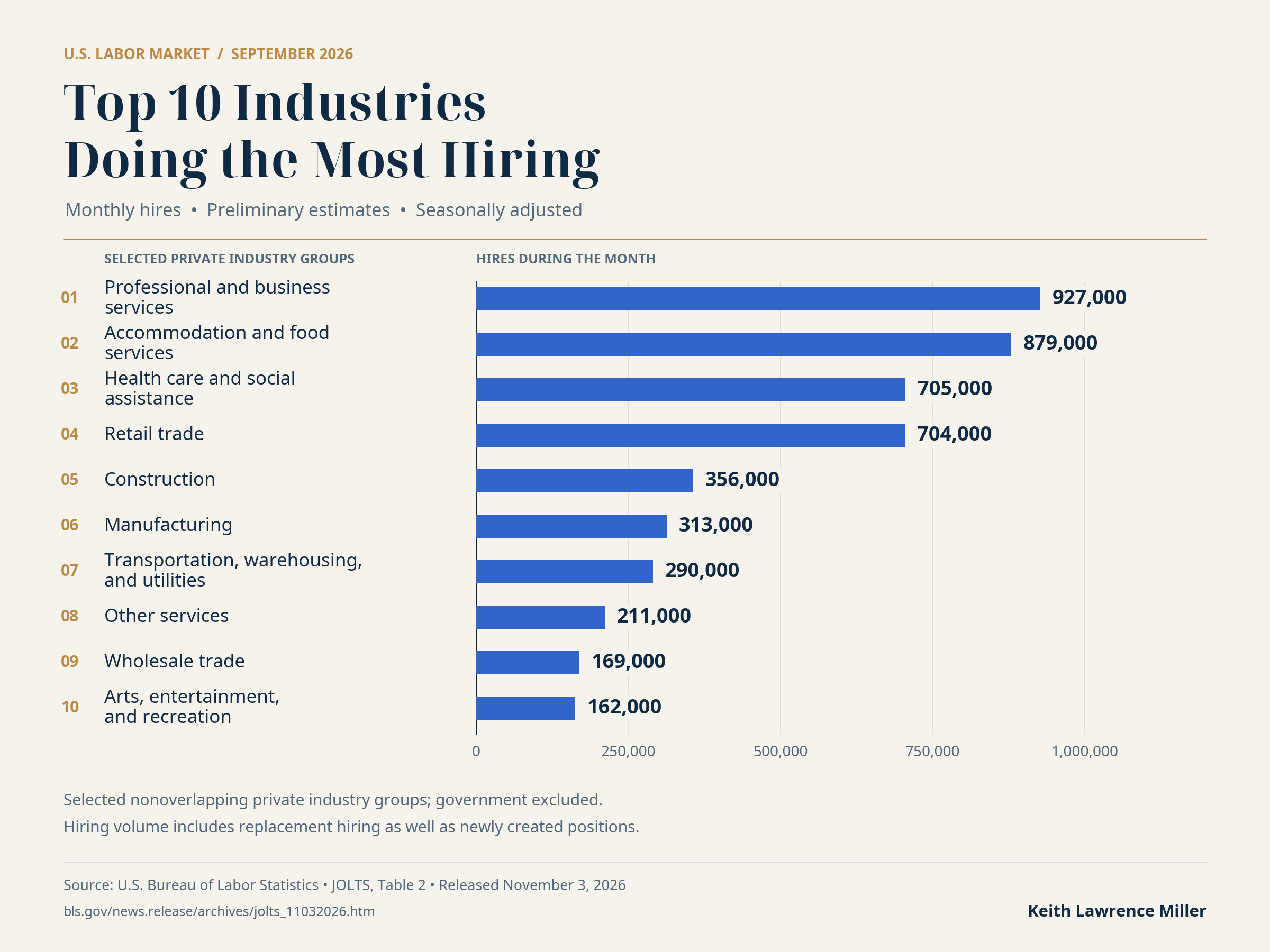
September 2026 hires in the ten selected private industry groups, led by professional and business services.
1 Professional and Business Services
This broad group includes professional, scientific, and technical firms; company management; and businesses providing administrative support, staffing, facilities services, and waste management. Its leading position covers a wide range of employers and qualifications. BLS industry overview [4].
A job seeker might explore accounting firms, consulting businesses, staffing agencies, security providers, or companies that maintain commercial facilities. Depending on the employer, relevant work may involve client service, administration, recruiting, technical expertise, or hands-on operational support. BLS administrative and support services [5].
The employer relationship matters. Agency workers are counted by the organization employing them, even when their assignments take place in another industry. Someone working at a manufacturing plant through a staffing agency may therefore appear in the business-services figures. BLS payroll definitions [2].
How to approach the search: Choose a specific service and job function. Ask whether the opportunity is direct employment or an agency assignment, how long the assignment is expected to last, and what the employer needs you to accomplish. Present examples of relevant results, such as accurate administrative work, reliable service delivery, or solving a client's problem.

Service roles connect daily operations with the customer's experience.
2 Accommodation and Food Services
Hotels, lodging businesses, restaurants, and other food-service establishments make this a large and varied employment market. Roles include hotel desk staff, cooks, food preparation workers, servers, and supervisors. The work connects directly to the customer's experience, whether that means a smooth check-in, an accurate order, or a well-run shift. BLS industry overview [6].
Many food-serving positions provide employer training and do not require formal educational credentials. Management and specialist positions have their own requirements. Applicants should examine the actual role rather than assume that every opening has the same entry route. BLS food and beverage serving occupations [7].
For someone entering the workforce, service and operational roles are worth investigating. An experienced applicant can also examine supervisory positions and responsibilities involving staff scheduling, service standards, or daily operations.
How to approach the search: Confirm expected weekly hours, shift requirements, seasonal status, and how compensation is calculated. On an application, explain how you have handled customers, maintained quality under pressure, supported coworkers, or taken responsibility for a shift.
3 Health Care and Social Assistance
This category includes ambulatory care providers, hospitals, nursing and residential care facilities, and social-assistance organizations. It encompasses both healthcare delivery and services that help individuals with daily needs. BLS industry data identify home health aides, practical and vocational nurses, and medical and health services managers among its occupations. BLS industry overview [8].
The entry requirements depend on the work. A licensed clinical position, a direct-support role, and a management position call for different qualifications. Start by identifying the responsibilities you want and checking the requirements attached to them.
The setting deserves equal attention. Supporting someone at home, working in a residential facility, and managing a healthcare operation involve different routines and expectations. A large national hiring figure gives you a reason to investigate; the specific work determines whether the opportunity suits you.
How to approach the search: Search by both job title and care setting. Identify which credentials are mandatory and which skills an employer will teach. Describe relevant evidence such as accurate documentation, dependable follow-through, respectful communication, or experience coordinating services.
4 Retail Trade
Retail includes employers selling merchandise to consumers across many product categories. BLS identifies salespeople, cashiers, customer service representatives, stock and order workers, and retail supervisors among the sector's occupations. That creates several directions for a search, depending on whether your strength is serving customers, managing inventory, or leading a team. BLS industry overview [9].
A useful application connects past experience to the store's operation. Someone with customer-service experience can show how they resolved problems or explained products. An inventory applicant can emphasize accuracy, organization, and product handling. A supervisory applicant should explain the scope of their responsibility and the results of their leadership.
Product knowledge can also help you identify a sensible target. Consider retailers whose merchandise you understand or could learn well enough to discuss confidently with customers.
How to approach the search: Compare the actual duties, expected hours, weekend requirements, and seasonal status. Ask what successful performance looks like and how employees become eligible for greater responsibility. Tailor your résumé to the function you want.
5 Construction
Construction covers building projects, civil engineering work such as roads and utility systems, and specialty trade contractors. The sector includes new construction as well as additions, alterations, maintenance, and repairs. Occupations include laborers, carpenters, electricians, equipment operators, and construction managers. BLS industry overview [10].
This range makes it especially important to choose a trade or function. A person interested in a helper position will face different requirements from an experienced electrician or someone responsible for managing a project. Applicants should also learn whether the employer's work is residential, commercial, or infrastructure-related.
Location matters at the project level. Ask where the work will take place, how assignments change, and what travel is expected. A national hiring total cannot establish whether a particular contractor has an opening within your commuting area.
How to approach the search: Review contractors and apprenticeship sponsors serving your area. Ask about entry requirements, training, jobsite responsibilities, and equipment expectations. Demonstrate relevant experience with tools, safety procedures, project coordination, or completing work accurately and on schedule.
6 Manufacturing
Manufacturing includes businesses that turn materials and components into products. The range spans food, machinery, fabricated metal, electronics, transportation equipment, and many other goods. BLS identifies production helpers, assemblers, machinists, inspectors, and purchasing agents among the sector's occupations. BLS industry overview [11].
The practical opportunity depends on the plant and the job. Production work, skilled machining, quality inspection, and purchasing involve different responsibilities. Understanding what a facility makes helps you interpret its vacancies and decide how your experience applies.
For an applicant with operational experience, useful evidence may include reducing errors, following production standards, handling equipment, maintaining accurate records, or resolving a process problem. Experienced professionals should identify the operational results they can support, including quality, supplier performance, or efficient use of resources.
How to approach the search: Identify manufacturers within reach and compare several positions at each. Ask about shifts, overtime expectations, training, and the requirements for moving into more skilled work. Use specific examples to show what you can contribute to the operation.

Operational work brings together product handling, coordination, and accuracy.
7 Transportation Warehousing and Utilities
This combined BLS category includes passenger and freight transportation, storage and distribution activities, and utility services. Transportation businesses operate across road, rail, air, water, and pipeline systems. Utilities provide services such as electricity, natural gas, and water. BLS transportation overview [12] and utilities overview [13].
The category contains very different career routes. A warehouse material-moving position, a commercial driving job, and a skilled utility role require different preparation. The combined hiring total should not be read as a count of warehouse opportunities alone.
For applicants with relevant experience, the strongest evidence may involve safe equipment operation, accurate inventory, reliable dispatch coordination, or on-time completion of work. The appropriate examples depend on the actual position.
How to approach the search: Select the part of the industry that interests you, then check the required credentials, physical duties, shift pattern, and travel. Clarify whether you would be employed directly by the operating company or assigned through another employer.
8 Other Services
The statistical label covers recognizable employers: repair shops, personal-care businesses, laundries, pet-care providers, religious organizations, and civic or membership organizations. The work ranges from maintaining equipment to serving customers and supporting an organization's daily activities. BLS industry overview [14].
Searching for "other services" is unlikely to be helpful. Translate the category into businesses and organizations you could actually work for. Someone with repair experience might investigate maintenance businesses. An applicant with customer-service or administrative experience could examine appropriate roles in a service business or membership organization.
Qualifications vary with the service. Before pursuing a position, establish what training, experience, or licensing it requires and how the employer defines the role.
How to approach the search: Build a local list organized by service type. Look for current vacancies and contact the employers that fit your experience. Explain how you can help them deliver reliable service, maintain accurate records, handle customers, or keep daily work organized.
9 Wholesale Trade
Wholesalers sell goods to other businesses, including products for resale, equipment, and supplies used in production. The sector connects producers with business customers and often operates through warehouses and offices. Its occupations include sales representatives, buyers, material movers, and truck drivers. BLS industry overview [15].
For a job seeker, product familiarity provides a useful starting point. Experience with building supplies, food products, machinery, or other business goods can help identify employers whose customers and purchasing needs you already understand.
Sales applicants can emphasize customer relationships, product knowledge, and follow-through. Applicants pursuing warehouse or delivery responsibilities can focus on accuracy, safe handling, and dependable execution. Those interested in purchasing should connect their experience to supplier decisions and inventory needs.
How to approach the search: Search for distributors and wholesalers by product category. Compare sales, purchasing, warehouse, and delivery positions separately. For a sales role, ask about account assignments, training, performance expectations, and the balance between base pay and commissions.
10 Arts Entertainment and Recreation
This sector includes live performance and spectator-sport organizations, museums and historical attractions, amusement businesses, and recreation facilities. Its employment reaches across the operation of venues, visitor services, recreation programs, and activities that serve the public. BLS industry overview [16].
For someone interested in the field, start with the employer's operation. A cultural institution, entertainment venue, and recreation business may need very different capabilities. Consider where your experience in customer service, administration, events, or facility operations could apply.
The employer's calendar is a useful part of the investigation. Ask whether the role supports ongoing operations, a particular event, or a limited season. That information helps you evaluate how the work fits your income needs and availability.
How to approach the search: Review venues, attractions, and recreation employers within reach. Identify a specific function, then demonstrate relevant experience with visitors, schedules, programs, equipment, or event execution.
Turn the ranking into a focused job search
Begin with two or three industries where your experience has a credible application. Then identify specific job titles within those industries. This narrows the search enough to make your research and applications useful.
Compare current employer postings for repeated requirements. Look for the responsibilities, credentials, schedules, and experience that appear consistently. This gives you a practical basis for deciding whether to apply now, target a different role, or investigate a training need.
Evaluate the terms of the job alongside the opportunity. Compensation, expected hours, benefits, location, supervision, and employment status all affect its value to you. Ask whether the position exists because the organization is expanding, replacing someone, or filling a temporary need.
Before paying for training, verify that it addresses a specific requirement for the work you want. Reviewing postings and speaking with employers can help establish that connection without a tuition commitment. Obtain the full cost and confirm any required program approval before enrolling.
Finally, make your résumé answer the employer's practical question: what can this person help us accomplish? Describe relevant responsibilities and results in terms the target employer can understand. An industry change may require explaining the connection more clearly, while preserving the truth of what you have done.
Hiring data can guide where you look. Your next step is to identify employers within those markets, understand their requirements, and show how your experience meets a concrete need.
Sources and research notes
1. BLS September release
https://www.bls.gov/news.release/archives/jolts_11032026.htm
2. BLS hiring definitions
https://www.bls.gov/jlt/jltdef.htm
3. BLS survey questions and answers
https://www.bls.gov/jlt/jltfaq.htm
4. BLS industry overview
https://www.bls.gov/iag/tgs/iag60.htm
5. BLS administrative and support services
https://www.bls.gov/iag/tgs/iag56.htm
6. BLS industry overview
https://www.bls.gov/iag/tgs/iag72.htm
7. BLS food and beverage serving occupations
8. BLS industry overview
https://www.bls.gov/iag/tgs/iag62.htm
9. BLS industry overview
https://www.bls.gov/iag/tgs/iag44-45.htm
10. BLS industry overview
https://www.bls.gov/iag/tgs/iag23.htm
11. BLS industry overview
https://www.bls.gov/iag/tgs/iag31-33.htm
12. BLS transportation overview
https://www.bls.gov/iag/tgs/iag48-49.htm
13. utilities overview
https://www.bls.gov/iag/tgs/iag22.htm
14. BLS industry overview
https://www.bls.gov/iag/tgs/iag81.htm
15. BLS industry overview
https://www.bls.gov/iag/tgs/iag42.htm
16. BLS industry overview