Career intelligence
This Week in Work: AI, Layoffs, Mergers, and the Changing Value of a Career
AI, layoffs, mergers, inflation, and hiring restraint are changing which work employers fund and what professionals need to understand about their next move.
The employment numbers tell us how many people are working. This week’s developments tell us something equally important: how employers are deciding which work to preserve, which positions to eliminate, and where to invest next.
By Keith Lawrence Miller
Week of October 12, 2026 | Reporting through October 15, 2026
Editorial illustration. The decorative line is not a statistical series. Week of October 12, 2026 | Reporting through October 15, 2026.
The job market can look reassuring from a distance and feel unforgiving up close.
A relatively steady unemployment rate does not tell an experienced professional how long it will take to find another position. A profitable company does not guarantee that every department will remain intact. An announcement about artificial intelligence does not establish that the technology has successfully replaced the people whose jobs are being eliminated.
This week brought those realities into sharper focus. Unemployment claims remained low, while major employers announced substantial workforce reductions. The Federal Reserve reported that some businesses were delaying hiring or reducing staffing through attrition after investing in AI. At the same time, companies announced multibillion-dollar acquisitions aimed at strengthening the capabilities they expect to need next. (U.S. Department of Labor ( https://www.dol.gov/ui/data.pdf ); Federal Reserve Beige Book ( https://www.federalreserve.gov/monetarypolicy/beigebook202610-summary.htm ); Proofpoint transaction announcement ( https://www.proofpoint.com/us/newsroom/press-releases/proofpoint-acquire-varonis-creating-global-leader-data-and-ai-security ))
The temptation is to compress all of this into a familiar conclusion: the job market is strong, the job market is broken, or AI is taking everyone’s job.
None adequately explains the evidence.
A more useful reading is that employment stability and career security are not the same thing. The economy can retain a substantial number of jobs while the opportunities to enter, advance, change employers, or recover from a layoff become more uncertain.
For workers, the question is not simply whether jobs exist. It is whether their experience connects to work that employers are willing to fund.
For employers, the question is not simply whether technology can perform a task. It is whether a different way of organizing that work will produce better results.
This week’s developments matter because they show both questions being tested at once.
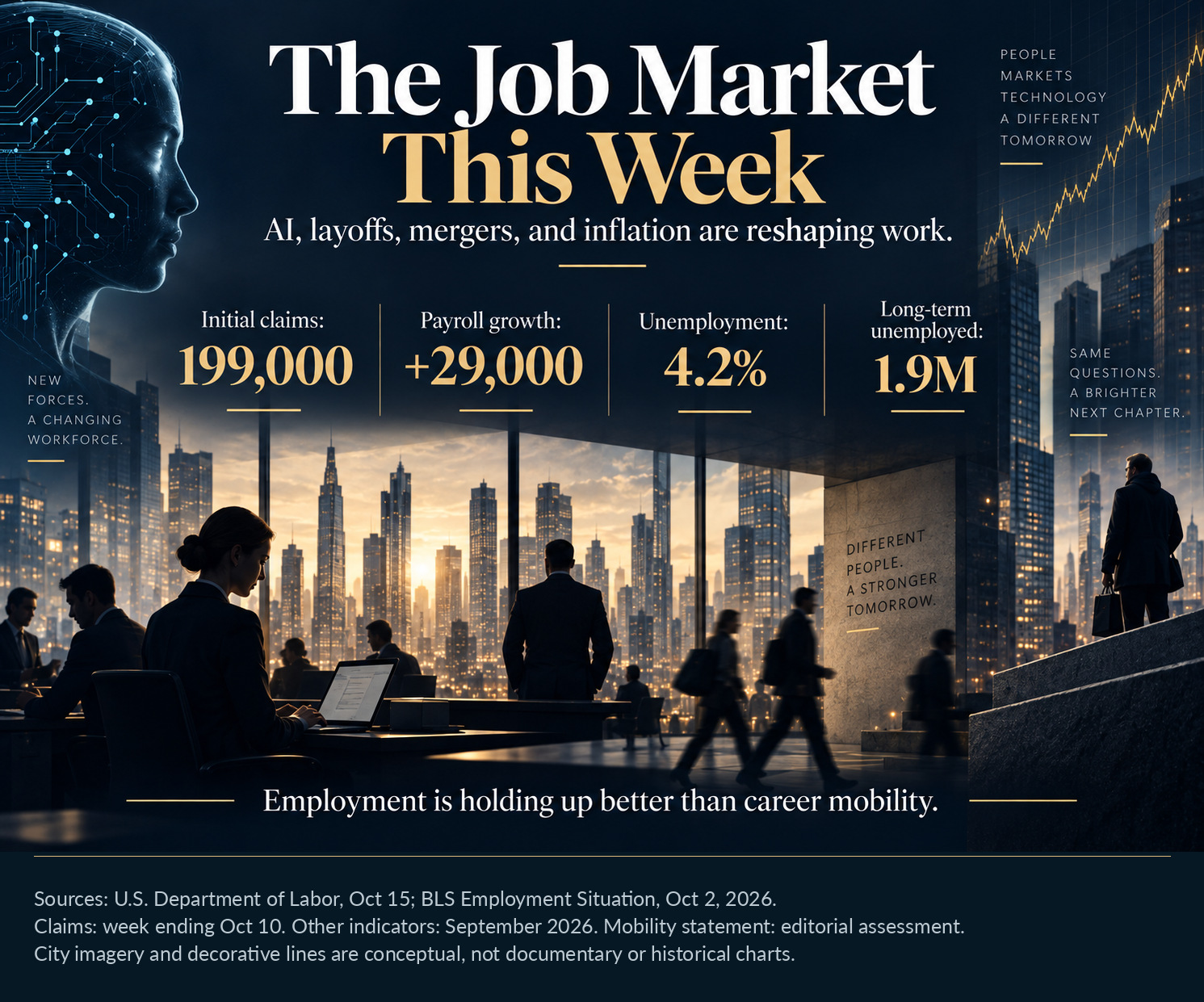
Sources: U.S. Department of Labor, Oct 15; BLS Employment Situation, Oct 2, 2026. Claims: week ending Oct 10. Other indicators: September 2026. Mobility statement: editorial assessment. City imagery and decorative lines are conceptual, not documentary or historical charts.
A Market That Is Holding Together, but Not Moving Freely
The Labor Department’s October 15 release showed 199,000 initial unemployment claims for the week ending October 10, an increase of 1,000 from the previous week’s revised figure. Continuing claims declined to approximately 1.71 million. Those numbers did not indicate a sudden, economy-wide surge in workers applying for unemployment benefits. (U.S. Department of Labor ( https://www.dol.gov/ui/data.pdf ))
But the latest monthly employment report, released earlier on October 2, showed considerably less momentum in job creation. Employers added a net 29,000 payroll jobs in September, compared with a revised 133,000 in August. The unemployment rate was 4.2%. The same report counted 1.9 million people unemployed for at least 27 weeks, representing 27.1% of unemployed workers. (Bureau of Labor Statistics: Employment Situation ( https://www.bls.gov/news.release/empsit.nr0.htm ))
These measures answer different questions.
Unemployment claims help identify emerging layoffs among eligible workers. Payroll growth measures the net change in employment. Neither, by itself, tells us how readily an individual can find an appropriate opening, secure an interview, and obtain an offer.
It is also important not to confuse weak net growth with an absence of hiring. The latest available Job Openings and Labor Turnover Survey, covering August and released September 29, recorded approximately 5.2 million hires and 5.1 million separations. Millions of employment relationships were beginning and ending even though the overall number of jobs changed relatively little. (Bureau of Labor Statistics: JOLTS ( https://www.bls.gov/news.release/jolts.nr0.htm ))
The practical concern is the quality and accessibility of that movement.
Someone who retains a suitable position may experience the economy as reasonably stable. Someone seeking to replace a senior role, enter a new profession, or return after an extended absence may encounter a much narrower set of acceptable opportunities.
That is why a national unemployment rate should be treated as context, not as a verdict on an individual’s experience.
My assessment is that the immediate career risk is not limited to losing employment. It includes losing a position when replacing its compensation, responsibilities, location, or flexibility may require a longer search or a meaningful compromise.
That calls for preparation, not panic. It also calls for a more precise understanding of where employers are changing their commitments.
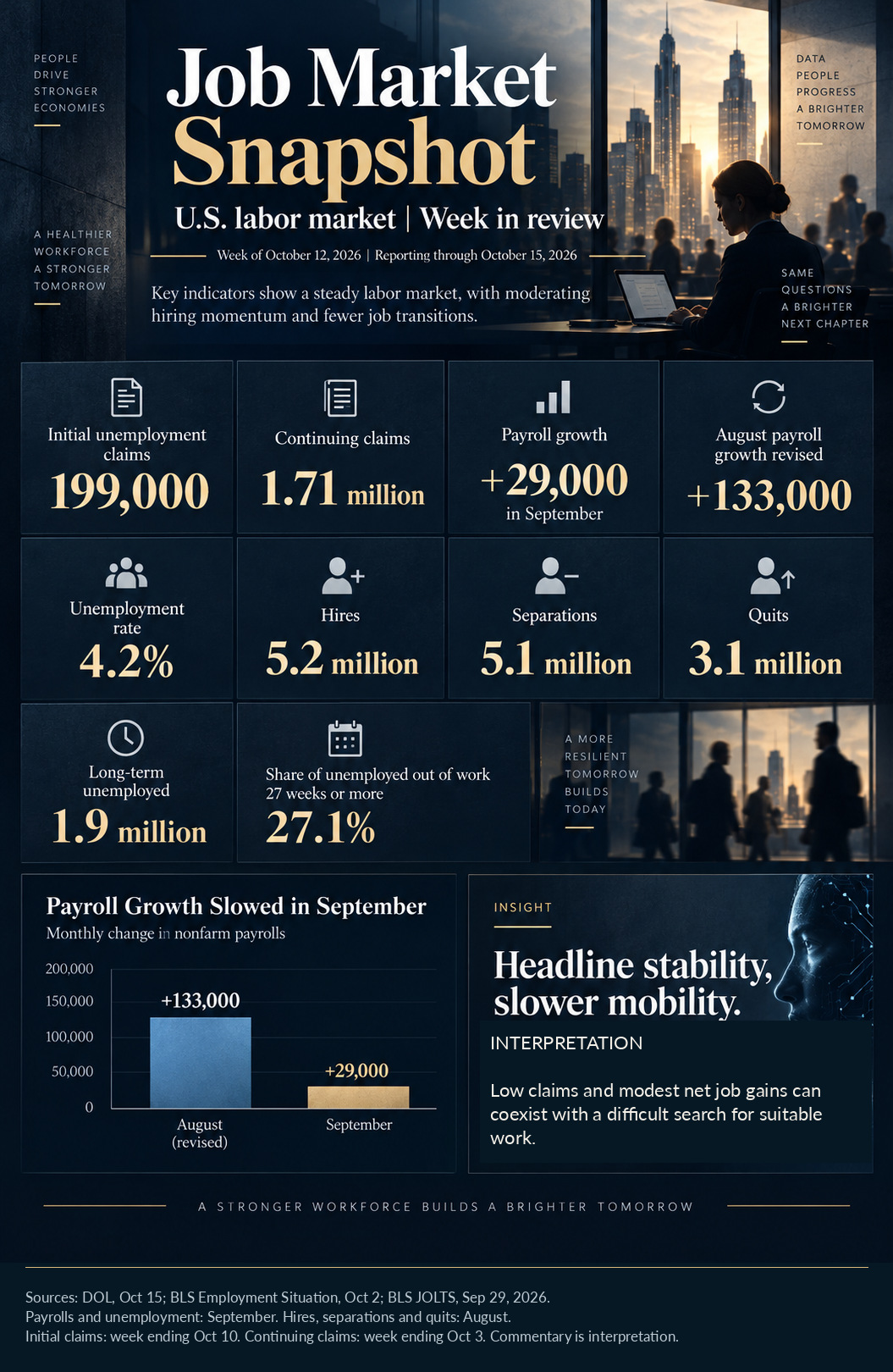
Sources: DOL, Oct 15; BLS Employment Situation, Oct 2; BLS JOLTS, Sep 29, 2026. Payrolls and unemployment: September. Hires, separations and quits: August. Initial claims: week ending Oct 10. Continuing claims: week ending Oct 3. Commentary is interpretation.
The Layoffs Were Significant, but They Did Not Tell One Story
Kroger supplied one of the week’s clearest examples of AI being explicitly connected to workforce planning.
On October 12, Reuters reported the company’s plan to eliminate approximately 3,000 corporate positions over three years, about 37% of its roughly 8,200 corporate roles. Management connected the changes to expanded AI use, reduced duplication, and investment in stores and frontline employees. This was a multiyear corporate restructuring plan, not 3,000 completed dismissals during the week or a comparable percentage reduction across Kroger’s entire workforce. (Reuters: Kroger ( https://www.reuters.com/business/kroger-plans-cut-about-third-corporate-roles-over-next-three-years-bloomberg-2026-10-12/ ))
Netflix’s announcement illustrated a different pressure.
On October 14, the company disclosed a reduction of approximately 6% of its workforce, or around 1,000 positions, primarily affecting product, technology, legal, and human resources. Its co-chief executives maintained that the business remained strong and on track for its annual forecast. The reporting did not establish AI replacement as the cause. (Reuters: Netflix ( https://www.reuters.com/business/world-at-work/netflix-cuts-about-6-jobs-wsj-reports-2026-10-14/ ); Associated Press: Netflix ( https://apnews.com/article/2290c8472a155adb9c4b85fdc885bc7e ))
The lesson is consequential: a company can consider its business healthy while deciding that its existing organizational structure is too expensive, misaligned, or no longer appropriate.
Outside the United States, GSK proposed eliminating up to 1,217 positions in Belgium as part of a broader restructuring. The proposed cuts excluded factory workers and accompanied efforts involving automation, digital tools, development priorities, and an approaching patent-expiration challenge. Reducing that announcement to “AI layoffs” would overlook several stated business reasons. (Reuters: GSK ( https://www.reuters.com/business/world-at-work/gsk-cut-up-1217-jobs-belgium-lecho-says-2026-10-14/ ))
Telia also announced plans to reduce approximately 900 positions, while moving some responsibilities closer to its country operations and targeting around SEK 1 billion in annual gross savings. Its announcement concerned organizational simplification and operating costs, not proof that a specific technology had replaced every affected role. (The Wall Street Journal: Telia ( https://www.wsj.com/business/earnings/telia-co-to-cut-900-jobs-in-plan-to-save-100-million-a-year-0c95ad11 ); Telia company announcement ( https://news.cision.com/telia-company/r/telia-proposes-further-localization-of-operations-and-targets-sek-1-billion-in-annual-gross-savings%2Cc4407089 ))
These figures should not be added together and presented as jobs lost this week. They span different countries, implementation periods, and stages of decision-making.
What connects them is not a single technology. It is the reassessment of work.
For employees, that changes the most useful question from “Is my company doing well?” to something more specific: “Is my company continuing to invest in the function, product, customer need, or responsibility that supports my position?”
A strong company can still eliminate a role. A changing company can also create opportunities in areas that are becoming more important.
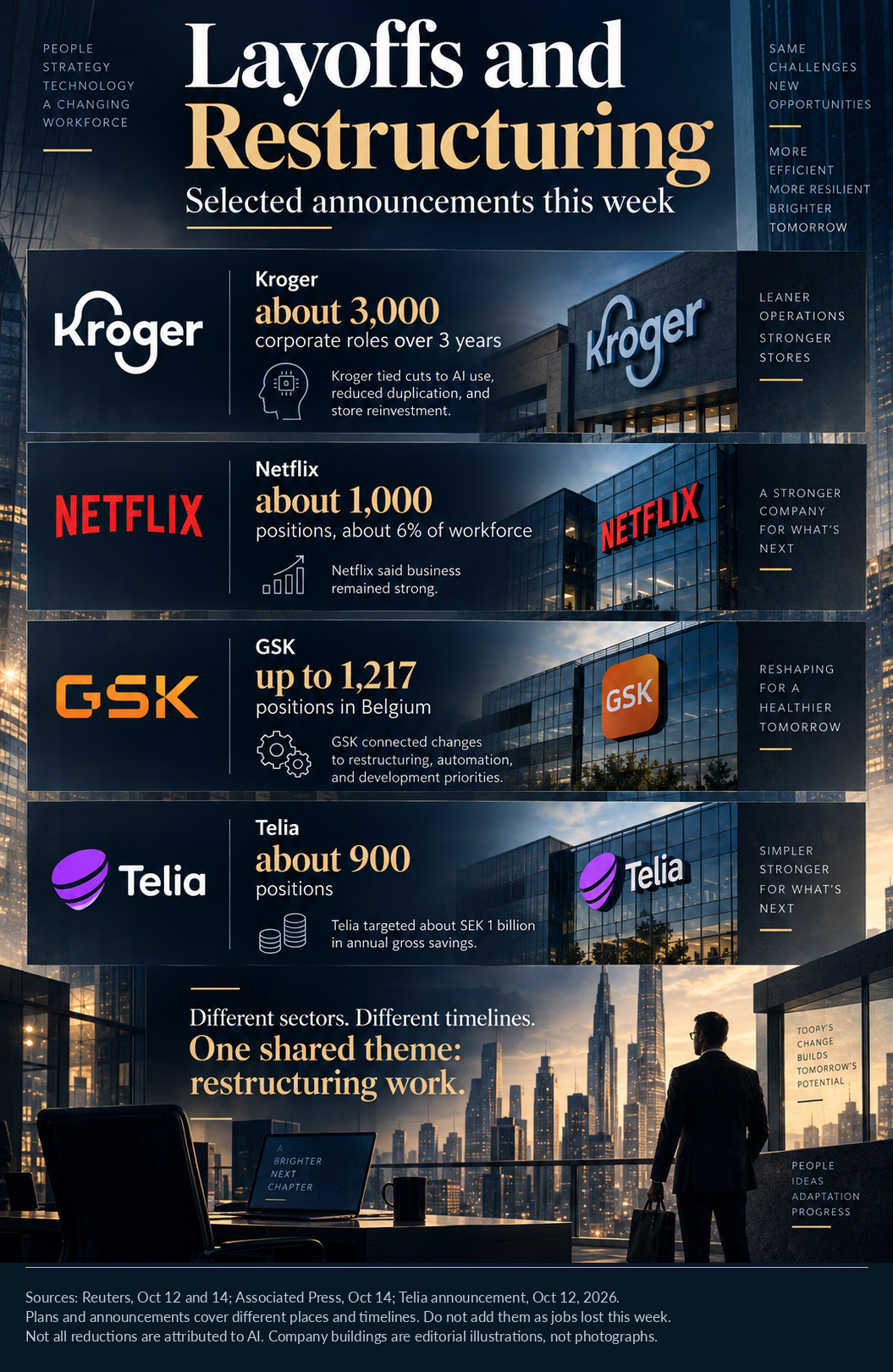
Sources: Reuters, Oct 12 and 14; Associated Press, Oct 14; Telia announcement, Oct 12, 2026. Plans and announcements cover different places and timelines. Do not add them as jobs lost this week. Not all reductions are attributed to AI. Company buildings are editorial illustrations, not photographs.
AI’s Employment Impact Includes the Jobs That Never Open
The Federal Reserve’s October 14 Beige Book contained one of the week’s most important observations.
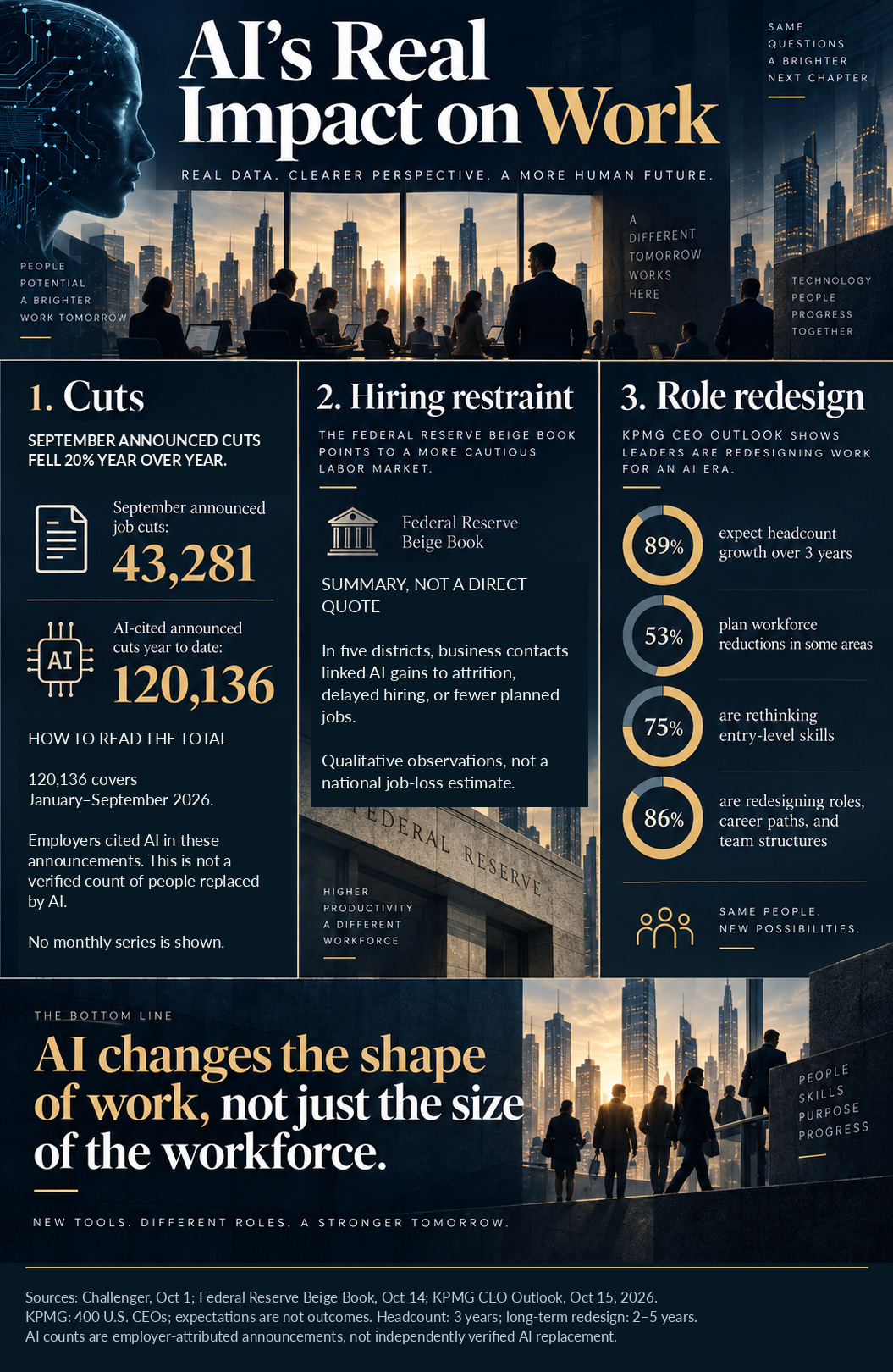
Across five Federal Reserve districts, business contacts reported that some firms had reduced staffing through attrition, delayed hiring, or anticipated less future job creation after increasing productivity through AI investment. The report was based on information collected on or before October 5. It reflects qualitative observations from contacts, not a statistically representative national estimate of AI-driven job losses. (Federal Reserve Beige Book ( https://www.federalreserve.gov/monetarypolicy/beigebook202610-summary.htm ))
Nevertheless, it identifies a change that a layoff headline cannot capture.
An employer does not have to dismiss someone to reduce its demand for labor. It can leave a departing employee’s position unfilled. It can cancel a planned expansion. It can decide that a smaller team should absorb additional responsibilities.
For a job seeker, the result may appear as a missing opportunity rather than an identifiable displacement.
This matters when evaluating AI’s employment effects. Counting announced layoffs alone will not reveal changes in replacement hiring, entry-level recruitment, internal promotion opportunities, or positions that were considered but never approved.
Challenger, Gray & Christmas’s report released October 1 provides additional context. Employers announced 43,281 job cuts in September, down 20% from a year earlier. AI was cited in 120,136 announced cuts during the first nine months of 2026, approximately 21% of the total, although it accounted for only about 9% of September’s announcements. (Challenger, Gray & Christmas ( https://www.challengergray.com/blog/job-cuts-fall-in-september-hiring-plans-up-3-over-2025-on-weak-early-seasonal-hiring/ ))
Those are employer-attributed announcements. They are not an independent demonstration that effective AI systems replaced every affected employee.
Both errors should be avoided: dismissing AI’s influence because total employment has not collapsed, and attributing every restructuring decision to AI because the technology appears in management’s explanation.
The more useful investigation is specific. What work changed? What system is performing it? What happened to quality, cost, staffing, and customer outcomes after the change?
An announcement describes a decision. Its results still have to be established.
Employers Can Plan to Hire and Cut at the Same Time
KPMG’s CEO Outlook, released October 15, made the apparent contradiction unusually visible.
Among the 400 U.S. CEOs included in its large-company survey, 89% expected to increase headcount over the next three years. Yet 53% were planning workforce reductions in some areas as part of their longer-term response to AI. These were executives’ intentions, not completed hiring or guaranteed openings. (KPMG U.S. CEO Outlook ( https://kpmg.com/us/en/media/news/kpmg-us-ceo-outlook-2026.html ))
There is no necessary conflict between the two answers.
A company might expand one business while withdrawing from another. It might recruit specialists while consolidating administrative responsibilities. It might retain total employment but substantially change the mix of positions.
The relevant issue for an individual is therefore not only the organization’s expected headcount. It is whether the individual’s capabilities fit the work being retained or developed.
The same KPMG survey found that 75% of U.S. CEOs were reconsidering the skills required for entry-level positions, while 86% were redesigning roles, career paths, and team structures to reflect human-AI collaboration. (KPMG U.S. CEO Outlook ( https://kpmg.com/us/en/media/news/kpmg-us-ceo-outlook-2026.html ))
That raises an important question for employers and educators: how will people develop professional judgment if the introductory work through which they learn is substantially redesigned?
Consider a hypothetical junior analyst whose software now produces the first version of a report. The educational task has not disappeared. Someone still needs to learn why the report matters, whether the underlying information is appropriate, which assumptions are defensible, and what conclusions the evidence supports.
The training should change with the work. It should not vanish because a first draft is easier to produce.
For early-career professionals, the corresponding goal is to demonstrate more than access to a tool. A useful work sample should reveal how a problem was understood, how information was evaluated, how mistakes were found, and why a recommendation followed.
Producing an answer and establishing that the answer is useful are different responsibilities. Career development should prepare people for both.
Sources: Challenger, Oct 1; Federal Reserve Beige Book, Oct 14; KPMG CEO Outlook, Oct 15, 2026. KPMG: 400 U.S. CEOs; expectations are not outcomes. Headcount: 3 years; long-term redesign: 2–5 years. AI counts are employer-attributed announcements, not independently verified AI replacement.
The Financial Pressure Is Reaching People Who Keep Their Jobs
This week was also a reminder that employment is not the same as financial progress.
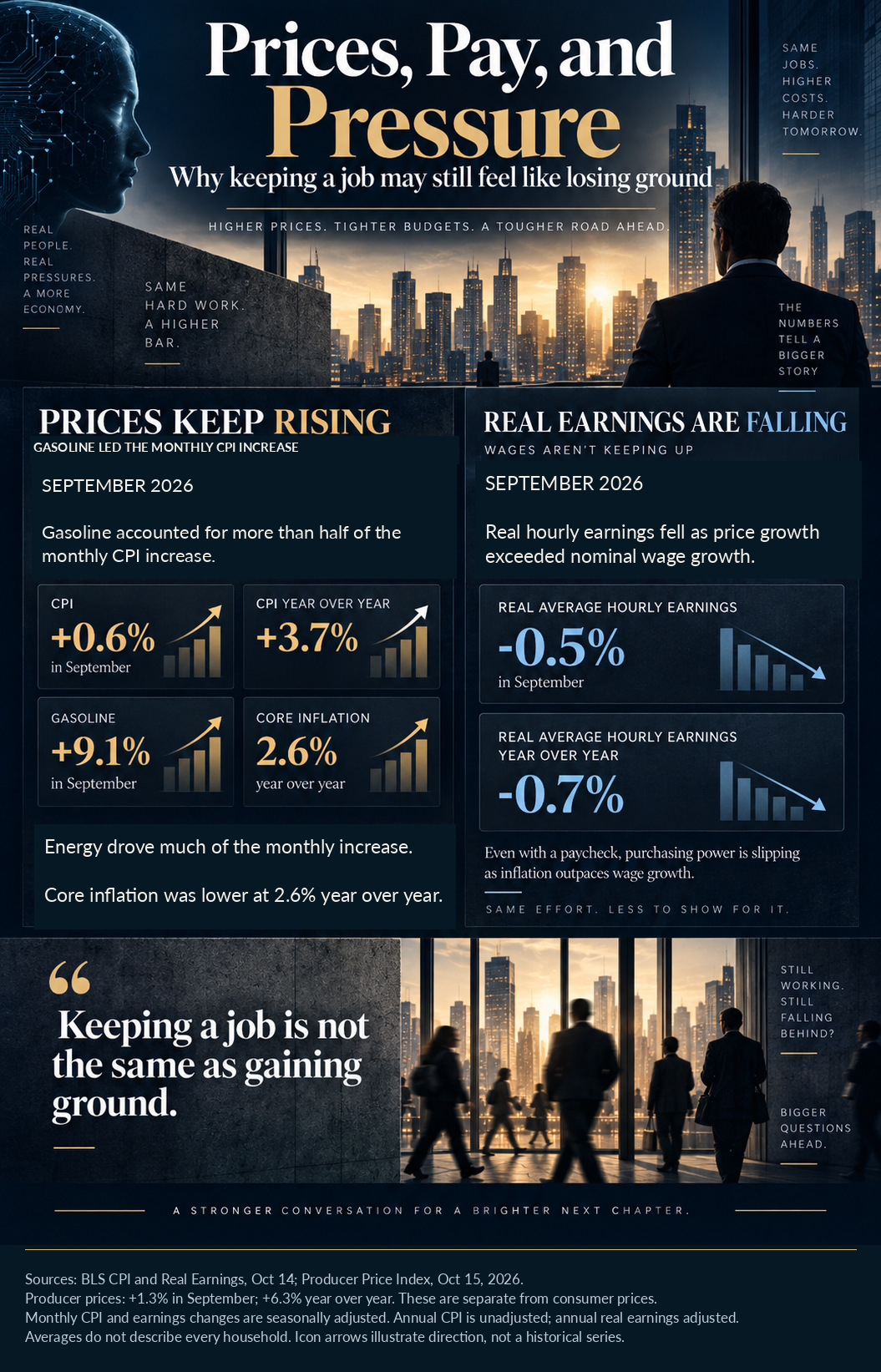
The consumer-price report released October 14 showed that prices rose 0.6% in September and 3.7% over the preceding year. Gasoline increased 9.1% during the month, accounting for more than half of the overall monthly increase. Inflation excluding food and energy was 2.6% annually, so the acceleration was not equally severe across every category. (Bureau of Labor Statistics: Consumer Price Index ( https://www.bls.gov/news.release/cpi.nr0.htm ))
The accompanying real-earnings report was more directly relevant to workers. Inflation-adjusted average hourly earnings fell 0.5% during September and 0.7% over the year. These are averages, not a statement that every employee experienced the same change, but they show why retaining a position may still feel like losing ground. (Bureau of Labor Statistics: Real Earnings ( https://www.bls.gov/news.release/realer.nr0.htm ))
The October 15 producer-price release added evidence of business cost pressure. Prices for final demand increased 1.3% during September and 6.3% over the year. Producer-price increases do not pass automatically or proportionally into consumer prices, but they complicate decisions about margins, investment, and compensation. (Bureau of Labor Statistics: Producer Price Index ( https://www.bls.gov/news.release/ppi.nr0.htm ))
Zoho offered a concrete example of technology spending entering that debate.
In reporting published this week, co-founder Sridhar Vembu said the company would not provide its usual annual salary increases, citing higher server costs, increased AI-related expenses, and an uncertain business environment. He also said employee numbers had not been growing for approximately 18 months and emphasized efforts to avoid mass layoffs. These were management’s explanations, not independently audited findings about AI’s financial return. (The Indian Express: Zoho ( https://indianexpress.com/article/business/zoho-unable-to-provide-pay-rise-ai-costs-co-founder-vembu-10919854/ ))
The implication is broader than one software company: AI can affect employees through the allocation of money before it affects them through the elimination of a position.
A business has to decide what it will fund. Technology, compensation, expansion, debt obligations, and other operating requirements compete within that decision.
The interest-rate environment offers little basis for assuming that cheaper money will immediately remove the pressure. In its September 16 decision, the Federal Reserve raised its target range to 3.75%–4.00%. That was an earlier policy decision, not a new increase this week. (Federal Reserve: September 16 statement ( https://www.federalreserve.gov/newsevents/pressreleases/monetary20260916a.htm ))
For career decisions, the lesson is practical: evaluate compensation in terms of what it supports, not only the number printed in an offer. Consider benefits, expected hours, flexibility, development, and the stability of the work itself.
A nominal improvement is not necessarily a complete improvement.
Sources: BLS CPI and Real Earnings, Oct 14; Producer Price Index, Oct 15, 2026. Producer prices: +1.3% in September; +6.3% year over year. These are separate from consumer prices. Monthly CPI and earnings changes are seasonally adjusted. Annual CPI is unadjusted; annual real earnings adjusted. Averages do not describe every household. Icon arrows illustrate direction, not a historical series.
The Merger Story Is About Who Will Control the Next Stage of Work
Several substantial transactions advanced this week, revealing where businesses and investors are concentrating their attention.
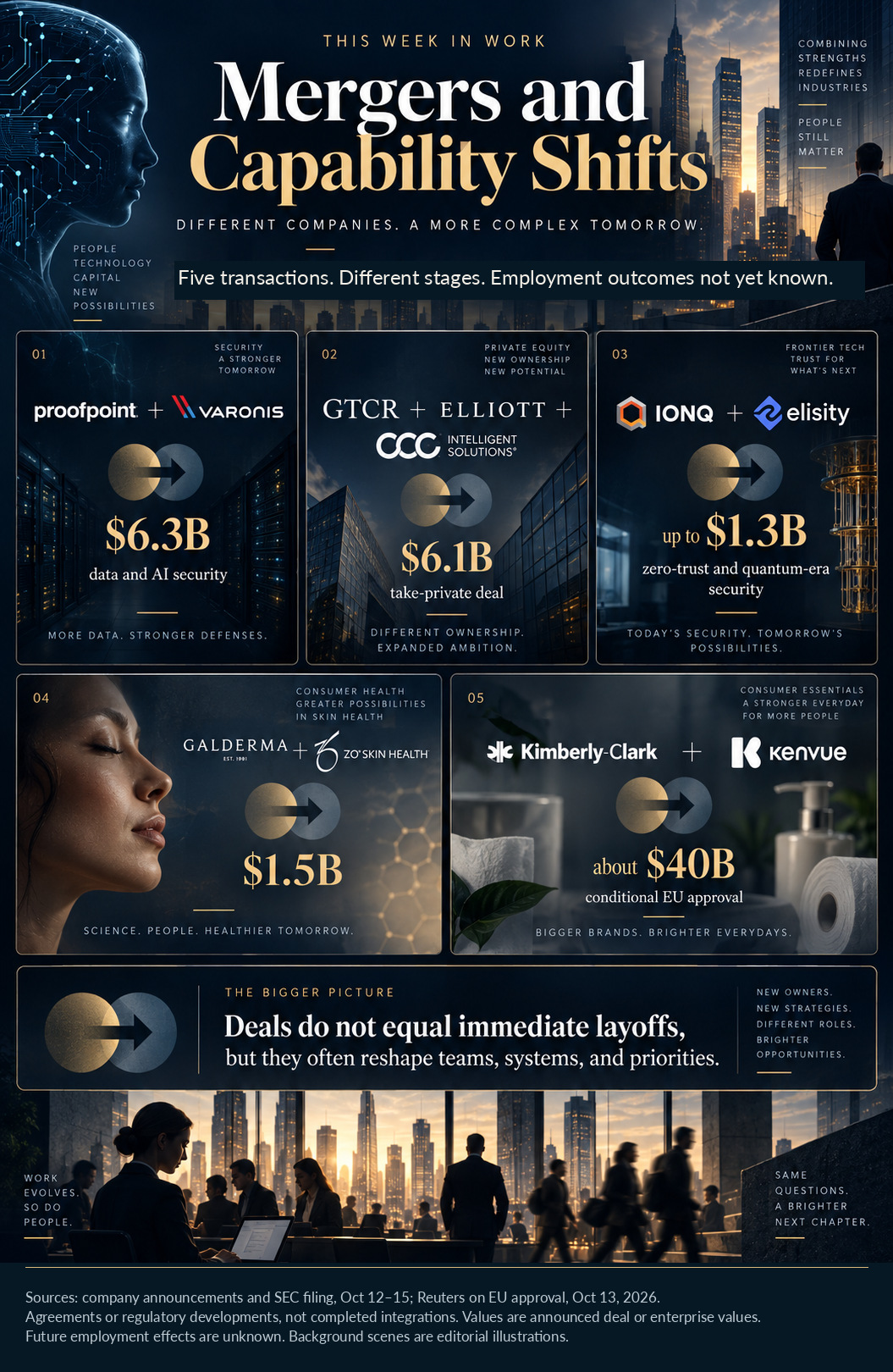
On October 15, Proofpoint announced a definitive agreement to acquire Varonis in an approximately $6.3 billion cash transaction, combining capabilities in data protection and AI-related security. The companies expect closing in the first half of 2027, subject to shareholder and regulatory approval and other conditions. (Proofpoint transaction announcement ( https://www.proofpoint.com/us/newsroom/press-releases/proofpoint-acquire-varonis-creating-global-leader-data-and-ai-security ))
Earlier, on October 12, IonQ announced an agreement to acquire Elisity in an all-stock transaction valued at up to $1.3 billion, bringing enterprise security capabilities together with its quantum-security strategy. (IonQ transaction announcement ( https://www.ionq.com/news/ionq-to-acquire-elisity-to-accelerate-zero-trust-for-the-quantum-era ))
The activity was not confined to technology. On October 14, Galderma signed an agreement to acquire ZO Skin Health at an enterprise value of approximately $1.5 billion, with closing expected in late 2026 or early 2027, subject to approvals and other conditions. (Galderma transaction announcement ( https://www.galderma.com/news/galderma-signs-agreement-acquire-zo-skin-health ))
On October 13, the European Commission conditionally approved Kimberly-Clark’s approximately $40 billion acquisition of Kenvue. The required divestitures include specified feminine-hygiene brands in the European Economic Area. The acquisition was announced in 2025; this week’s development was regulatory clearance with conditions. (Reuters: Kimberly-Clark and Kenvue ( https://www.reuters.com/world/eu-approves-kimberly-clarks-acquisition-kenvue-subject-conditions-2026-10-13/ ))
And on October 15, CCC Intelligent Solutions announced an agreement to be acquired by a consortium led by GTCR and including Elliott, in a cash transaction with an enterprise value of approximately $6.1 billion. (CCC announcement filed with the SEC ( https://www.sec.gov/Archives/edgar/data/1818201/000119312526422320/d140608dex991.htm ))
None of these transaction values establishes an employment outcome.
An acquisition agreement is not a completed integration. A proposed combination does not, by itself, establish how many positions will be created, eliminated, transferred, or redefined.
For employees, however, a transaction should prompt closer attention to the business reasons supporting their work.
Which products are central to the combined organization? Which customer relationships need to be preserved? Which systems will remain? Is the employee’s business being retained, expanded, or sold?
These questions are more useful than assuming that every merger guarantees layoffs or that every acquisition premium signals growth for the workforce.
For professionals seeking opportunities, integration may create needs in finance, systems, compliance, customer retention, and organizational change. That is a reason to investigate specific employers and approved positions, not to assume that every announced deal comes with a hiring program.
The transaction is the beginning of an employment story, not its conclusion.
Sources: company announcements and SEC filing, Oct 12–15; Reuters on EU approval, Oct 13, 2026. Agreements or regulatory developments, not completed integrations. Values are announced deal or enterprise values. Future employment effects are unknown. Background scenes are editorial illustrations.
AI Is Creating Work, but Not Necessarily for the People Losing It
A complete review also has to examine the work generated by technological change.
In a disclosure reported this week, Bank of America’s chief executive described bringing in approximately 1,000 external contractors to address software vulnerabilities exposed by advanced AI capabilities. The contractors had been added during the second quarter and remained involved. This was not an announcement that 1,000 permanent jobs were newly created this week. (Business Insider: Bank of America ( https://www.businessinsider.com/bank-of-america-hired-contractors-protect-software-rogue-ai-agents-2026-10 ))
The example illustrates a requirement that should be included in any serious account of AI economics: more capable technology can produce additional work in remediation, security, and oversight.
Identifying a problem does not complete the work of fixing it. Deploying a capability does not settle the responsibilities associated with its use.
The physical infrastructure supporting technology also requires investment. On October 14, American Electric Power announced plans for approximately $4 billion of investment in a 702-megawatt fuel-cell project near Cheyenne, Wyoming, supplying Google under a 20-year power agreement. The planned facility is expected to become fully operational by the end of 2028. (American Electric Power announcement ( https://www.aep.com/news/stories/view/12314/ ))
It is reasonable to infer potential work in construction, engineering, electrical systems, procurement, and operations. The announcement reviewed did not provide a verified employment total.
That limitation matters because investment is not the same as a job count, and a new job is not necessarily an accessible replacement for a lost one.
A displaced corporate employee may not possess the credentials, location flexibility, or practical experience required for a construction or cybersecurity position. A temporary contract may not replace a permanent role’s benefits or predictability.
The question is not merely whether technological change creates work somewhere. It is who can access that work, on what terms, and with what transition required.
A credible discussion of opportunity has to include the people expected to make that transition.
Global Conditions and Public Policy Still Shape the Outcome
AI is important, but it is not the only force acting on employers.
In its October 13 World Economic Outlook release, the International Monetary Fund projected global growth of 3.1% in 2026 and 3.4% in 2027. It described an increasingly uneven economy, with countries benefiting from AI investment or favorable trade conditions doing relatively better than many energy-importing and lower-income economies. These remain forecasts, not completed-year results. (International Monetary Fund ( https://mediacenter.imf.org/news/imf---world-economic-outlook-annual-meetings--2026/s/22f94667-d194-473b-87b2-34c692b5a5a3 ))
The IMF also identified risks from Middle East tensions, energy and food costs, borrowing costs, and renewed trade friction. Its assessment of AI was two-sided: stronger productivity could improve outcomes, while excessive optimism could lead to a financial-market correction. (International Monetary Fund ( https://mediacenter.imf.org/news/imf---world-economic-outlook-annual-meetings--2026/s/22f94667-d194-473b-87b2-34c692b5a5a3 ))
For employment, that means there is no simple assumption that more AI investment must reduce jobs or that less investment would necessarily protect them. A pullback could reduce some pressure to automate while also weakening demand in businesses supplying technology and infrastructure.
Policy creates additional employment risks unrelated to professional performance.
On October 14, the Department of Homeland Security published a final rule retaining changes to automatic extensions for certain employment authorization documents. It finalized an interim policy introduced on October 30, 2025, rather than creating a new blanket termination of work authorization this week. Qualifying earlier applications and specified legal or Federal Register exceptions remain relevant. (Federal Register ( https://www.federalregister.gov/documents/2026/10/14/2026-20955/removal-of-automatic-extensions-for-certain-employment-authorization-documents ))
For affected categories, a pending renewal may not preserve authorization after expiration. Employers and workers therefore need to examine the actual category, filing date, and applicable exceptions rather than rely on a general headline. (Federal Register ( https://www.federalregister.gov/documents/2026/10/14/2026-20955/removal-of-automatic-extensions-for-certain-employment-authorization-documents ))
The broader point is that career continuity depends on more than competence. Business demand, financing, ownership, geography, infrastructure, and legal eligibility can all affect whether a person is able to continue doing valuable work.
Recognizing those conditions is part of making sound decisions.
What Workers Should Do With This Information
The first task is to understand the market without allowing a general description of it to replace an examination of the individual situation.
A difficult market and an ineffective job-search strategy can exist at the same time. Neither explanation should be used to avoid investigating the other.
A person who is not finding suitable openings faces a different problem from someone whose applications are not producing interviews. Someone reaching final interviews but not receiving offers faces another problem again.
Those differences should guide the response.
Review the target roles, evidence of fit, application materials, outreach, interview performance, and actual feedback. Where feedback is unavailable, change one meaningful part of the approach and observe what follows. More applications alone do not identify why a search is failing.
The second task is to make professional value understandable.
A résumé should do more than preserve a history of responsibilities. It should explain the problems addressed, decisions made, scope handled, and results achieved. Where results were shared across a team, the individual contribution should be accurate rather than inflated.
AI experience should be treated the same way. Instead of merely naming tools, explain what the work required, how the technology was used, how the output was evaluated, and what improved.
The third task is to examine opportunities at the level of the work, not only the employer’s reputation.
A useful question during a search is why the position exists. Is it replacing a departing employee, supporting a funded expansion, resolving an operational problem, or managing a temporary transition? What would successful performance look like? What changed to make the hire necessary?
Those questions do not eliminate uncertainty, but they produce more useful information than relying on a familiar company name.
For people who are employed, preparation should begin before urgency.
Maintain an accurate record of achievements without taking confidential material. Keep professional relationships active. Understand where the organization is investing. Consider which parts of your knowledge transfer to other industries, customers, or business problems.
None of this guarantees protection from restructuring. It can, however, improve the quality of the decisions available when circumstances change.
A position is something an organization funds. A career is the professional capacity a person develops and carries forward.
The goal is to strengthen that capacity without pretending the surrounding economy is under individual control.
What Employers Owe the Work and the People Doing It
Employers should apply the same evidentiary standard to workforce redesign that they expect employees to apply to business decisions.
Before treating faster output as a reason to reduce staffing, determine what has actually improved.
Suppose a tool dramatically accelerates the first draft of a customer deliverable. That improvement is valuable. But the relevant operating question includes review time, error correction, client revisions, security requirements, and the consequences of a mistake.
If the bottleneck simply moves from production to review, the staffing calculation is incomplete.
The test should be the complete result, not the most impressive step.
Organizations should also be explicit about what happens after work is redistributed. Who handles unusual cases? Who maintains relationships? Who retains the knowledge needed to identify an error? Who develops less experienced colleagues? Who is accountable when the system fails?
These questions are not objections to technology. They are requirements for using it responsibly and effectively.
When positions genuinely are no longer required, the human consequences should be treated as part of the execution decision. Clear communication, meaningful internal consideration, appropriate transition support, and accurate explanations are not substitutes for business discipline. They are part of it.
An employee should not have to interpret vague claims about transformation to understand whether a role is ending, what the timetable is, or what assistance is available.
Likewise, remaining employees should not be left to discover that an announced efficiency improvement means an unexamined transfer of workload.
Reducing a payroll expense can be measured immediately. Establishing that the organization is stronger requires a longer and more complete evaluation.
What to Watch Next
My assessment is that the available evidence supports planning for continued unevenness, rather than assuming either an imminent broad hiring recovery or an inevitable employment collapse.
Low claims and weak net job growth can coexist. So can corporate hiring plans and reductions in particular functions. The next meaningful evidence will show whether those conditions persist and how announced changes are implemented. (U.S. Department of Labor ( https://www.dol.gov/ui/data.pdf ); Bureau of Labor Statistics: Employment Situation ( https://www.bls.gov/news.release/empsit.nr0.htm ); KPMG U.S. CEO Outlook ( https://kpmg.com/us/en/media/news/kpmg-us-ceo-outlook-2026.html ))
Several scheduled events will help clarify the picture.
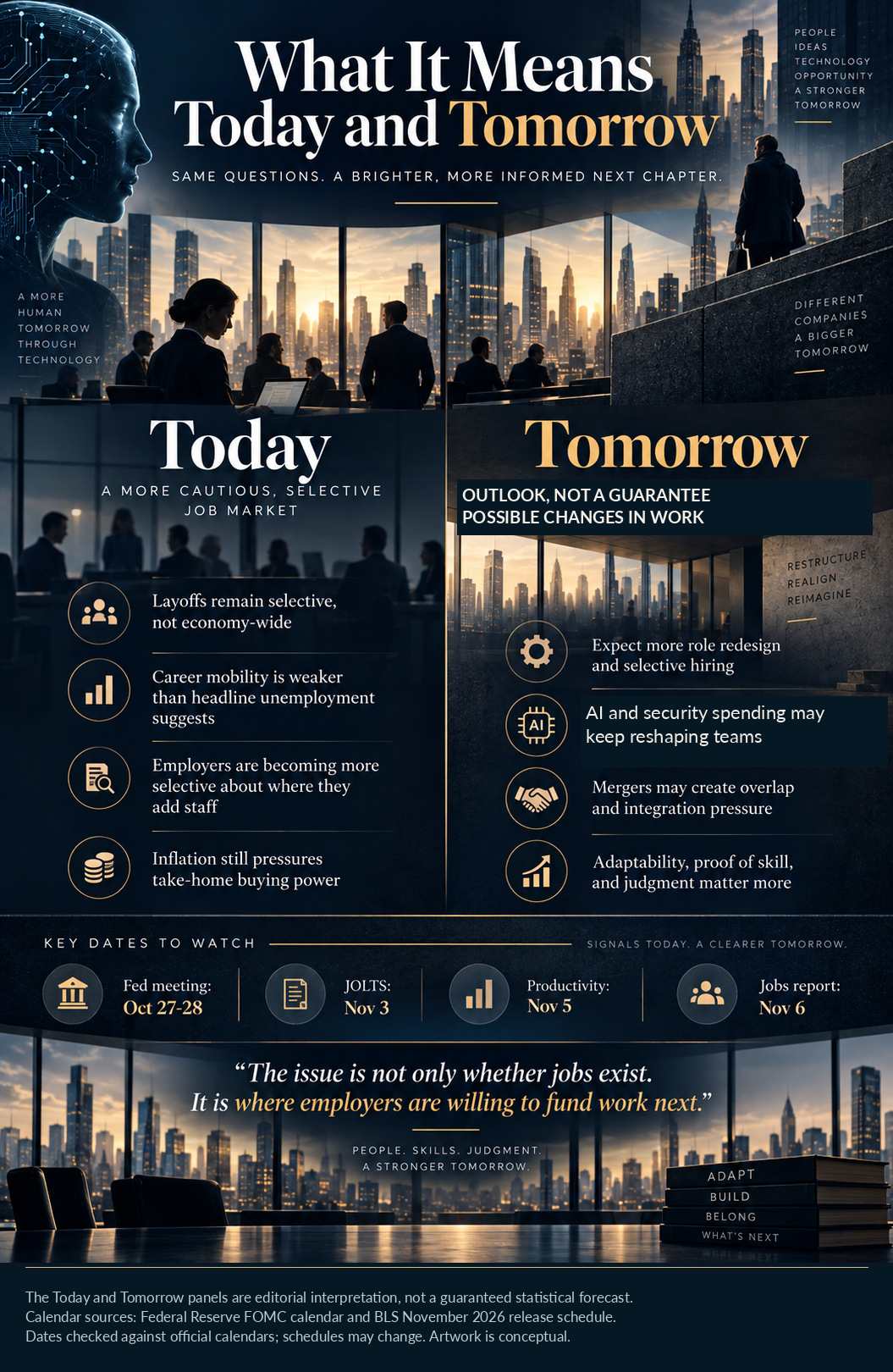
The Federal Reserve meets October 27–28. The Bureau of Labor Statistics is scheduled to release September job-openings and turnover data on November 3, third-quarter productivity data on November 5, and the October employment report on November 6. (Federal Reserve meeting calendar ( https://www.federalreserve.gov/monetarypolicy/fomccalendars.htm ); Bureau of Labor Statistics November schedule ( https://www.bls.gov/schedule/2026/11_sched.htm ))
The important questions extend beyond whether each headline number rises or falls.
Is hiring broadening across industries? Are people moving into appropriate employment more readily? Are compensation gains exceeding price increases? Are employers filling replacement positions or continuing to absorb work into smaller teams?
At the company level, the test is implementation. Did the acquisition close? What changed afterward? Were announced reductions carried out? Did customer service, reliability, and financial performance improve? Were productivity claims sustained once the full costs became visible?
Over the next several years, it is plausible that the contents of many jobs will change substantially even without an equivalent change in total employment. More work may be organized around deciding what needs to be done, integrating systems, evaluating output, handling exceptions, and accepting responsibility.
That is a possibility to prepare for, not a guarantee that every profession will evolve in the same direction.
The eventual outcome will depend on technology’s capabilities, customer demand, business choices, public policy, and the opportunities people receive to develop new competence.
The Today and Tomorrow panels are editorial interpretation, not a guaranteed statistical forecast. Calendar sources: Federal Reserve FOMC calendar and BLS November 2026 release schedule. Dates checked against official calendars; schedules may change. Artwork is conceptual.
The Real Question Is What We Build From Here
This week’s most important message is not that work is disappearing everywhere. It is that employers are reconsidering which work they will fund, where it will sit, and how they expect it to be performed.
The evidence includes AI-related hiring restraint, major corporate restructuring, acquisitions targeting strategic capabilities, and new investment in the systems supporting technological growth. (Federal Reserve Beige Book ( https://www.federalreserve.gov/monetarypolicy/beigebook202610-summary.htm ); Proofpoint transaction announcement ( https://www.proofpoint.com/us/newsroom/press-releases/proofpoint-acquire-varonis-creating-global-leader-data-and-ai-security ); American Electric Power announcement ( https://www.aep.com/news/stories/view/12314/ ))
For workers, the response should be informed action rather than reassurance or defeatism. Understand the environment. Examine the actual opportunity. Make professional value visible. Develop the knowledge and judgment required to contribute as the work changes.
For employers, the responsibility is equally demanding. Do not confuse a technological capability with a completed business improvement. Do not confuse fewer employees with a stronger organization. Establish what works, account for the consequences, and preserve the capacity required to deliver dependable results.
AI is a tool. A merger is a transaction. A layoff is a decision. None is, by itself, a complete explanation of progress.
The future of work should be judged by what people and organizations become capable of doing, how reliably they do it, and whether the benefits justify the costs.
That is the standard worth carrying from this week into the next.