Career intelligence
Buyer Beware When AI Applies for Jobs Under Your Name
Applying to hundreds of jobs with AI can spread inaccurate claims under your name. Build a truthful career foundation before automating your search.
Illustration for Buyer Beware When AI Applies for Jobs Under Your Name, by Keith Lawrence Miller.
Graphic text: BUYER BEWARE AI applies. Your name. Your reputation. Build the foundation first. Keith Lawrence Miller IvyLeagueResume.com
Imagine discovering that an automated system submitted 200 job applications under your name, and the résumé attached to them contains responsibilities you never held, achievements you never claimed, or qualifications you do not have.
You wanted assistance with your job search. Now you may have to explain statements that companies reasonably understood to be yours.
The promise of applying to hundreds of jobs can be appealing. Searching, tailoring documents, completing forms, and tracking applications take time. A system that handles that work can provide real value. The concern begins when speed outruns the accuracy of the information being distributed.
Your name is on the application. Your professional reputation is attached to it.
Truth on a résumé remains critical. Allowing AI to improve a document without preserving the underlying facts can have serious consequences. When that same document is automatically submitted across a job search, an error can travel much farther than the person realizes.
A polished résumé can still be wrong
A résumé can be well written, visually attractive, and full of relevant terminology while misrepresenting the person it describes.
Consider a few hypothetical changes. A candidate who contributed to a project becomes the person who led it. A professional who worked with a department of 20 becomes the manager of 20 direct reports. A training course becomes a certification. A result achieved at a former employer appears beneath the current employer.
Each revision might make the document sound stronger. Each changes what the candidate is claiming.
Even a number that is accurate somewhere in a person's history can become inaccurate when attached to a different responsibility, employer, or period. Preserving individual words and numbers is insufficient if the system changes their relationship.
The National Institute of Standards and Technology identifies confidently false generated content as a risk of generative AI. Its guidance also recognizes outputs that depart from the information supplied to the system. Fluent writing does not establish factual accuracy. [1]
Johnson & Johnson's own career guidance describes a closely related concern: an incomplete résumé prompt can lead a generative AI system to invent information and misrepresent the applicant. [2]
A person may accept the revision because it sounds professional. That is precisely why the underlying claims deserve attention.
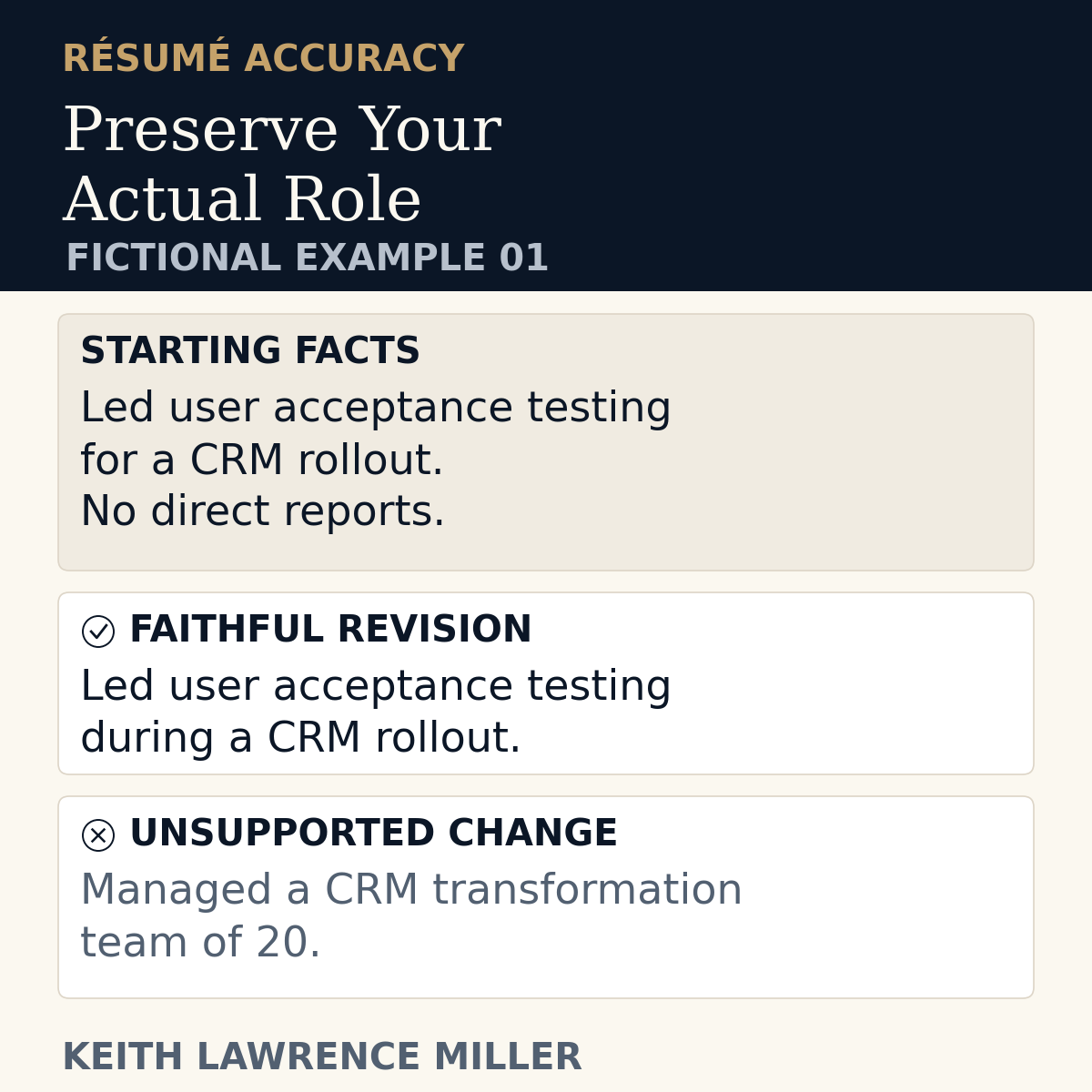
Fictional example. Accurate tailoring preserves the original facts; the unsupported revision adds or changes claims.
Graphic text: RÉSUMÉ ACCURACY Preserve Your Actual Role FICTIONAL EXAMPLE 01 STARTING FACTS Led user acceptance testing for a CRM rollout. No direct reports. FAITHFUL REVISION Led user acceptance testing during a CRM rollout. UNSUPPORTED CHANGE Managed a CRM transformation team of 20. KEITH LAWRENCE MILLER
Automation can distribute the same error repeatedly
The scale of an application campaign changes the reach of a mistake.
If one inaccurate achievement is included in 200 submitted applications, the same unsupported claim has been distributed 200 times.
The candidate may not know which résumé version went to which company. A later interview could then begin with a question about a budget the person never owned, a system they never implemented, or a team they never managed.
A candidate who cannot substantiate a prominent claim may lose credibility at the moment they most need to establish it. The conversation can shift from what they offer to whether their account can be trusted.
That can damage a relationship with a company the person wanted to join. A candidate may also discover the problem only after investing considerable effort in the hiring process.
Explaining that software created the statement does not automatically resolve the employer's concern about the application.
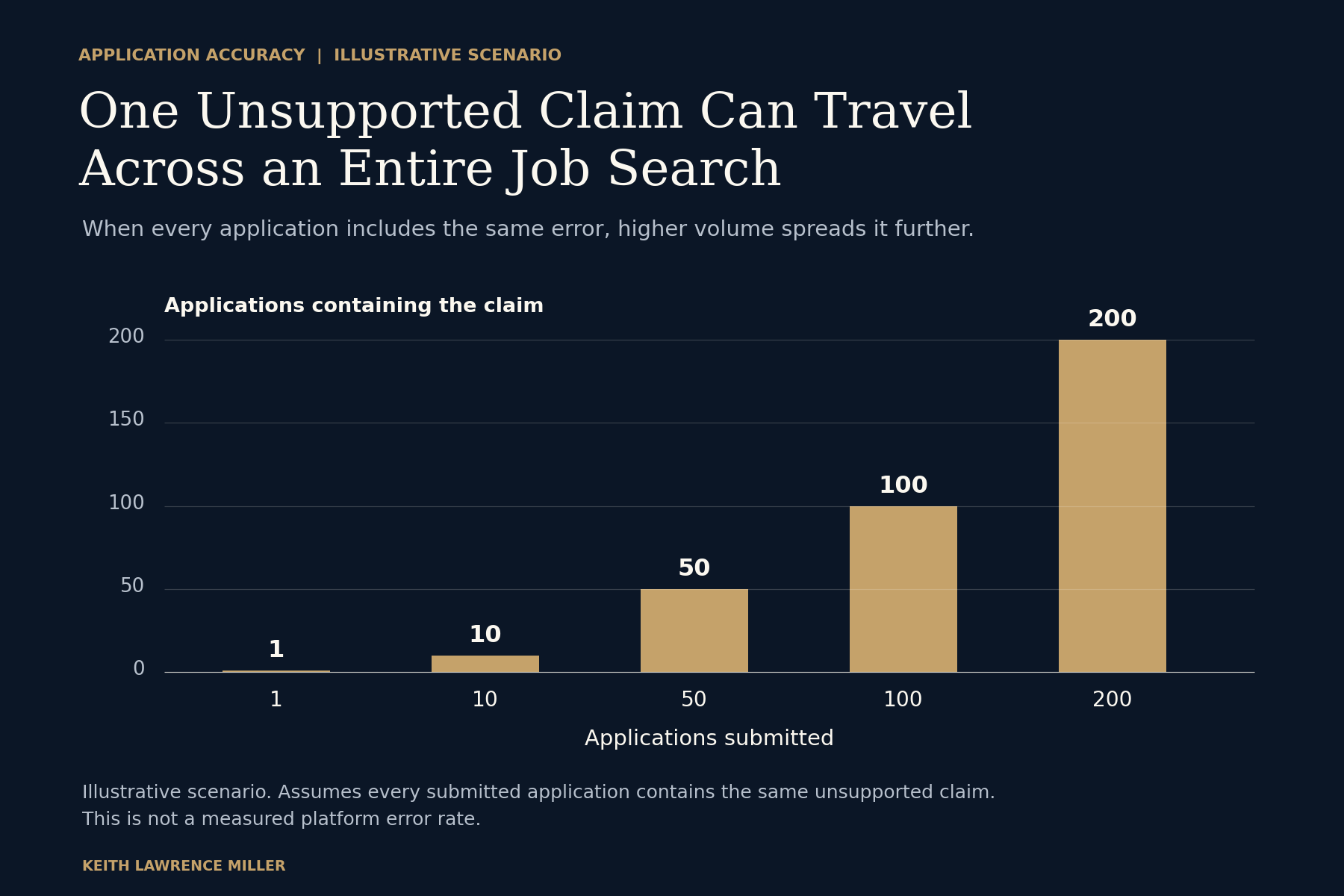
Illustrative scenario. Assumes every submitted application contains the same unsupported claim. This is not a measured platform error rate.
Graphic text: APPLICATION ACCURACY | ILLUSTRATIVE SCENARIO One Unsupported Claim Can Travel Across an Entire Job Search When every application includes the same error, higher volume spreads it further. Applications containing the claim Y-axis ticks: 0, 50, 100, 150, 200 Applications submitted Bar labels and categories: 1, 10, 50, 100, 200 Illustrative scenario. Assumes every submitted application contains the same unsupported claim. This is not a measured platform error rate. KEITH LAWRENCE MILLER
Employers still expect truthful applications
Deloitte's U.S. recruiting guidance permits AI to help organize and refine application materials. It also makes applicants responsible for ensuring that submissions accurately reflect their own experience and qualifications. [3]
The UK Civil Service similarly allows assistance with clarity and preparation while prohibiting invented or inflated skills and experience. Its guidance says applications may be rejected when AI is used inappropriately. [4]
These employers permit useful assistance while maintaining an expectation of truthful representation. A candidate should know the rules of the particular hiring process and retain control of the claims submitted.
The application remains a professional statement about the person seeking the role. A tool's involvement does not make an inaccurate statement accurate.
The platform also has a responsibility. A service that promises to customize applications should preserve the facts it receives, identify missing information, and make consequential changes visible. Telling customers to review their work is inadequate if the product quietly changes the underlying career story.
Build the foundation first
Before automating a job search, establish a reliable account of the professional who is applying.
That foundation includes the person's employers, actual titles, employment dates, education, credentials, and work history. It also includes what the person was responsible for, the results they produced, the tools they actually used, and the contribution they made to shared achievements.
Context matters. Managing employees differs from coordinating a project. Owning a budget differs from working on a project with that budget. Completing coursework differs from earning a degree. A meaningful achievement should remain connected to the role in which it occurred.
An existing résumé may leave much of this information unclear. It may also contain an old mistake. Uploading it should begin the process of establishing the facts, rather than turning every sentence into an unquestioned source.
The foundation needs direction as well. What work does the person want next? Which responsibilities do they want to retain or leave behind? What compensation, location, schedule, and other requirements matter?
Without that understanding, a tool can work efficiently toward an unsuitable target.
Building the foundation may involve reviewing documents, asking focused questions, discussing experience with a career professional, and confirming the resulting record. The purpose is to establish information that can be reused with confidence throughout the search.
A candidate does not need a receipt for every sentence about their own experience. They need an accurate account they can explain and stand behind, with uncertainty identified where it remains.
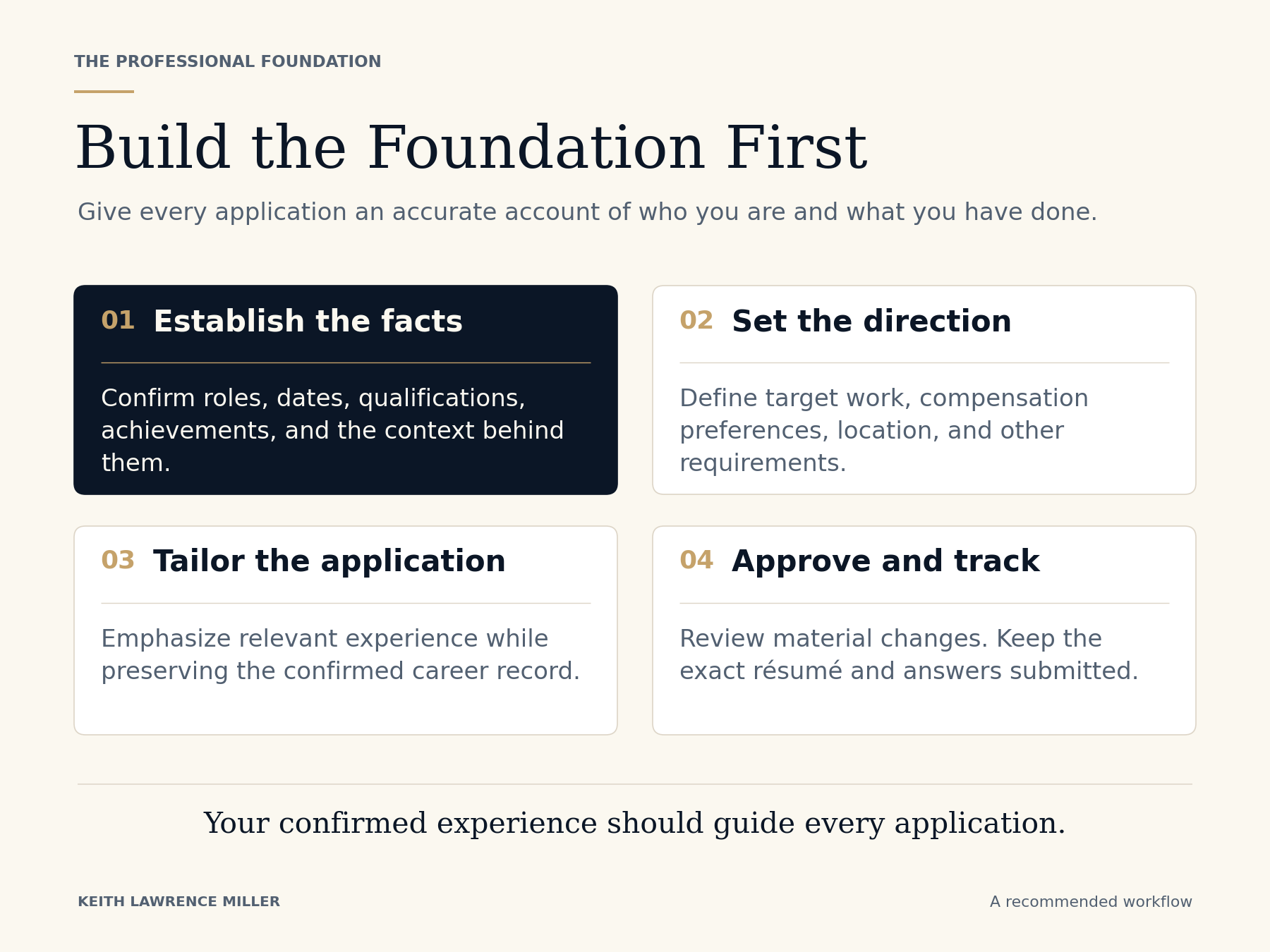
Establish the facts and career direction first, then tailor, review, and track applications. A recommended workflow for AI-assisted applications.
Graphic text: THE PROFESSIONAL FOUNDATION Build the Foundation First Give every application an accurate account of who you are and what you have done. 01 Establish the facts. Confirm roles, dates, qualifications, achievements, and the context behind them. 02 Set the direction. Define target work, compensation preferences, location, and other requirements. 03 Tailor the application. Emphasize relevant experience while preserving the confirmed career record. 04 Approve and track. Review material changes. Keep the exact résumé and answers submitted. Your confirmed experience should guide every application. KEITH LAWRENCE MILLER A recommended workflow
Customize the presentation while preserving the facts
Once the foundation is sound, customization becomes much more useful.
A person with experience in operations and customer service may emphasize different achievements for different roles. A relevant accomplishment may move higher on the page. Technical language may be clarified. A cover letter can connect a genuine example to an employer's stated need.
The same person can have several effective résumés without having several incompatible career histories.
The job description tells the system what the employer wants. It does not establish that the candidate possesses every requested qualification.
When the employer requests a skill that is absent from the professional record, the useful next step is a question. Has the candidate used it? Is there related experience that deserves explanation? Is this a real gap?
The system should never silently convert a requirement from the job advertisement into a fact about the applicant.
A missing qualification is information that helps someone make a decision. Manufacturing it merely postpones the problem.
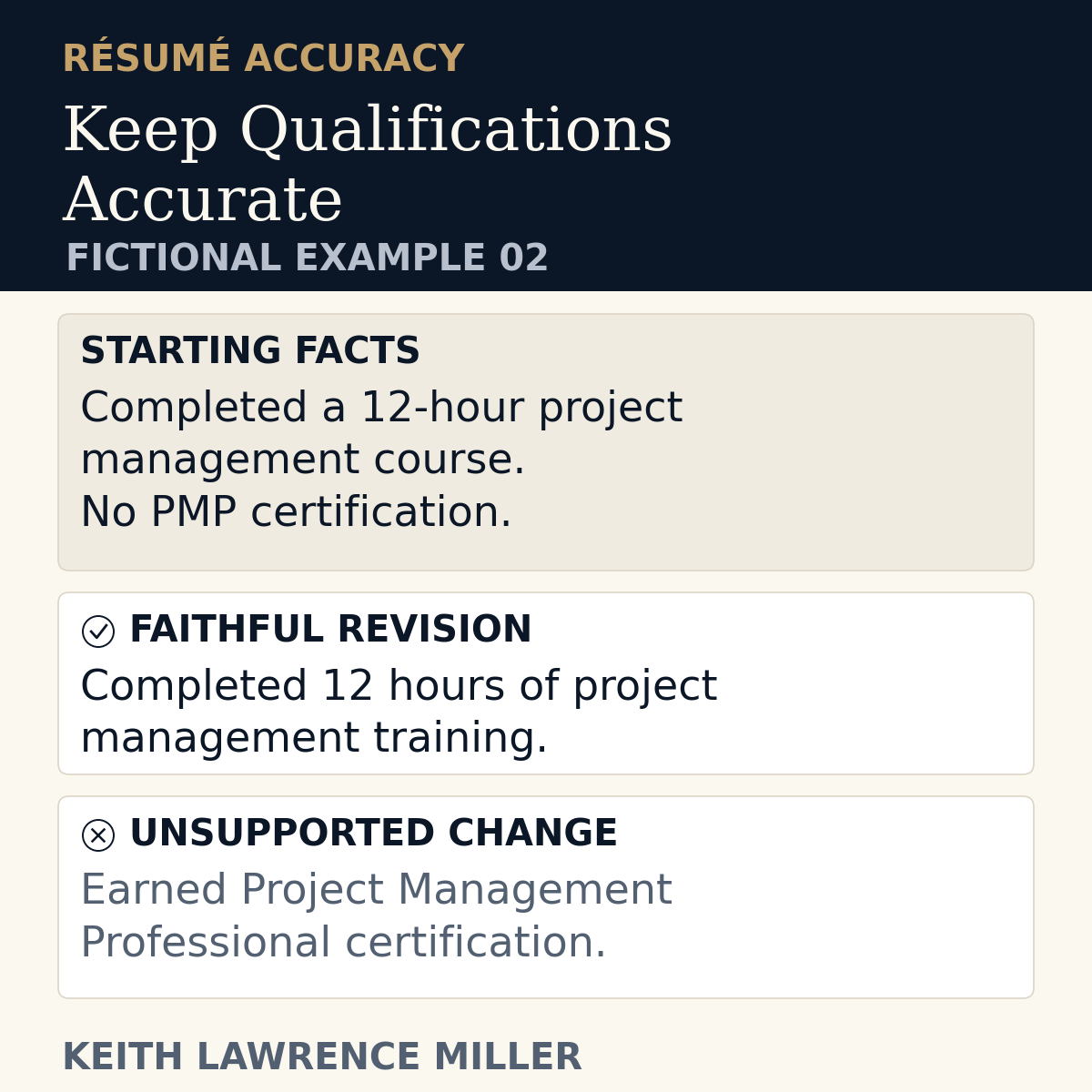
Fictional example. Accurate tailoring preserves the original facts; the unsupported revision adds or changes claims.
Graphic text: RÉSUMÉ ACCURACY Keep Qualifications Accurate FICTIONAL EXAMPLE 02 STARTING FACTS Completed a 12-hour project management course. No PMP certification. FAITHFUL REVISION Completed 12 hours of project management training. UNSUPPORTED CHANGE Earned Project Management Professional certification. KEITH LAWRENCE MILLER
Better information improves the work that follows
A sound foundation benefits more than the résumé.
Matching can draw on the person's actual experience and direction. Cover letters can use relevant examples. Interview preparation can develop answers around events the candidate remembers. Applications can remain consistent about dates, credentials, scope, and achievements.
Corrections also become easier when the system keeps a record of which information and documents each application used. A change to the professional record can then identify drafts that need revision and applications that used an earlier version.
There is evidence that improving how experience is expressed can help. A study published in Management Science found that jobseekers offered nongenerative writing assistance were hired 8% more often in an online labor market. The experiment examined writing assistance, not mass auto-apply or a career-foundation service. [5]
The practical point is that clearer communication can make real capability easier to understand. A strong professional foundation gives the tools better material to work with and gives the candidate a consistent account to carry into interviews.
That is how useful improvements can build on one another throughout the search.
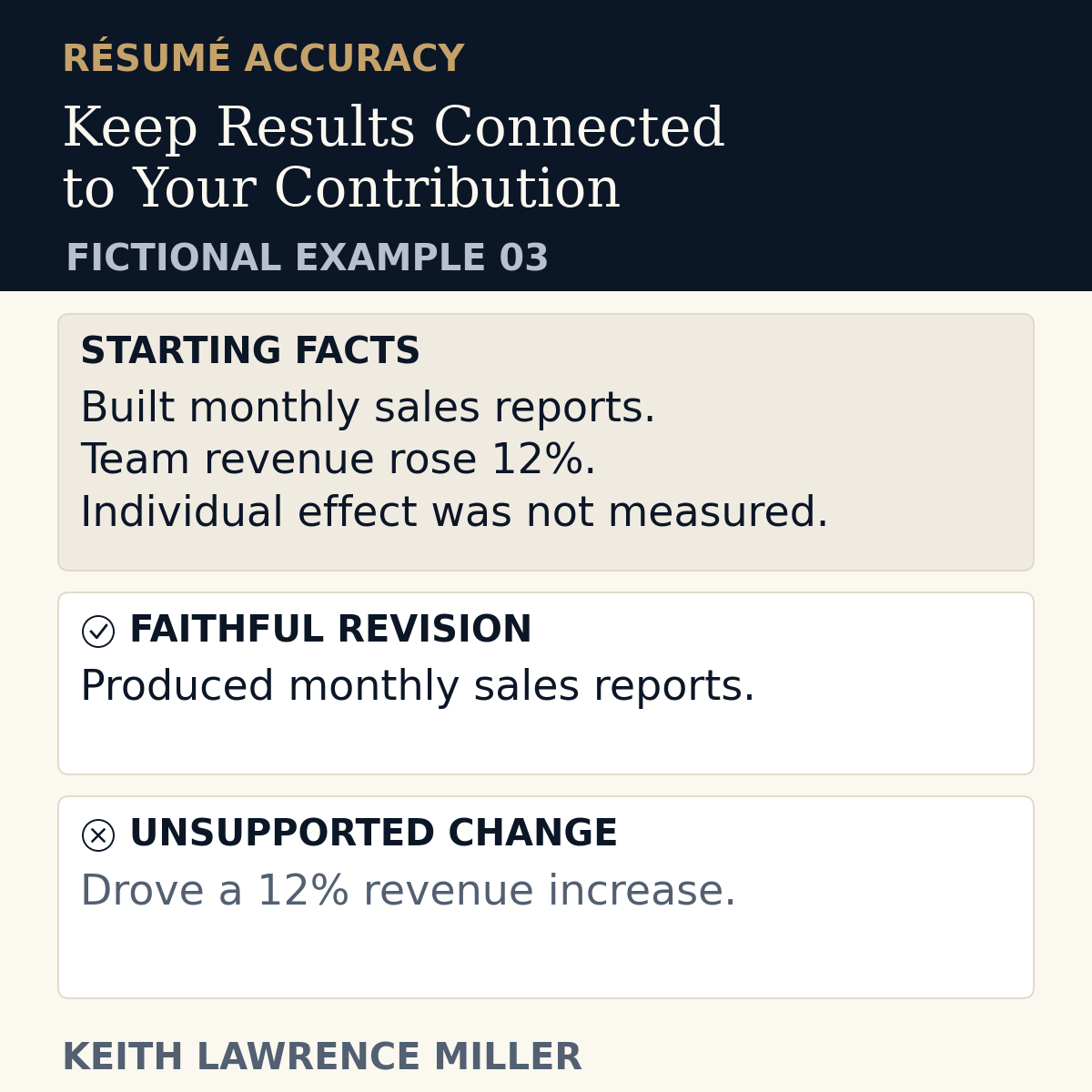
Fictional example. Accurate tailoring preserves the original facts; the unsupported revision adds or changes claims.
Graphic text: RÉSUMÉ ACCURACY Keep Results Connected to Your Contribution FICTIONAL EXAMPLE 03 STARTING FACTS Built monthly sales reports. Team revenue rose 12%. Individual effect was not measured. FAITHFUL REVISION Produced monthly sales reports. UNSUPPORTED CHANGE Drove a 12% revenue increase. KEITH LAWRENCE MILLER
What a buyer should be able to see
Before handing an automated service the authority to represent you, look at how it handles your information.
You should be able to review the career facts it will use, see material changes to your documents, and correct an error without losing your work. You should know which résumé and answers belong to each application.
The service should clearly separate a prepared application from a confirmed submission. It should explain which actions it performs automatically and where your approval is required. If a submission result is uncertain, that uncertainty should remain visible.
You should also understand what the advertised plan includes. A free account, document customization, application preparation, and completed submissions are different services. Their limits and costs should be clear before you commit.
A useful demonstration would take a fictional candidate through a real example: show the starting facts, the target job, the proposed changes, and the finished application. That makes the quality of the service easier to assess than an application counter alone.
Protect the person the system represents
The potential value of AI in a job search is substantial. It can organize information, identify relevant opportunities, improve communication, and reduce repetitive work.
Those advantages become more dependable when the professional foundation is accurate.
The order matters. Establish who the person is, what they have done, what they can demonstrate, and where they want to go. Confirm that record. Then use technology to carry it through matching, customization, and the application process.
Buyer beware when automation moves faster than the truth behind it. The system may complete the application in seconds. The name, reputation, and professional future attached to it belong to you.
Sources
[1] National Institute of Standards and Technology. Artificial Intelligence Risk Management Framework Generative Artificial Intelligence Profile. NIST AI 600-1, July 2024, section 2.2. https://nvlpubs.nist.gov/nistpubs/ai/NIST.AI.600-1.pdf
[2] Johnson & Johnson Careers. Generative AI for resumes and cover letters Pros and cons. February 20, 2025. https://www.careers.jnj.com/nl-nl/employee-stories/career-tips/generative-ai-for-resumes-and-cover-letters-pros-and-cons/?p=2&sf154619088=1
[3] Deloitte US. Using AI Tools in the Recruitment Process. Reviewed October 20, 2026. https://www.deloitte.com/us/en/careers/join-deloitte/recruiting-tips/using-ai-tools-in-recruitment-process.html
[4] Civil Service Careers. Artificial intelligence and recruitment. Reviewed October 20, 2026. https://www.civil-service-careers.gov.uk/artificial-intelligence-and-recruitment/
[5] Wiles, E., Munyikwa, Z., and Horton, J. Algorithmic Writing Assistance on Jobseekers' Resumes Increases Hires. Management Science, published online April 18, 2025. https://doi.org/10.1287/mnsc.2024.04528